Kaukab Azra, Nekkanti Sridhar
Department of Pediatric and Preventive Dentistry, Manipal College of Dental Sciences, Manipal Academy of Higher Education, Manipal, India.
ScientificWorldJournal. 2025 Jun 9;2025:5182716. doi: 10.1155/tswj/5182716. eCollection 2025.
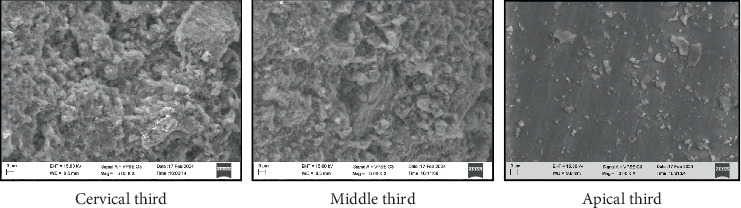
Placing an intracanal medicament helps in the disinfection of primary root canals, and nanoparticles enhance the material properties by increasing the physical and chemical reactivity. The study was aimed at assessing the efficacy of calcium hydroxide+calcium hydroxide nanoparticles and zinc oxide+zinc oxide nanoparticles as an intracanal medicament when compared with calcium hydroxide and zinc oxide eugenol in terms of antibacterial efficacy and penetration depth. Forty extracted human primary teeth were included in the study. Of these, 40 teeth were divided into two subgroups-Group A (to assess antibacterial efficacy) and Group B (to assess penetration depth). The teeth in Group A were contaminated with an biofilm for 7 days, and CFU count was determined. Calcium hydroxide (A1), calcium hydroxide with calcium hydroxide nanoparticles (A2), zinc oxide with zinc oxide nanoparticles (A3), and zinc oxide eugenol (A4) were placed in the canals. CFU count was determined on Day 7 and Day 14. The teeth in Group B were also divided into calcium hydroxide (B1), calcium hydroxide with calcium hydroxide nanoparticles (B2), zinc oxide with zinc oxide nanoparticles (B3), and zinc oxide eugenol (B4) groups. Two teeth from each group were subjected to SEM analysis. A statistically significant difference was noted in the CFU count reduction on Day 7 in Group A2, Group A3, and Group A4. The highest penetration depth was noted in Group B2. The authors concluded that the antibacterial efficacy and penetration depth into dentin improved on incorporating calcium hydroxide and zinc oxide nanoparticles. Based on this conclusion, the authors recommend further in vivo studies with nanoparticles incorporated intracanal medicaments in primary teeth to determine their safety of use and feasibility in a clinical scenario.
在根管内放置药物有助于对乳牙根管进行消毒,而纳米颗粒可通过提高物理和化学反应性来增强材料性能。本研究旨在评估氢氧化钙+氢氧化钙纳米颗粒和氧化锌+氧化锌纳米颗粒作为根管内药物,与氢氧化钙和氧化锌丁香酚相比,在抗菌效果和渗透深度方面的疗效。该研究纳入了40颗拔除的人类乳牙。其中,40颗牙齿被分为两个亚组——A组(评估抗菌效果)和B组(评估渗透深度)。A组的牙齿被生物膜污染7天,然后测定菌落形成单位(CFU)数量。将氢氧化钙(A1)、含氢氧化钙纳米颗粒的氢氧化钙(A2)、含氧化锌纳米颗粒的氧化锌(A3)和氧化锌丁香酚(A4)置于根管内。在第7天和第14天测定CFU数量。B组的牙齿也分为氢氧化钙(B1)、含氢氧化钙纳米颗粒的氢氧化钙(B2)、含氧化锌纳米颗粒的氧化锌(B3)和氧化锌丁香酚(B4)组。每组选取两颗牙齿进行扫描电子显微镜(SEM)分析。在A组中,A2、A3和A4组在第7天的CFU数量减少方面存在统计学上的显著差异。B2组的渗透深度最高。作者得出结论,加入氢氧化钙和氧化锌纳米颗粒后,抗菌效果和对牙本质的渗透深度得到改善。基于这一结论,作者建议进一步进行体内研究,使用含有纳米颗粒的根管内药物治疗乳牙,以确定其在临床情况下使用的安全性和可行性。