Fu Chu-Liang, Cheng Mouyang, Hung Nguyen Tuan, Rha Eunbi, Chen Zhantao, Okabe Ryotaro, Carrizales Denisse Córdova, Mandal Manasi, Cheng Yongqiang, Li Mingda
Quantum Measurement Group, MIT, Cambridge, MA, 02139, USA.
Department of Nuclear Science & Engineering, MIT, Cambridge, MA, 02139, USA.
Adv Mater. 2025 Sep;37(35):e2505642. doi: 10.1002/adma.202505642. Epub 2025 Jun 23.
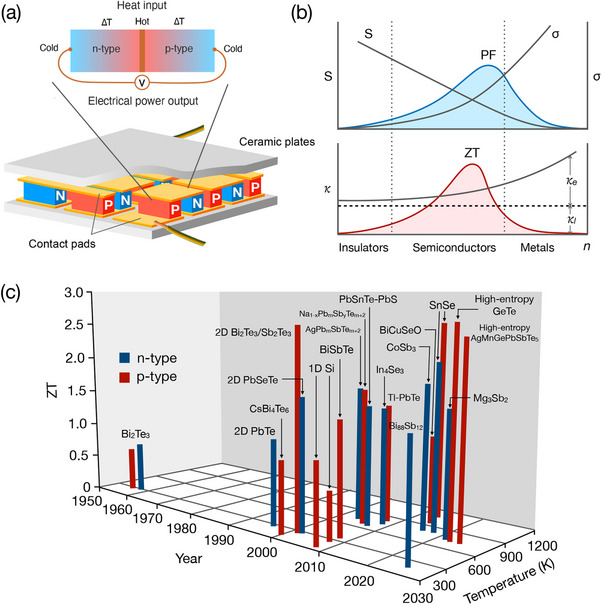
Thermoelectric materials offer a promising pathway to directly convert waste heat to electricity. However, achieving high performance remains challenging due to intrinsic trade-offs between electrical conductivity, the Seebeck coefficient, and thermal conductivity, which are further complicated by the presence of defects. This review explores how artificial intelligence (AI) and machine learning (ML) are transforming thermoelectric materials design. Advanced ML approaches including deep neural networks, graph-based models, and transformer architectures, integrated with high-throughput simulations and growing databases, effectively capture structure-property relationships in a complex multiscale defect space and overcome the "curse of dimensionality". This review discusses AI-enhanced defect engineering strategies such as composition optimization, entropy and dislocation engineering, and grain boundary design, along with emerging inverse design techniques for generating materials with targeted properties. Finally, it outlines future opportunities in novel physics mechanisms and sustainability, highlighting the critical role of AI in accelerating the discovery of thermoelectric materials.
热电材料为将废热直接转化为电能提供了一条有前景的途径。然而,由于电导率、塞贝克系数和热导率之间存在固有的权衡关系,并且缺陷的存在使情况更加复杂,因此实现高性能仍然具有挑战性。本综述探讨了人工智能(AI)和机器学习(ML)如何改变热电材料的设计。先进的机器学习方法,包括深度神经网络、基于图的模型和变压器架构,与高通量模拟和不断增长的数据库相结合,能够在复杂的多尺度缺陷空间中有效地捕捉结构-性能关系,并克服“维度诅咒”。本综述讨论了人工智能增强的缺陷工程策略,如成分优化、熵和位错工程以及晶界设计,以及用于生成具有目标性能材料的新兴逆向设计技术。最后,它概述了在新型物理机制和可持续性方面的未来机遇,强调了人工智能在加速热电材料发现中的关键作用。