Vermeulen Astrid, Bootsma Erik, Proost Sebastian, Vieira-Silva Sara, Kathagen Gunter, Vázquez-Castellanos Jorge F, Tito Raul Y, Sabino João, Vermeire Séverine, Matthys Christophe, Raes Jeroen, Falony Gwen
Department of Microbiology, Immunology and Transplantation, KU Leuven, Leuven, Belgium.
Center for Microbiology, VIB, Leuven, Belgium.
eGastroenterology. 2025 May 30;3(2):e100161. doi: 10.1136/egastro-2024-100161. eCollection 2025.
Dietary variation has been identified as a key contributor to microbiome diversification. However, assessing its true impact in a cross-sectional setting is complicated by biological confounders and methodological hurdles. We aimed to estimate the impact of a reduction of dietary variation (dietary convergence) on faecal microbiota composition among individuals consuming a Western-type diet.
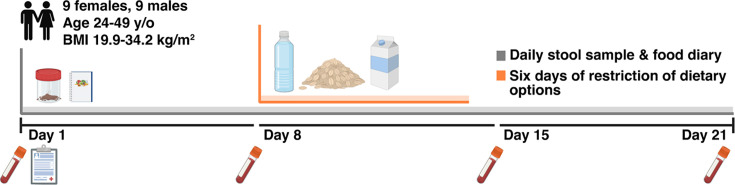
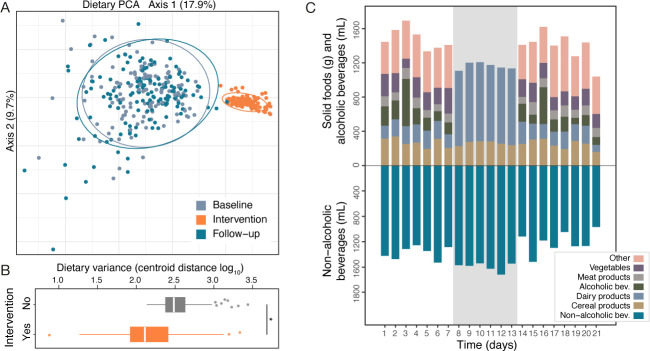
18 healthy volunteers recruited in the region of Flanders (Belgium) were followed up for 21 days. Participants were allowed to consume their habitual diet during a baseline and follow-up period (7 and 8 days, respectively), intersected by a 6-day intervention during which dietary options were restricted to oat flakes, whole milk and still water. Faecal samples were collected on a daily basis. Quantitative microbiome profiles were constructed, combining 16S rRNA gene amplicon sequencing with flow cytometry cell counting. Blood samples were taken at the beginning and end of each study week.
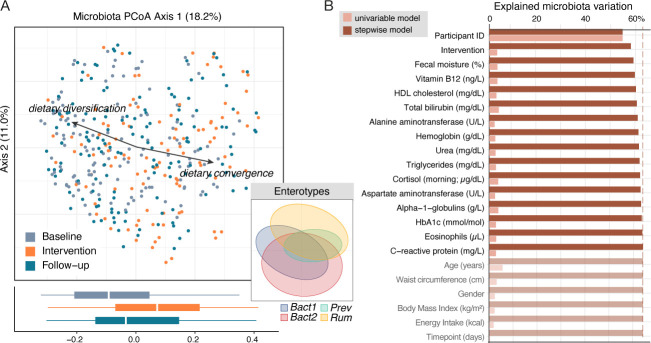
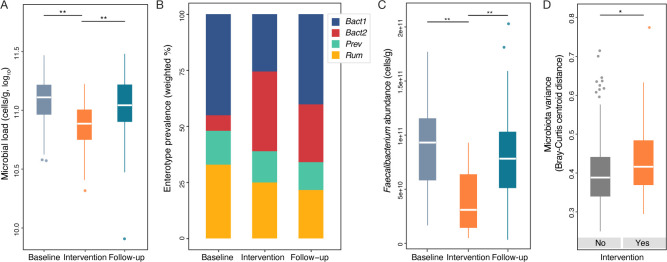
While the intervention did not affect transit time (as assessed through the analysis of stool moisture), consumption of the restricted diet resulted in an increased prevalence of the 2 microbiome community type. Microbial load and abundance decreased markedly. Despite dietary restrictions, no convergence of microbial communities (reduction of interindividual and intraindividual variation) was observed. The effect size (ES) of the intervention on genus-level microbiome community differentiation was estimated as 3.4%, but substantial interindividual variation was observed (1.67%-16.42%).
The impact of dietary variation on microbiome composition in a Western population is significant but limited in ES, with notable individual exceptions. Dietary convergence does not invariably translate into interindividual convergence of faecal microbial communities.
饮食变化已被确定为微生物组多样化的关键因素。然而,在横断面研究中评估其真正影响会受到生物学混杂因素和方法学障碍的干扰。我们旨在评估减少饮食变化(饮食趋同)对食用西式饮食个体粪便微生物群组成的影响。
招募了18名来自比利时弗拉芒地区的健康志愿者,随访21天。参与者在基线期和随访期(分别为7天和8天)可食用其习惯饮食,中间穿插为期6天的干预期,在此期间饮食选择限制为燕麦片、全脂牛奶和静水。每天采集粪便样本。构建定量微生物组图谱,将16S rRNA基因扩增子测序与流式细胞术细胞计数相结合。在每个研究周开始和结束时采集血样。
虽然干预未影响转运时间(通过粪便水分分析评估),但食用受限饮食导致两种微生物组群落类型的患病率增加。微生物负荷和丰度显著下降。尽管有饮食限制,但未观察到微生物群落趋同(个体间和个体内变异减少)。干预对属水平微生物组群落分化的效应大小(ES)估计为3.4%,但观察到个体间存在显著差异(1.67%-16.42%)。
饮食变化对西方人群微生物组组成的影响显著,但效应大小有限,个别情况除外。饮食趋同并不总是转化为粪便微生物群落的个体间趋同。