Aasmets Oliver, Krigul Kertu Liis, Lüll Kreete, Metspalu Andres, Org Elin
Estonian Genome Centre, Institute of Genomics, University of Tartu, Tartu, Estonia.
Institute of Cell and Molecular Biology, University of Tartu, Tartu, Estonia.
Nat Commun. 2022 Feb 15;13(1):869. doi: 10.1038/s41467-022-28464-9.
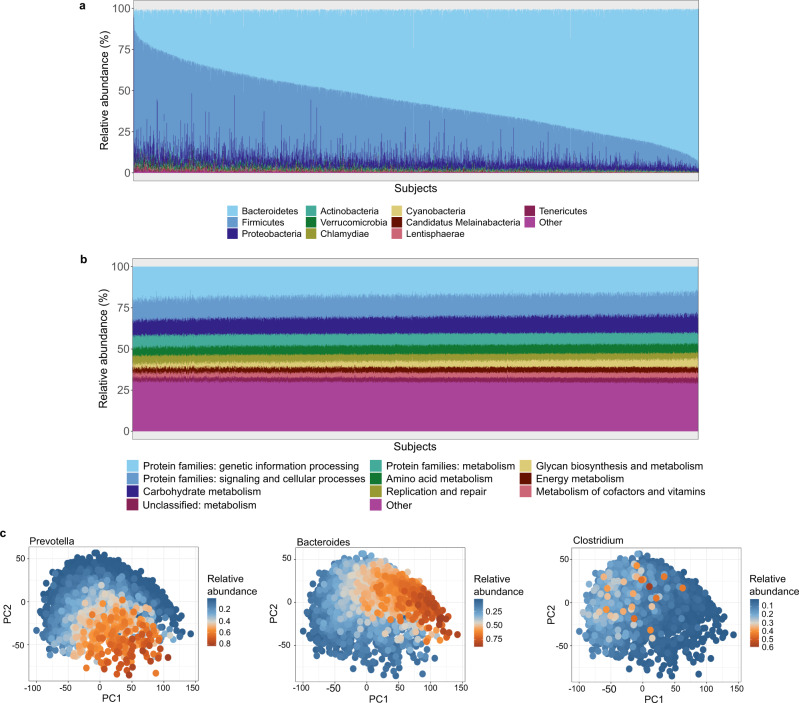
Microbiome research is starting to move beyond the exploratory phase towards interventional trials and therefore well-characterized cohorts will be instrumental for generating hypotheses and providing new knowledge. As part of the Estonian Biobank, we established the Estonian Microbiome Cohort which includes stool, oral and plasma samples from 2509 participants and is supplemented with multi-omic measurements, questionnaires, and regular linkages to national electronic health records. Here we analyze stool data from deep metagenomic sequencing together with rich phenotyping, including 71 diseases, 136 medications, 21 dietary questions, 5 medical procedures, and 19 other factors. We identify numerous relationships (n = 3262) with different microbiome features. In this study, we extend the understanding of microbiome-host interactions using electronic health data and show that long-term antibiotic usage, independent from recent administration, has a significant impact on the microbiome composition, partly explaining the common associations between diseases.
微生物组研究正开始从探索阶段迈向干预试验,因此,特征明确的队列对于提出假设和提供新知识将起到重要作用。作为爱沙尼亚生物银行的一部分,我们建立了爱沙尼亚微生物组队列,其中包括来自2509名参与者的粪便、口腔和血浆样本,并辅以多组学测量、问卷调查以及与国家电子健康记录的定期关联。在此,我们结合丰富的表型分析深度宏基因组测序的粪便数据,这些表型包括71种疾病、136种药物、21个饮食问题、5种医疗程序以及19个其他因素。我们发现了众多与不同微生物组特征的关联(n = 3262)。在本研究中,我们利用电子健康数据扩展了对微生物组与宿主相互作用的理解,并表明长期使用抗生素(与近期用药无关)对微生物组组成有重大影响,这部分解释了疾病之间常见的关联。