
用于多功能异质结构的导电金属有机框架纳米晶体的微观结构工程
Microstructural Engineering of Conductive MOF Nanocrystals for Multifunctional Heterostructures.
作者信息
Park Jae Seo, Yang Seo Mi, Park Dongyoun, Park Young Joon, Sim Ye Jin, Nam Hye Ji, Kim So Eun, Kim Jae Ho, Yang Seung Jae
机构信息
Department of Chemistry and Chemical Engineering, Education and Research Center for Smart Energy and Materials, Inha University, Incheon, 22212, Republic of Korea.
Department of Materials Science and Engineering, Seoul National University, Seoul, 08826, Republic of Korea.
出版信息
Small. 2025 Aug;21(33):e2504112. doi: 10.1002/smll.202504112. Epub 2025 Jun 26.
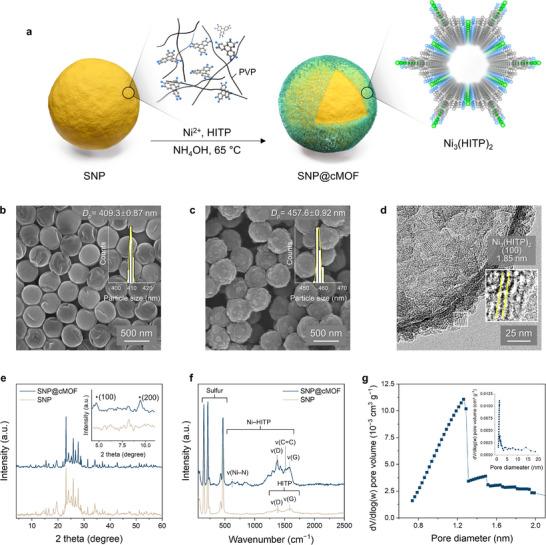
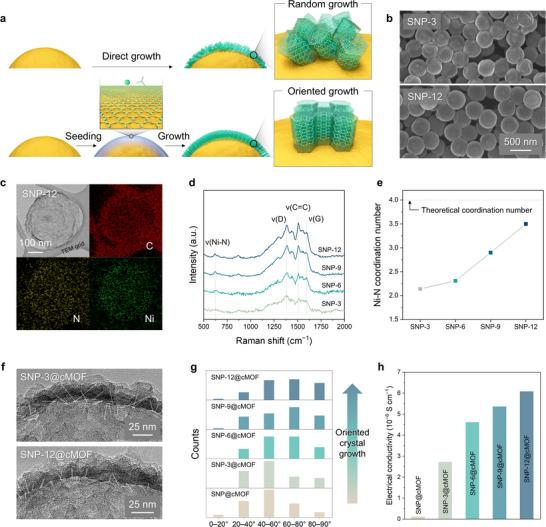
Conductive metal-organic frameworks (cMOFs) have emerged as transformative materials, significantly expanding the functional landscape of conventional MOFs by integrating electrical conductivity. Despite this, harnessing their full potential in heterostructured architectures is constrained by challenges in finely tuning the critical structural parameters, notably the packing density and crystallographic orientation. This paper introduces an innovative approach to engineering the microstructure of cMOFs as conformal shell-enveloping spherical nanoparticles. The compactness of the cMOF layer is modulated by the crystallization kinetics, while a deliberate seeding process directed the alignment of cMOF nanocrystallites. These methodologies collectively facilitated the formation of densely packed, highly ordered nanocrystallite assemblies in a core-shell configuration, enhancing mechanical robustness, selective permeability, and electron transport. The resulting cMOF assembly markedly augmented the stability and electrochemical performance of the sulfur core, showing significant promise as a next-generation cathode material for lithium-sulfur batteries.
导电金属有机框架(cMOF)已成为变革性材料,通过整合导电性显著扩展了传统MOF的功能范围。尽管如此,在异质结构中充分发挥其潜力受到精细调整关键结构参数(尤其是堆积密度和晶体取向)方面挑战的限制。本文介绍了一种创新方法,将cMOF的微观结构设计为包裹球形纳米颗粒的共形壳层。cMOF层的致密性由结晶动力学调节,而精心设计的晶种过程引导cMOF纳米微晶的排列。这些方法共同促进了核壳结构中密集堆积、高度有序的纳米微晶组件的形成,增强了机械强度、选择性渗透性和电子传输。所得的cMOF组件显著提高了硫核的稳定性和电化学性能,作为锂硫电池的下一代阴极材料显示出巨大潜力。


 Zotero 插件