Ebel Matthis, Domin Martin, Neumann Nicola, Schmidt Carsten Oliver, Lotze Martin, Stanke Mario
University of Greifswald, Institute of Mathematics and Computer Science, Greifswald, 17489, Germany.
University Medicine Greifswald, Functional Imaging, Institute of Diagnostic Radiology and Neuroradiology, Greifswald, 17489, Germany.
Neuroimage Rep. 2023 Jul 20;3(3):100181. doi: 10.1016/j.ynirp.2023.100181. eCollection 2023 Sep.
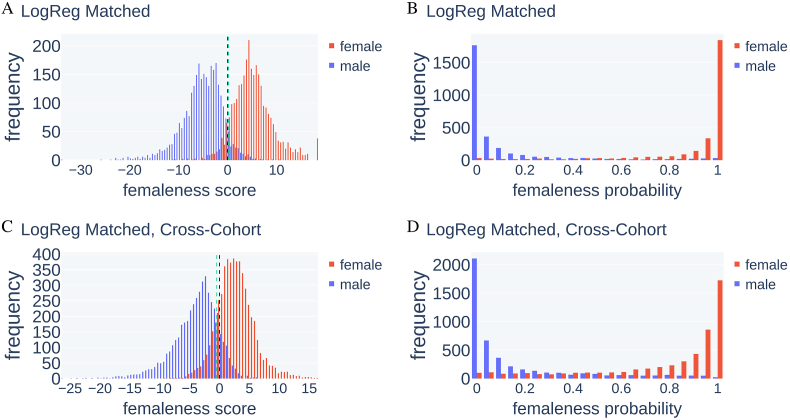
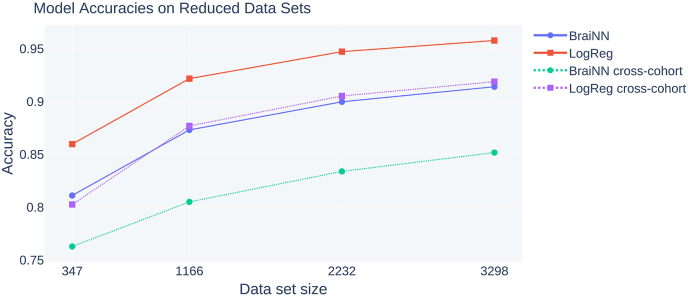
Sex differences in the size of specific brain structures have been extensively studied, but careful and reproducible statistical hypothesis testing to identify them produced overall small effect sizes and differences in brains of males and females. On the other hand, multivariate statistical or machine learning methods that analyze MR images of the whole brain have reported respectable accuracies for the task of distinguishing brains of males from brains of females. However, most existing studies lacked a careful control for brain volume differences between sexes and, if done, their accuracy often declined to 70% or below. This raises questions about the relevance of accuracies achieved without careful control of overall volume. We examined how accurately sex can be classified from gray matter properties of the human brain when matching on overall brain volume. We tested, how robust machine learning classifiers are when predicting cross-cohort, i.e. when they are used on a different cohort than they were trained on. Furthermore, we studied how their accuracy depends on the size of the training set and attempted to identify brain regions relevant for successful classification. MRI data was used from two population-based data sets of 3298 mostly older adults from the Study of Health in Pomerania (SHIP) and 399 mostly younger adults from the Human Connectome Project (HCP), respectively. We benchmarked two multivariate methods, logistic regression and a 3D convolutional neural network. We show that male and female brains of the same intracranial volume can be distinguished with >92% accuracy with logistic regression on a dataset of 1166 matched individuals. The same model also reached 85% accuracy on a different cohort without retraining. The accuracy for both methods increased with the training cohort size up to and beyond 3000 individuals, suggesting that classifiers trained on smaller cohorts likely have an accuracy disadvantage. We found no single outstanding brain region necessary for successful classification, but important features appear rather distributed across the brain.
特定脑结构大小的性别差异已得到广泛研究,但通过仔细且可重复的统计假设检验来识别这些差异时,总体效应量较小,且男性和女性大脑存在差异。另一方面,分析全脑磁共振图像的多变量统计或机器学习方法在区分男性大脑和女性大脑的任务上报告了可观的准确率。然而,大多数现有研究缺乏对两性脑容量差异的仔细控制,即便进行了控制,其准确率往往也会降至70%或更低。这引发了对于在未仔细控制总体容量情况下所达到的准确率相关性的质疑。我们研究了在匹配总体脑容量时,根据人类大脑灰质属性对性别进行准确分类的程度。我们测试了机器学习分类器在预测跨队列情况时(即用于与其训练队列不同的队列时)的稳健性。此外,我们研究了其准确率如何依赖于训练集的大小,并试图识别与成功分类相关的脑区。分别使用了来自波美拉尼亚健康研究(SHIP)的3298名大多为老年人的基于人群的两个数据集以及来自人类连接体项目(HCP)的399名大多为年轻人的磁共振成像数据。我们对两种多变量方法进行了基准测试,即逻辑回归和三维卷积神经网络。我们表明对于1166名匹配个体的数据集,使用逻辑回归可以以超过92%的准确率区分相同颅内体积的男性和女性大脑。同一模型在不同队列上未经重新训练也达到了85%的准确率。两种方法的准确率都随着训练队列规模增加到3000人及以上而提高,这表明在较小队列上训练的分类器可能在准确率上存在劣势。我们发现成功分类并非需要单个突出的脑区,而是重要特征似乎分布于整个大脑。