Lin Jing, Tan Hai-Long, Ge Huan
Department of General Surgery, Cancer Hospital of Xinjiang Medical University, Urumqi, Xinjiang, 830011, People's Republic of China.
Department of General Surgery, Xiangya Hospital Central South University, Changsha, Hunan, 410008, People's Republic of China.
Int J Womens Health. 2025 Jun 21;17:1863-1875. doi: 10.2147/IJWH.S513856. eCollection 2025.
Iodine deficiency threatens women of reproductive-age (15-49 years) worldwide, increasing risks of thyroid dysfunction and developmental abnormalities. Accurate trend prediction is essential for targeted prevention strategies.
To investigates the global, regional, and national disease burden of iodine deficiency among reproductive-age women from 1990 to 2019, as well as projected trends through 2035.
Using Global Burden of Disease 2019 data, we assessed prevalence, mortality, years lived with disability (YLDs), and disability-adjusted life years (DALYs) across 204 countries/territories (1990-2019). Age-period-cohort Bayesian model was used to predict trends from 2020 to 2035.
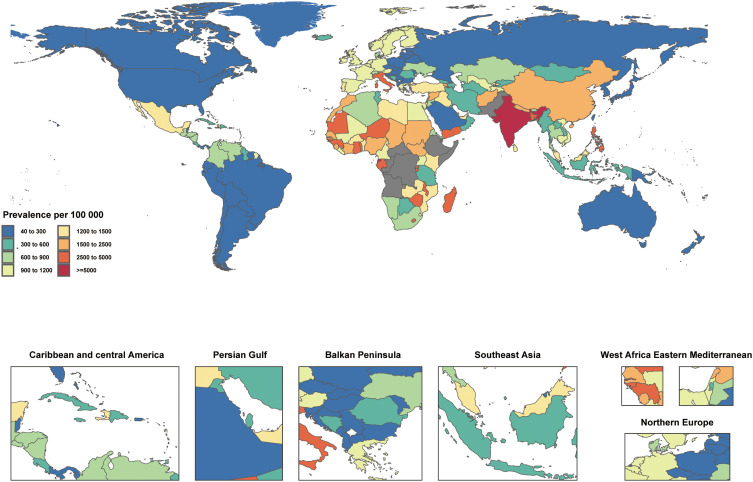
In 2019, 81.4 million women of reproductive age globally had iodine deficiency (age-standardized prevalence: 2871.7/100,000), reflecting a 13.3% reduction since 1990. The condition caused 1.1 million YLDs (age-standardized rate: 38.4/100,000), marking a 27.4% decrease from 1990. Projections suggest sustained declines through 2035. Notably, a strong inverse correlation emerged between Socio-demographic Index (SDI) and disease burden, with a correlation coefficient of -0.58 (95% CI: -0.63 to -0.53, <0.001). Geographically, the highest burden clustered in Central Sub-Saharan Africa, South Asia, and Eastern Sub-Saharan Africa, with Somalia, the Democratic Republic of the Congo, and Congo having the highest national prevalence.
The global burden of iodine deficiency among women of reproductive age has decreased substantially since 1990. Nonetheless, considerable challenges persist in lower SDI regions, especially affecting women within the reproductive age. Addressing these inequities in global iodine nutrition and alleviate the iodine deficiency-related burden, targeted implementation strategies and continuous monitoring measures are urgently needed.
碘缺乏威胁着全球育龄妇女(15 - 49岁),增加了甲状腺功能障碍和发育异常的风险。准确的趋势预测对于有针对性的预防策略至关重要。
调查1990年至2019年全球、区域和国家育龄妇女碘缺乏的疾病负担,以及到2035年的预测趋势。
利用2019年全球疾病负担数据,我们评估了204个国家/地区(1990 - 2019年)的患病率、死亡率、残疾生存年数(YLDs)和残疾调整生命年数(DALYs)。采用年龄-时期-队列贝叶斯模型预测2020年至2035年的趋势。
2019年,全球8140万育龄妇女存在碘缺乏(年龄标准化患病率:2871.7/100,000),较1990年下降了13.3%。该疾病导致110万YLDs(年龄标准化率:38.4/100,000),较1990年下降了27.4%。预测表明到2035年将持续下降。值得注意的是,社会人口指数(SDI)与疾病负担之间呈现出强烈的负相关,相关系数为-0.58(95%CI:-0.63至-0.53,<0.001)。在地理上,最高负担集中在撒哈拉以南非洲中部、南亚和撒哈拉以南非洲东部,索马里、刚果民主共和国和刚果的国家患病率最高。
自1990年以来,全球育龄妇女碘缺乏疾病负担已大幅下降。尽管如此,在社会人口指数较低的地区仍然存在相当大的挑战,尤其影响育龄期妇女。为了解决全球碘营养方面的这些不平等问题并减轻碘缺乏相关负担,迫切需要有针对性的实施策略和持续监测措施。