Tetereva Alina, Knodt Annchen R, Melzer Tracy R, van der Vliet William, Gibson Bryn, Hariri Ahmad R, Whitman Ethan T, Li Jean, Lal Khakpoor Farzane, Deng Jeremiah, Ireland David, Ramrakha Sandhya, Pat Narun
Department of Psychology, University of Otago, Dunedin 9016, New Zealand.
Department of Psychology and Neuroscience, Duke University, Durham, NC 27710, USA.
PNAS Nexus. 2025 Jun 24;4(6):pgaf175. doi: 10.1093/pnasnexus/pgaf175. eCollection 2025 Jun.
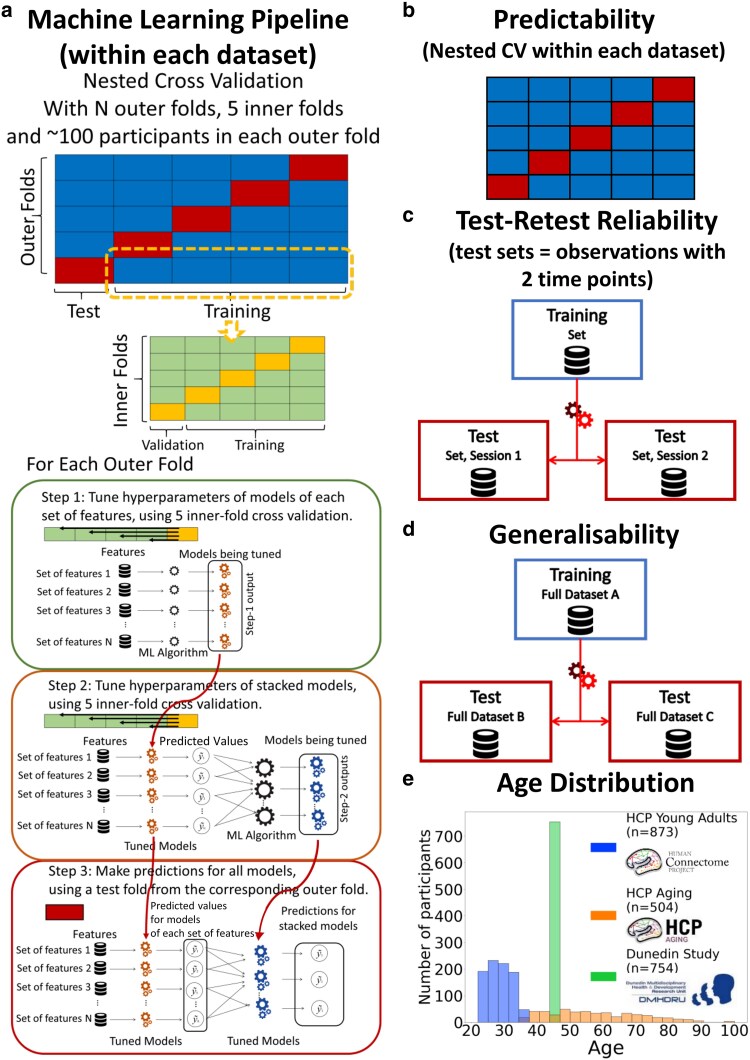
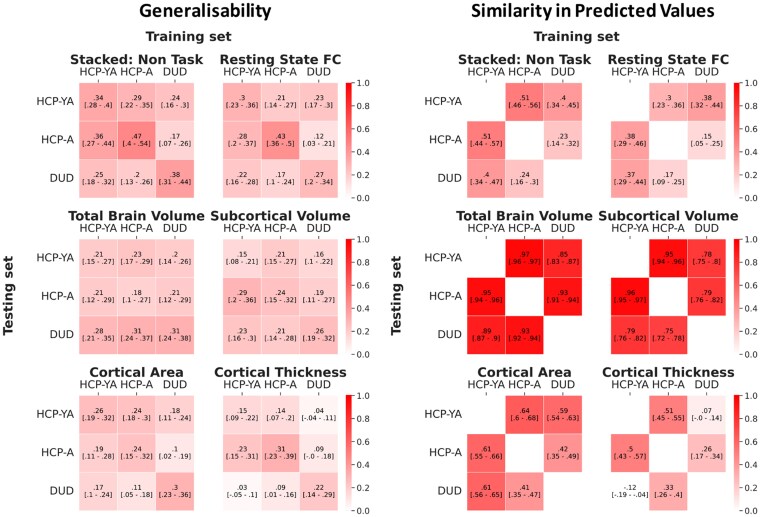
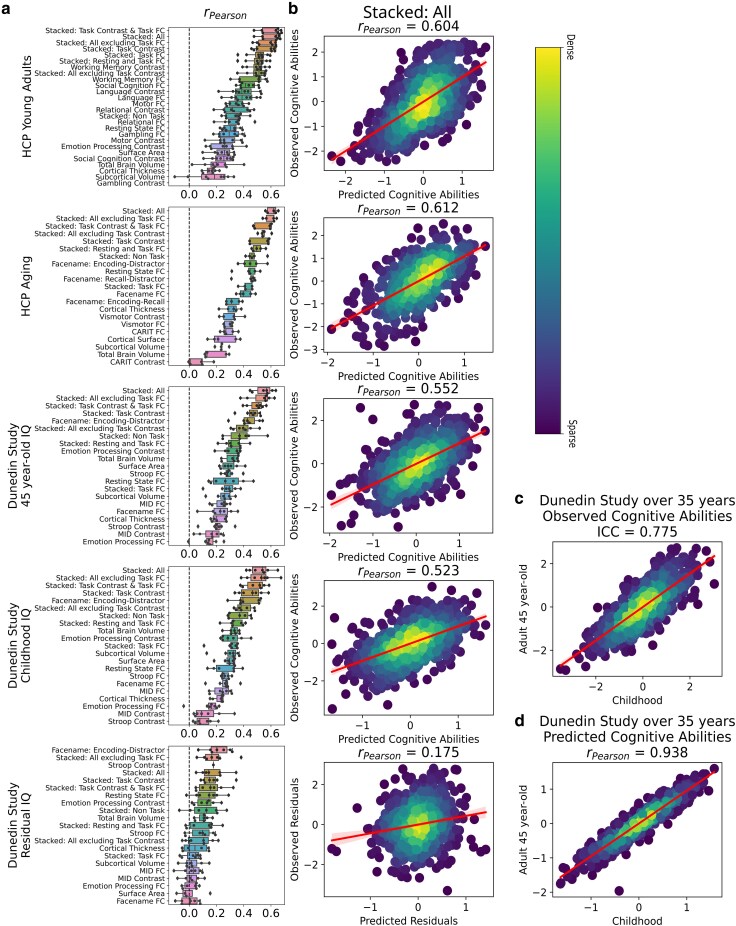
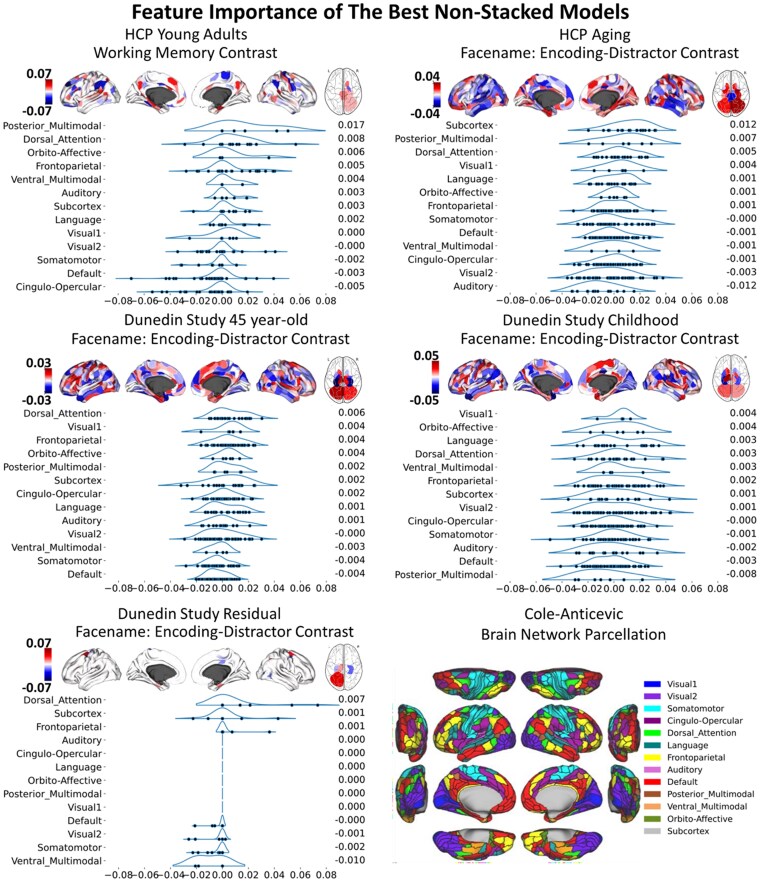
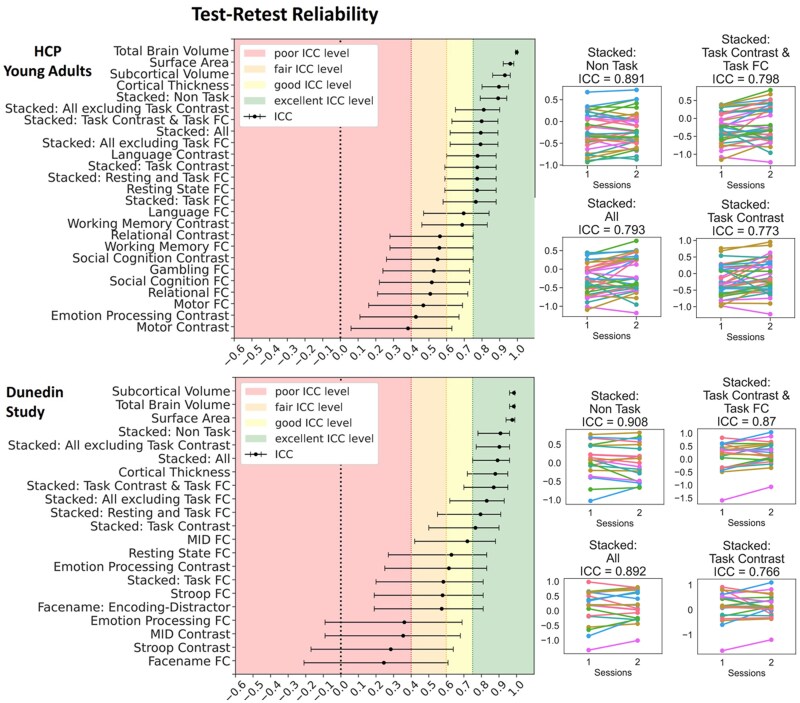
Brain-wide association studies (BWASs) have attempted to relate cognitive abilities with brain phenotypes, but have been challenged by issues such as predictability, test-retest reliability, and cross-cohort generalizability. To tackle these challenges, we proposed a machine learning "stacking" approach that draws information from whole-brain MRI across different modalities, from task-functional MRI (fMRI) contrasts and functional connectivity during tasks and rest to structural measures, into one prediction model. We benchmarked the benefits of stacking using the Human Connectome Projects: Young Adults ( = 873, 22-35 years old) and Human Connectome Projects-Aging ( = 504, 35-100 years old) and the Dunedin Multidisciplinary Health and Development Study (Dunedin Study, = 754, 45 years old). For predictability, stacked models led to out-of-sample ∼0.5-0.6 when predicting cognitive abilities at the time of scanning, primarily driven by task-fMRI contrasts. Notably, using the Dunedin Study, we were able to predict participants' cognitive abilities at ages 7, 9, and 11 years using their multimodal MRI at age 45 years, with an out-of-sample of 0.52. For test-retest reliability, stacked models reached an excellent level of reliability (interclass correlation > 0.75), even when we stacked only task-fMRI contrasts together. For generalizability, a stacked model with nontask MRI built from one dataset significantly predicted cognitive abilities in other datasets. Altogether, stacking is a viable approach to undertake the three challenges of BWAS for cognitive abilities.
全脑关联研究(BWAS)试图将认知能力与脑表型联系起来,但受到可预测性、重测信度和跨队列可推广性等问题的挑战。为应对这些挑战,我们提出了一种机器学习“堆叠”方法,该方法从全脑MRI的不同模态中提取信息,从任务功能MRI(fMRI)对比以及任务和静息状态下的功能连接到结构测量,将这些信息整合到一个预测模型中。我们使用人类连接组计划:青年成人(n = 873,22 - 35岁)、人类连接组计划 - 衰老组(n = 504,35 - 100岁)和达尼丁多学科健康与发展研究(达尼丁研究,n = 754,45岁)来评估堆叠方法的优势。在可预测性方面,堆叠模型在预测扫描时的认知能力时,样本外预测准确率约为0.5 - 0.6,主要由任务fMRI对比驱动。值得注意的是,利用达尼丁研究,我们能够使用45岁参与者的多模态MRI预测其7岁、9岁和11岁时的认知能力,样本外预测准确率为0.52。在重测信度方面,即使我们仅将任务fMRI对比堆叠在一起,堆叠模型也达到了极高的信度水平(组内相关系数> 0.75)。在可推广性方面,基于一个数据集构建的包含非任务MRI的堆叠模型能够显著预测其他数据集中的认知能力。总之,堆叠是应对BWAS在认知能力方面的三个挑战的一种可行方法。