Li Xue, Zuo Shuyu, Li Ming, Li Qin, Su Lei
NHC Key Laboratory of Human Disease Comparative Medicine, National Human Diseases Animal Model Resource Center, International center for technology and innovation of animal model, Institute of Laboratory Animal Science, Chinese Academy of Medical Sciences (CAMS) and Peking Union Medical College (PUMC), Beijing, 100021, China.
Institute of Animal Science, Chinese Academy of Agricultural Sciences, Technology Support Platform, Beijing, 100193, China.
Sci Rep. 2025 Jul 1;15(1):21750. doi: 10.1038/s41598-025-06760-w.
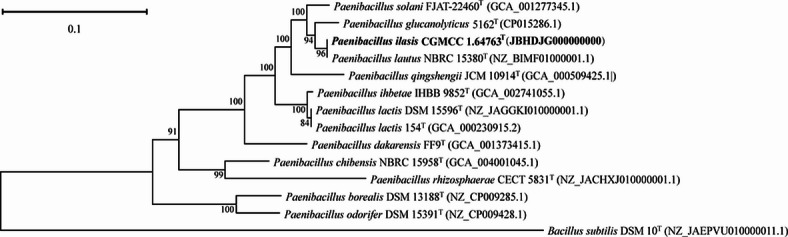
The genus Paenibacillus, known for its diverse sources, is a valuable reservoir of antimicrobial compounds, enzymes and other valuable chemicals, with applications in medicine, agriculture, and bioremediation. Despite this, Paenibacillus strains, particularly those isolated from unique environments, remain underexplored, limiting our understanding of their potential, capabilities and taxonomic classifications. The gut microbiome of large herbivores, such as rhinoceroses, harbors underexplored microbial diversity with unique metabolic capabilities. In this study, a Gram-stain-negative, facultatively aerobic, motile, spore-forming, rod-shaped bacterial strain, NGMCC 1.200843 (= CGMCC 1.64763 = JCM 37214), was isolated from fresh rhinoceros feces and characterized its taxonomic status and metabolic potential. Phylogenetic, phenotypic, and chemotaxonomic analyses confirmed the isolate as a novel species within the genus Paenibacillus, closely related to Paenibacillus lautus DSM 3035 (98.62% 16S rRNA gene similarity). The average nucleotide identity (ANI) and the digital DNA-DNA hybridization values were below the threshold for species delineation. The major cellular fatty acids were anteiso-C, C and iso-C (> 10%) and the polar lipid profile contained diphosphatidylglycerol (DPG), phosphatidylglycerol (PG), phosphatidylethanolamine (PE), two unidentified phospholipids (PL1-2) and one phosphatidyl choline (PC). The total DNA G + C content was 49.69 mol%. The isolate exhibited significant phosphate solubilization and starch hydrolysis activities in plate assays, suggesting a role in nutrient cycling within the rhinoceros gut. We propose the name Paenibacillus ilasis sp. nov. for this strain. These findings enhance our understanding of gut microbial diversity in herbivores and lay the foundation for future applications in agriculture or industry.
芽孢杆菌属以其多样的来源而闻名,是抗菌化合物、酶和其他有价值化学物质的宝贵储存库,在医学、农业和生物修复中都有应用。尽管如此,芽孢杆菌菌株,尤其是那些从独特环境中分离出来的菌株,仍未得到充分研究,这限制了我们对其潜力、能力和分类学分类的了解。大型食草动物(如犀牛)的肠道微生物群具有尚未充分探索的微生物多样性和独特的代谢能力。在本研究中,从新鲜犀牛粪便中分离出一株革兰氏染色阴性、兼性需氧、运动、产芽孢、杆状细菌菌株,编号为NGMCC 1.200843(= CGMCC 1.64763 = JCM 37214),并对其分类地位和代谢潜力进行了表征。系统发育、表型和化学分类分析证实该分离株是芽孢杆菌属内的一个新物种,与迟缓芽孢杆菌DSM 3035密切相关(16S rRNA基因相似度为98.62%)。平均核苷酸同一性(ANI)和数字DNA-DNA杂交值低于物种划分阈值。主要细胞脂肪酸为anteiso-C、C和iso-C(> 10%),极性脂质谱包含双磷脂酰甘油(DPG)、磷脂酰甘油(PG)、磷脂酰乙醇胺(PE)、两种未鉴定的磷脂(PL1-2)和一种磷脂酰胆碱(PC)。总DNA G + C含量为49.69摩尔%。该分离株在平板试验中表现出显著的解磷和淀粉水解活性,表明其在犀牛肠道营养循环中发挥作用。我们提议将该菌株命名为伊拉西斯芽孢杆菌(Paenibacillus ilasis sp. nov.)。这些发现增进了我们对食草动物肠道微生物多样性的理解,并为未来在农业或工业中的应用奠定了基础。