Yang Yixin, Liu Kexuan, Gao Yunhui, Wang Chen, Cao Liangcai
Department of Precision Instruments, Tsinghua University, Beijing, 100084, China.
School of Materials Science and Engineering, Tsinghua University, Beijing, 100084, China.
Light Sci Appl. 2025 Jul 24;14(1):250. doi: 10.1038/s41377-025-01923-w.
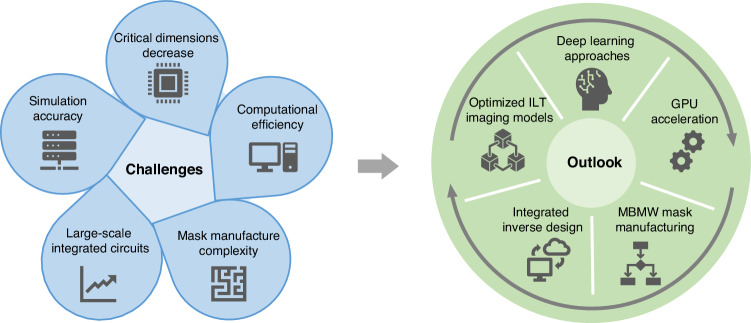
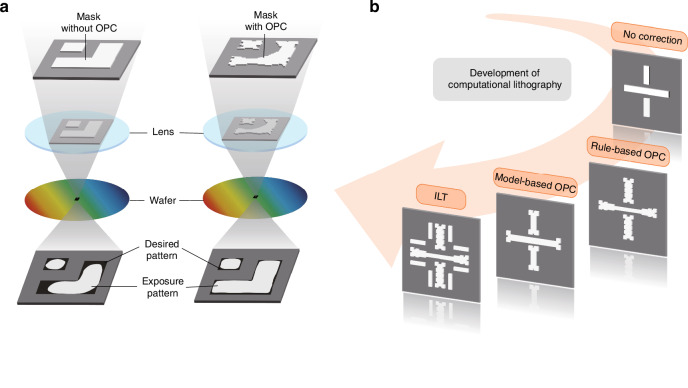
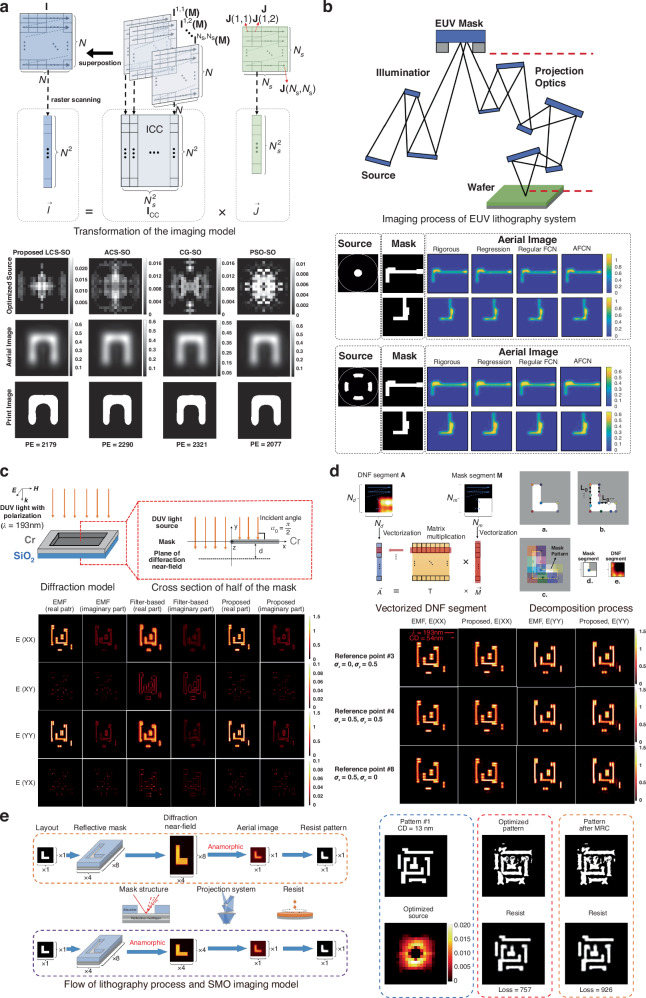
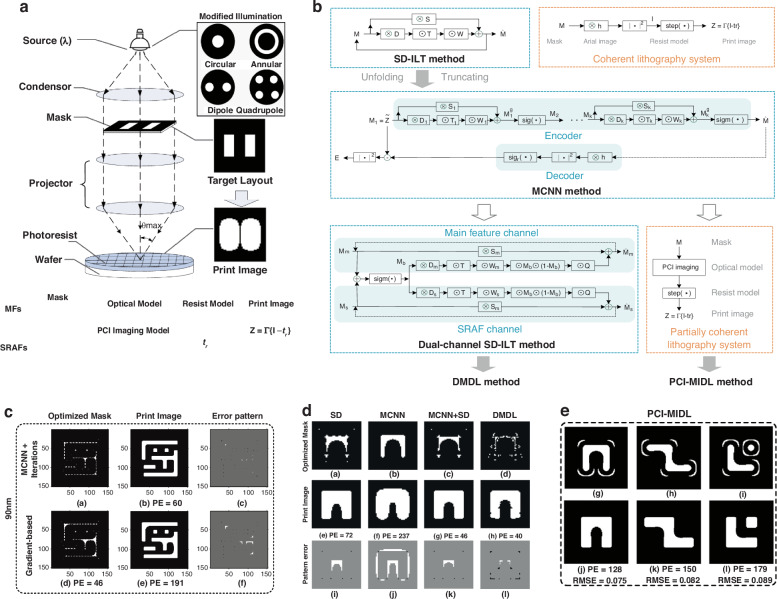
Inverse lithography technology (ILT) is a promising approach in computational lithography to address the challenges posed by shrinking semiconductor device dimensions. The ILT leverages optimization algorithms to generate mask patterns, outperforming traditional optical proximity correction methods. This review provides an overview of ILT's principles, evolution, and applications, with an emphasis on integration with artificial intelligence (AI) techniques. The review tracks recent advancements of ILT in model improvement and algorithmic efficiency. Challenges such as extended computational runtimes and mask-writing complexities are summarized, with potential solutions discussed. Despite these challenges, AI-driven methods, such as convolutional neural networks, deep neural networks, generative adversarial networks, and model-driven deep learning methods, are transforming ILT. AI-based approaches offer promising pathways to overcome existing limitations and support the adoption in high-volume manufacturing. Future research directions are explored to exploit ILT's potential and drive progress in the semiconductor industry.
逆光刻技术(ILT)是计算光刻中一种很有前景的方法,用于应对半导体器件尺寸不断缩小所带来的挑战。ILT利用优化算法来生成掩膜图案,性能优于传统的光学邻近校正方法。本文综述了ILT的原理、发展历程和应用,重点介绍了其与人工智能(AI)技术的集成。该综述追踪了ILT在模型改进和算法效率方面的最新进展。总结了诸如计算运行时间延长和掩膜写入复杂性等挑战,并讨论了潜在的解决方案。尽管存在这些挑战,但诸如卷积神经网络、深度神经网络、生成对抗网络和模型驱动的深度学习方法等人工智能驱动的方法正在改变ILT。基于人工智能的方法为克服现有局限性和支持在大规模制造中的应用提供了有前景的途径。探讨了未来的研究方向,以挖掘ILT的潜力并推动半导体行业的发展。