
从社会经济学角度看,环境和家庭细颗粒物暴露所致缺血性心脏病的全球负担:一项全面分析(1990 - 2021年)
Global burden of ischemic heart disease attributable to ambient and household PM exposure: a comprehensive analysis (1990-2021) from socioeconomics perspective.
作者信息
Zhang Chenran, Su Wanghong, Xi Huijuan, Li Shaoru, Xu Hongmei, Cheng Yue, Han Bei
机构信息
School of Public Health, Health Science Center, Xi'an Jiaotong University, Xi'an, China.
Department of Environmental Science and Engineering, Xi'an Jiaotong University, Xi'an, China.
出版信息
Front Public Health. 2025 Jul 10;13:1607163. doi: 10.3389/fpubh.2025.1607163. eCollection 2025.
OBJECTIVES
Socioeconomic status links to exposure of air pollutants. This study evaluates global PM-attributable ischemic heart disease (IHD) burden from 1990 to 2021.
METHODS
Using Global Burden of Disease (GBD) 2021 data, PM-related IHD burdens were analyzed. Joinpoint regression identified annual percentage changes (AAPCs); Pearson correlation assessed associations with Socio-demographic Index (SDI); Slope Index of Inequality (SII) and Concentration Index (CI) were applied to quantify inequality; Frontier analysis was conducted to evaluate the efficiency of health outcomes relative to development level; Decomposition analysis was performed to identify key drivers of burden changes over time.
RESULTS
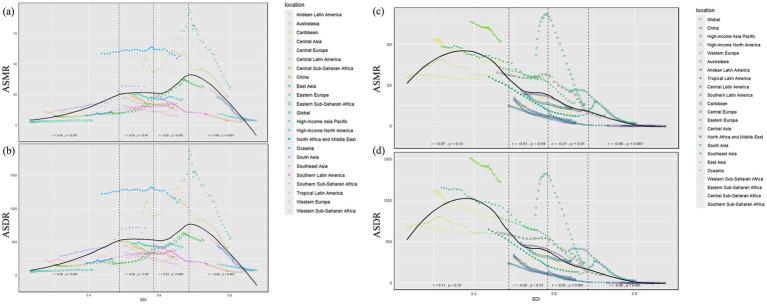
From 1990 to 2021, age-standardized rates (ASMR, ASDR) of IHD attributable to ambient PM declined to 20.85 per 100,000 (AAPC = -0.7), with attributable to household PM decreased to 9.02 per 100,000 (AAPC = -2.49). Middle-low SDI regions exhibited the highest increases in ambient PM-related burden, whereas high SDI regions showed marked declines (AAPC = -4.31). All regions showed downward in household PM-attributable ASMR and ASDR. Disease burden was disproportionately higher among males and older populations. ASMR and ASDR of IHD exhibited a nonlinear association with SDI. PM demonstrated positive correlation in regions with SDI < 0.49, and negative correlation in regions with SDI > 0.623. SII and CI indicated rising inequality in ambient PM-related burden. Frontier analysis revealed efficiency gaps in low-SDI regions. Decomposition highlighted population aging and ambient PM exposure as major drivers of burden trends.
CONCLUSION
Ambient pollution burdens increase in middle-SDI and household pollution impacts focus on low-SDI, which needs prioritizing clean energy and protecting high-risk populations.
目标
社会经济地位与空气污染物暴露相关。本研究评估了1990年至2021年全球因细颗粒物(PM)导致的缺血性心脏病(IHD)负担。
方法
利用《2021年全球疾病负担》(GBD 2021)数据,分析与PM相关的IHD负担。连接点回归确定年度百分比变化(AAPC);Pearson相关性评估与社会人口指数(SDI)的关联;应用不平等斜率指数(SII)和浓度指数(CI)量化不平等;进行前沿分析以评估相对于发展水平的健康结果效率;进行分解分析以确定负担随时间变化的关键驱动因素。
结果
1990年至2021年,环境PM导致的IHD年龄标准化发病率(ASMR,ASDR)降至每10万人20.85例(AAPC = -0.7),家庭PM导致的发病率降至每10万人9.02例(AAPC = -2.49)。中低SDI地区环境PM相关负担增加最多,而高SDI地区则显著下降(AAPC = -4.31)。所有地区家庭PM导致的ASMR和ASDR均呈下降趋势。男性和老年人群的疾病负担不成比例地更高。IHD的ASMR和ASDR与SDI呈非线性关联。在SDI < 0.49的地区,PM呈正相关,在SDI > 0.623的地区呈负相关。SII和CI表明环境PM相关负担的不平等在加剧。前沿分析揭示了低SDI地区的效率差距。分解分析突出了人口老龄化和环境PM暴露是负担趋势的主要驱动因素。
结论
中SDI地区的环境污染负担增加,家庭污染影响集中在低SDI地区,这需要优先考虑清洁能源并保护高危人群。




 Zotero 插件