Das Abir, Singh Saurabh, Kim Jaejeung, Ahanger Tariq Ahamed, Pise Anil Audumbar
JCFS, Endicott College, Woosong University, Daejeon, Republic of Korea.
AI and Big Data, Endicott College Woosong University, Daejeon, Republic of Korea.
Sci Rep. 2025 Jul 25;15(1):27161. doi: 10.1038/s41598-025-07427-2.
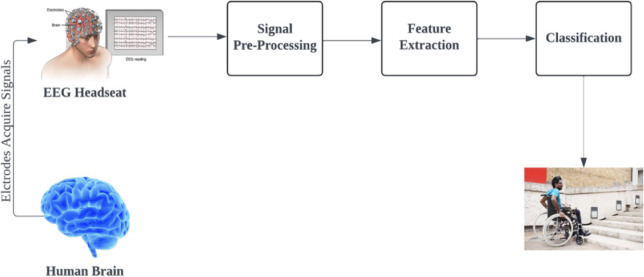
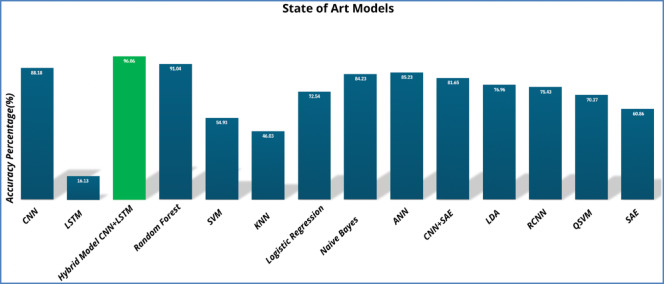
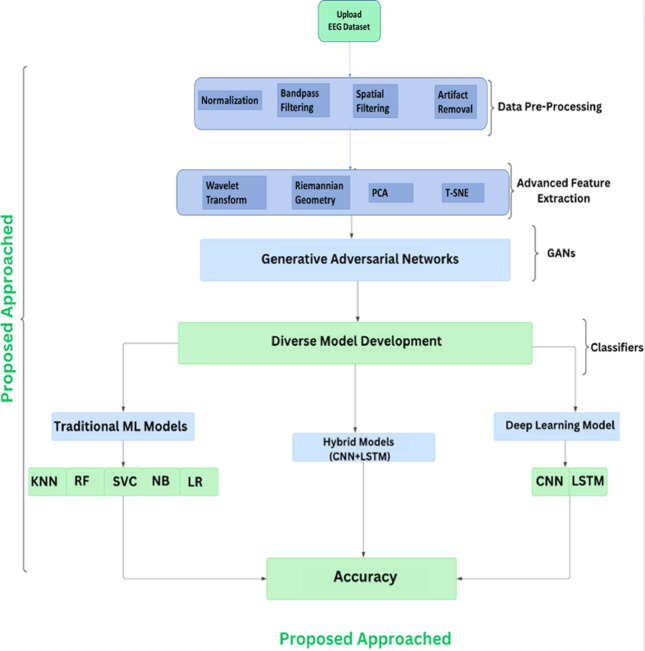
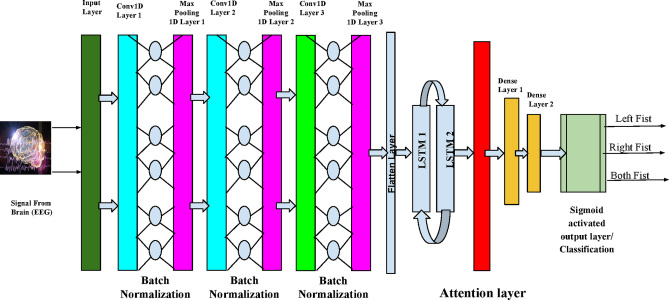
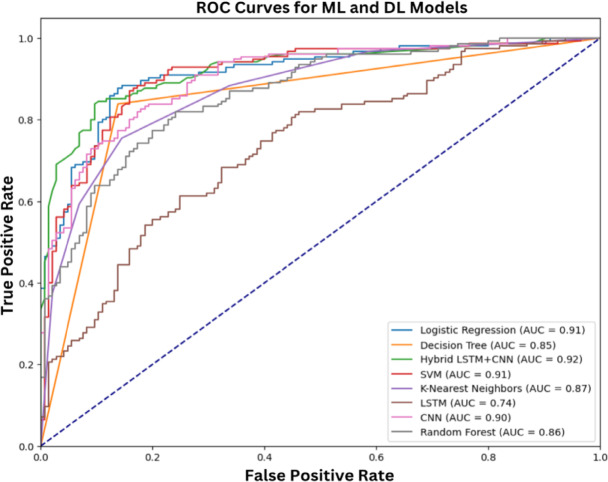
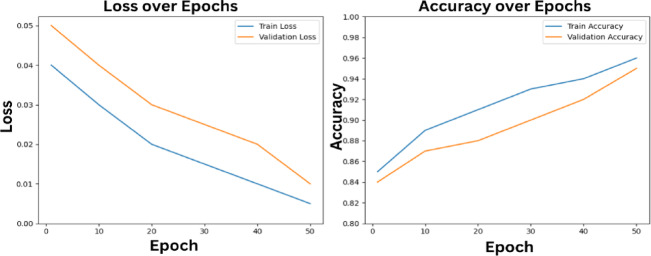
Brain-computer interfaces (BCIs) establish a communication pathway between the human brain and external devices by decoding neural signals. This study focuses on enhancing the classification of Motor Imagery (MI) within BCI systems by leveraging advanced machine learning and deep learning techniques. The accurate classification of electroencephalogram (EEG) data is crucial for enhancing BCI performance. The BCI architecture processes electroencephalography signals through three critical stages: data pre-processing, feature extraction, and classification. The research evaluates the performance of five traditional machine learning classifiers- K-Nearest Neighbors (KNN), Support Vector Classifier (SVC), Logistic Regression (LR), Random Forest (RF), and Naive Bayes (NB)-using the "PhysioNet EEG Motor Movement/Imagery Dataset". This dataset encompasses EEG data from various motor tasks, including both actual and imagined movements. Among the traditional classifiers, Random Forest achieved the highest accuracy of 91%, underscoring its efficacy in motor imagery classification within BCI systems. In addition to conventional approaches, the study also explores deep learning techniques, with Convolutional Neural Networks (CNN) and Long Short-Term Memory (LSTM) networks yielding accuracies of 88.18% and 16.13%, respectively. However, the proposed hybrid model, which synergistically combines CNN and LSTM, significantly surpasses both traditional machine learning and individual deep learning methods, achieving an exceptional accuracy of 96.06%. This substantial improvement highlights the potential of hybrid deep learning models to advance the state of the art in BCI systems, offering a more robust and precise approach to motor imagery classification.
脑机接口(BCIs)通过解码神经信号在人脑与外部设备之间建立通信路径。本研究专注于利用先进的机器学习和深度学习技术来增强脑机接口系统中运动想象(MI)的分类。脑电图(EEG)数据的准确分类对于提高脑机接口性能至关重要。脑机接口架构通过三个关键阶段处理脑电图信号:数据预处理、特征提取和分类。该研究使用“PhysioNet EEG运动/想象数据集”评估了五种传统机器学习分类器——K近邻(KNN)、支持向量分类器(SVC)、逻辑回归(LR)、随机森林(RF)和朴素贝叶斯(NB)的性能。该数据集包含来自各种运动任务的脑电图数据,包括实际运动和想象运动。在传统分类器中,随机森林的准确率最高,达到了91%,这突出了其在脑机接口系统中运动想象分类方面的有效性。除了传统方法外,该研究还探索了深度学习技术,卷积神经网络(CNN)和长短期记忆(LSTM)网络的准确率分别为88.18%和16.13%。然而,所提出的将CNN和LSTM协同结合的混合模型显著超越了传统机器学习和个体深度学习方法,实现了96.06%的卓越准确率。这一显著提升凸显了混合深度学习模型在推动脑机接口系统技术发展方面的潜力,为运动想象分类提供了一种更强大、更精确的方法。