Hu Jan C-C, Liang Tian, Zhang Hong, Hu Yuanyuan, Yamakoshi Yasuo, Yamamoto Ryuji, Zhang Chuhua, Li Hui, Smith Charles E, Simmer James P
Department of Biologic and Materials Sciences & Prosthodontics, University of Michigan School of Dentistry, 1011 N University Ave., Ann Arbor, MI 48109, USA.
Department of Orthodontic and Pediatric Dentistry, University of Michigan School of Dentistry, 1011 N University Ave., Ann Arbor, MI 48109, USA.
Int J Mol Sci. 2025 Jul 12;26(14):6707. doi: 10.3390/ijms26146707.
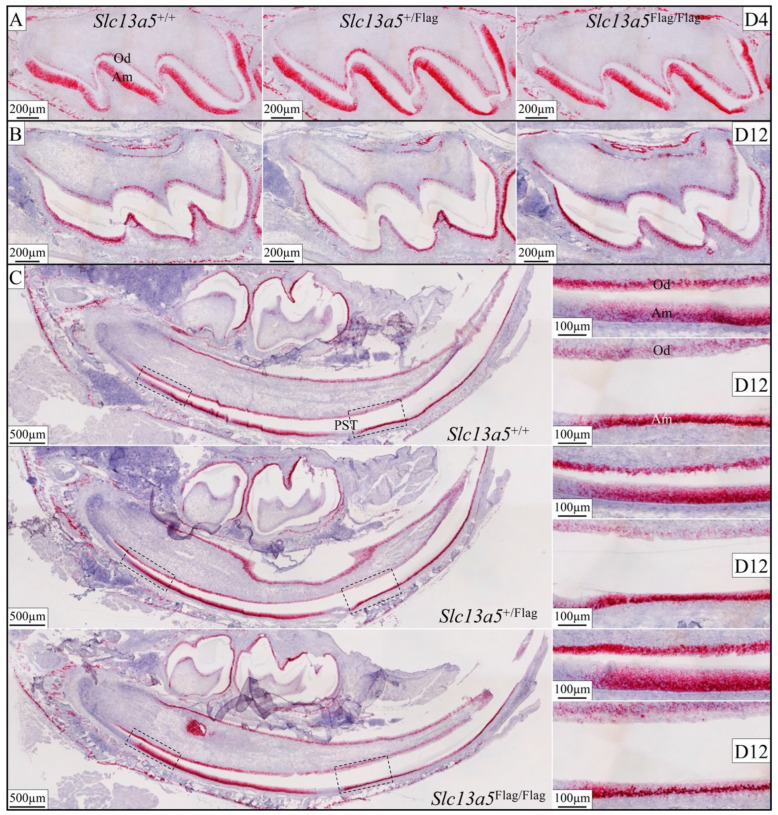
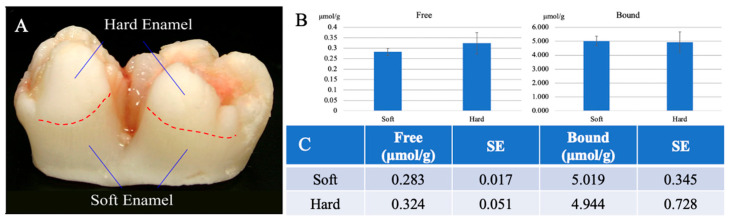
The sodium-citrate cotransporter (NaCT) plays a crucial role in citrate transport during amelogenesis. Mutations in the gene, which encodes the NaCT, cause early infantile epileptic encephalopathy 25 and amelogenesis imperfecta. We analyzed developing pig molars and determined that the citrate concentrations in secretory- and maturation-stage enamel are both 5.3 µmol/g, with about 95% of the citrate being bound to mineral. To better understand how citrate might enter developing enamel, we developed reporter mice that express NaCT with a C-terminal Flag-tag (DYKDDDDK) that can be specifically and accurately recognized by commercially available anti-Flag antibodies. The 24-base Flag coding sequence was located immediately upstream of the natural translation termination codon (TAG) and was validated by Sanger sequencing. The general development, physical activities, and reproductive outcomes of this mouse strain were comparable to those of the C57BL/6 mice. No differences were detected between the and wild-type mice. Tooth development was extensively characterized using dissection microscopy, bSEM, light microscopy, in situ hybridization, and immunohistochemistry. Tooth formation was not altered in any detectable way by the introduction of the Flag. The citrate transporter was observed on all outer membranes of secretory ameloblasts (distal, lateral, and proximal), with the strongest signal on the Tomes process, and was detectable in all but the distal membrane of maturation-stage ameloblasts. The papillary layer also showed positive immunostaining for Flag. The outer membrane of odontoblasts stained stronger than ameloblasts, except for the odontoblastic processes, which did not immunostain. As NaCT is thought to only facilitate citrate entry into the cell, we performed in situ hybridization that showed is not expressed by secretory- or maturation-stage ameloblasts, ruling out that ANK can transport citrate into enamel. In conclusion, we developed reporter mice that provide specific and sensitive localization of a fully functional NaCT-Flag protein. The localization of the citrate transporter throughout the ameloblast membrane suggests that either citrate enters enamel by a paracellular route or NaCT can transport citrate bidirectionally (into or out of ameloblasts) depending upon local conditions.
柠檬酸钠共转运蛋白(NaCT)在釉质形成过程中的柠檬酸盐转运中起关键作用。编码NaCT的基因突变会导致早发性婴儿癫痫性脑病25型和釉质发育不全。我们分析了发育中的猪磨牙,确定分泌期和成熟期牙釉质中的柠檬酸盐浓度均为5.3微摩尔/克,其中约95%的柠檬酸盐与矿物质结合。为了更好地了解柠檬酸盐如何进入发育中的牙釉质,我们构建了报告基因小鼠,其表达带有C末端Flag标签(DYKDDDDK)的NaCT,该标签可被市售抗Flag抗体特异性且准确地识别。24个碱基的Flag编码序列位于天然翻译终止密码子(TAG)的紧上游,并经桑格测序验证。该小鼠品系的一般发育、身体活动和生殖结果与C57BL/6小鼠相当。在该小鼠与野生型小鼠之间未检测到差异。使用解剖显微镜、背散射电子显微镜、光学显微镜、原位杂交和免疫组织化学对牙齿发育进行了广泛表征。引入Flag并未以任何可检测到的方式改变牙齿形成。在分泌期成釉细胞的所有外膜(远端、侧面和近端)均观察到柠檬酸盐转运蛋白,在托姆斯突上信号最强,在成熟期成釉细胞除远端膜外的所有膜中均可检测到。乳头层也显示出Flag阳性免疫染色。成牙本质细胞的外膜染色比成釉细胞更强,除了成牙本质细胞突起未进行免疫染色。由于认为NaCT仅促进柠檬酸盐进入细胞,我们进行了原位杂交,结果显示分泌期或成熟期成釉细胞不表达ANK,排除了ANK可将柠檬酸盐转运到牙釉质中的可能性。总之,我们构建了报告基因小鼠,其可对功能完全正常的NaCT-Flag蛋白进行特异性和灵敏的定位。整个成釉细胞膜上柠檬酸盐转运蛋白的定位表明,要么柠檬酸盐通过细胞旁途径进入牙釉质,要么NaCT可根据局部条件双向转运柠檬酸盐(进入或流出成釉细胞)。