Wang Jing, Xia Xinglu, Lin Xi, Xu Xiaomin
Department of Gynecology, The Quzhou Affiliated Hospital of Wenzhou Medical University, Quzhou People's Hospital, Quzhou, Zhejiang, 324000, People's Republic of China.
Int J Womens Health. 2025 Jul 22;17:2265-2276. doi: 10.2147/IJWH.S513067. eCollection 2025.
Hormone replacement therapy (HRT) plays a critical role in managing perimenopausal syndrome, yet patients' knowledge, attitudes, and practices (KAP) toward HRT remain insufficiently understood. This study aimed to assess KAP toward HRT among patients with perimenopausal syndrome.
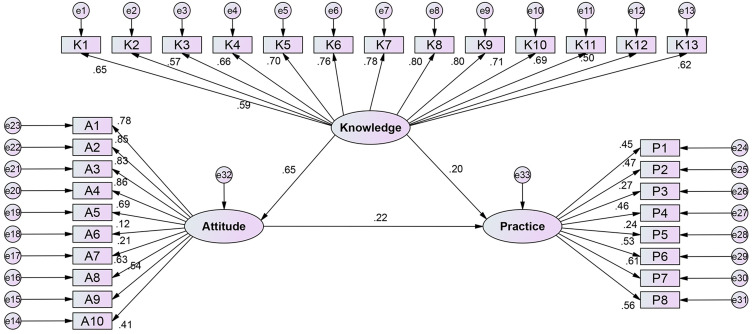
This cross-sectional study conducted in Quzhou, Zhejiang Province, China, in February 2024 used a validated self-designed questionnaire to assess demographic characteristics and knowledge, attitudes, and practices (KAP) toward hormone replacement therapy (HRT). Structural equation modeling (SEM) was applied to examine the pathways among KAP dimensions.
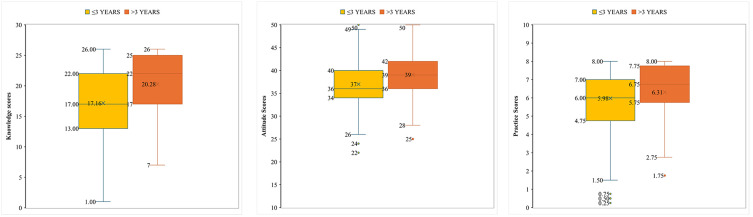
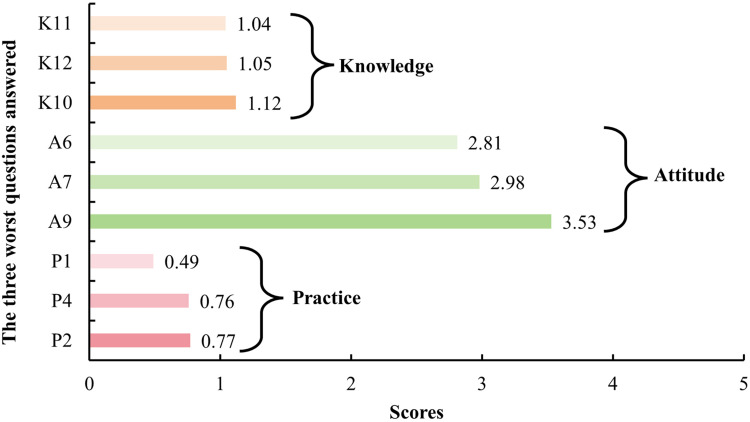
Among the 520 participants analyzed, 73.3% resided in urban areas, and 37.9% had used HRT for less than one year. The knowledge, attitude, and practice scores were 18.01±6.05 (possible range: 0-26), 37.56±5.07 (possible range: 10-50), and 6.07±1.70 (possible range: 0-8), respectively. There were significant positive correlations among knowledge, attitudes, and practices (all P < 0.001). SEM results showed that knowledge directly influenced attitudes (β = 0.499, P < 0.001) and practices (β = 0.125, P = 0.007), and that attitudes also directly influenced practices (β = 0.175, P = 0.005).
Patients exhibited moderate knowledge and relatively positive practices, though their attitudes toward HRT were suboptimal. The findings highlight the interrelationships among knowledge, attitudes, and practices regarding HRT, suggesting that educational efforts may play a key role in improving patient understanding and engagement.
激素替代疗法(HRT)在围绝经期综合征的管理中起着关键作用,但患者对HRT的知识、态度和行为(KAP)仍未得到充分了解。本研究旨在评估围绝经期综合征患者对HRT的KAP。
2024年2月在中国浙江省衢州市进行的这项横断面研究,使用经过验证的自行设计问卷评估人口统计学特征以及对激素替代疗法(HRT)的知识、态度和行为(KAP)。采用结构方程模型(SEM)来检验KAP维度之间的路径。
在分析的520名参与者中,73.3%居住在城市地区,37.9%使用HRT的时间不到一年。知识、态度和行为得分分别为18.01±6.05(可能范围:0 - 26)、37.56±5.07(可能范围:10 - 50)和6.07±1.70(可能范围:0 - 8)。知识、态度和行为之间存在显著的正相关(均P < 0.001)。SEM结果显示,知识直接影响态度(β = 0.499,P < 0.001)和行为(β = 0.125,P = 0.007),态度也直接影响行为(β = 0.175,P = 0.005)。
患者表现出中等程度的知识水平和相对积极的行为,尽管他们对HRT的态度并不理想。研究结果突出了关于HRT的知识、态度和行为之间的相互关系,表明教育努力可能在提高患者的理解和参与度方面发挥关键作用。