Zhou Hongxu, Ren Yue, Wang Yangli, Su Jing, Zhou Xiangmin, Huang Siyu, Yan Rui, Zeng Jun, Chen Min, Zhang En, Chen Xiaohu
CQMPA Key Laboratory for Quality Control and Evaluation of Traditional Chinese Medicine, Chongqing Institute for Food and Drug Control, Chongqing, China.
Chongqing Key Laboratory of New Drug Screening from Traditional Chinese Medicine, Integrative Science Center of Germplasm Creation in Western China (Chongqing) Science City and Southwest University, SWU-TAAHC Medicinal Plant Joint R&D Centre, College of Pharmaceutical Sciences, Southwest University, Chongqing, China.
Front Chem. 2025 Jul 15;13:1587915. doi: 10.3389/fchem.2025.1587915. eCollection 2025.
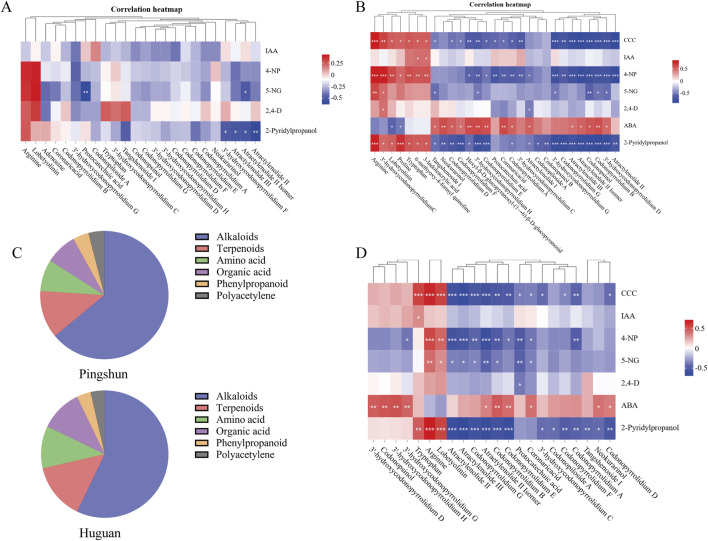
Plant growth regulators (PGRs) enhance the biosynthesis of plant secondary metabolites but can cause environmental pollution and health risks, especially if synthetic or overused. Here, we developed a simple, high-throughput method using salting-out extraction and LC-MS/MS to analyze 62 PGR residues. The extraction, chromatographic conditions, and spectrometric parameters were systematically optimized. The extraction process was performed with acetonitrile-water (1:1), EN15662 extraction salt and d-SPE sorbent. This method was applied to analyze commercial and field trial (CR) samples. The limit of quantification (LOQ), for 62 PGRs ranged from 0.03 to 82.50 μg/kg, and the limit of detection (LOD) ranged from 0.01 to 18.58 μg/kg. Furthermore, we employed plant metabolomics to assess changes in secondary metabolites in CR following fertilizer application and conducted a correlation analysis to explore the relationship between PGRs and secondary metabolites. In commercial samples, residues of 10 PGRs were detected, while in field trial samples, residues of 7 PGRs were found. In plant metabolomics, the arrangement of CR samples, which have been exposed to different fertilization levels, along the axes of partial least squares-discriminant analysis (PLS-DA) indicates that the chemical composition of CR experiences substantial alterations once a particular fertilization threshold is surpassed. The correlation analysis showed that PGRs boost amino acid metabolite synthesis and inhibit alkaloid biosynthesis. This study focuses on quality and safety concerns from the unchecked use of PGRs in CR production. It offers a framework for standardized cultivation and quality control to ensure the sustainable development of Traditional Chinese Medicine.
植物生长调节剂(PGRs)可促进植物次生代谢产物的生物合成,但可能导致环境污染和健康风险,尤其是在合成或过度使用的情况下。在此,我们开发了一种简单的高通量方法,利用盐析萃取和液相色谱-串联质谱法(LC-MS/MS)分析62种植物生长调节剂残留。对萃取、色谱条件和光谱参数进行了系统优化。萃取过程使用乙腈-水(1:1)、EN15662萃取盐和分散固相萃取(d-SPE)吸附剂进行。该方法应用于分析商业样品和田间试验(CR)样品。62种植物生长调节剂的定量限(LOQ)范围为0.03至82.50μg/kg,检测限(LOD)范围为0.01至18.58μg/kg。此外,我们采用植物代谢组学评估施肥后CR中次生代谢产物的变化,并进行相关性分析以探索植物生长调节剂与次生代谢产物之间的关系。在商业样品中,检测到10种植物生长调节剂残留,而在田间试验样品中,发现了7种植物生长调节剂残留。在植物代谢组学中,暴露于不同施肥水平的CR样品沿偏最小二乘判别分析(PLS-DA)轴的排列表明,一旦超过特定施肥阈值,CR的化学成分就会发生显著变化。相关性分析表明,植物生长调节剂促进氨基酸代谢产物的合成并抑制生物碱的生物合成。本研究关注CR生产中未加控制使用植物生长调节剂所带来的质量和安全问题。它为规范种植和质量控制提供了一个框架,以确保中药的可持续发展。