Hoang Nguyen Huy, Thanh Toan Le, Saengchan Chanon, Sangpueak Rungthip, Thepbandit Wannaporn, Zhou Xiaolu, Kamkaew Anyanee, Buensanteai Kumrai
School of Crop Production Technology, Institute of Agricultural Technology, Suranaree University of Technology, Nakhon Ratchasima 30000, Thailand.
Department of Plant Protection, Can Tho University, Can Tho City, 94100, Vietnam.
Plant Pathol J. 2025 Aug;41(4):437-455. doi: 10.5423/PPJ.RW.02.2025.0029. Epub 2025 Aug 1.
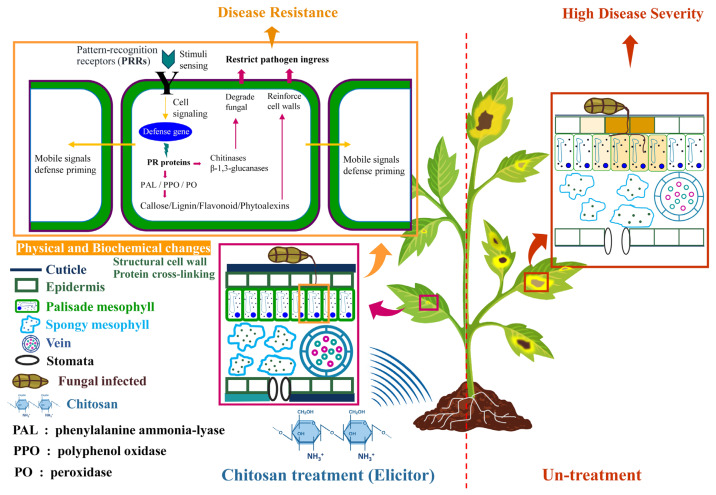
Phytopathogen caused loss of global crop production of 16% and up to 25% in developing countries. Among them, fungi accounted for the highest ratio value with 42%, which direct reduced crop yield and quality. Nanotechnology can be applied to crop protection to build sustainable agricultural production. Polymers (gum, mucilage, chitosan) are naturally derived, readily available, inexpensive, convertible, and biodegradable, which could be combined with nanotechnology to enhance their properties and benefit. In this review, ionic gelation is more popular than nanoprecipitation, emulsion, γ-rays irradiation, and chemical reduction methods in preparing nanocomposites-based polymers in the management of fungal diseases in crop production. The chitosan was often dominated among the polymers. Moreover, the chitosan can be applied as chitosan nanoparticles or combined with an active ingredient (saponin, copper, silver, zinc, titanium dioxide, ethanolic blueberry extract, methanol of nanche extract, Mentha longifolia extract, Cymbopogon martinii essential oil, Harpin, salicylic acid, Thiamine, hexaconazole, dazomet, hexaconazole-dazomet) to enhance their efficacy in managing plant fungal disease. The fungicide, mental, and plant extracts are often loaded into the chitosan matrix to enhance antifungal and/or physical barrier properties. While phytohormones, vitamins, and mental are often used to stimulate plant disease resistance. And chitosan can be used as an adjuvant in metal/oxide mixture. In recent years, other polymers including polyethylene glycol, nanoliposomes, and poly(L-lactide) have been shown remarkable capabilities including resisting water washing and acting as a membrane filter with antifungal properties. These results show that the nanocomposites based-polymer has the ability to effectively manage plant diseases.
植物病原体导致全球农作物产量损失16%,在发展中国家高达25%。其中,真菌占比最高,为42%,直接降低了作物产量和质量。纳米技术可应用于作物保护,以建立可持续农业生产。聚合物(树胶、黏液、壳聚糖)天然来源、容易获得、价格低廉、可转化且可生物降解,可与纳米技术结合以增强其性能并带来益处。在本综述中,在制备用于作物生产中真菌病害管理的基于纳米复合材料的聚合物时,离子凝胶法比纳米沉淀法、乳液法、γ射线辐照法和化学还原法更受欢迎。壳聚糖在聚合物中通常占主导地位。此外,壳聚糖可以作为壳聚糖纳米颗粒应用,或与活性成分(皂素、铜、银、锌、二氧化钛、乙醇蓝莓提取物、番荔枝甲醇提取物、长叶薄荷提取物、马丁香茅精油、Harpin、水杨酸、硫胺素、己唑醇、棉隆、己唑醇-棉隆)结合,以提高其在管理植物真菌病害方面的功效。杀菌剂、金属和植物提取物通常负载到壳聚糖基质中,以增强抗真菌和/或物理屏障性能。而植物激素、维生素和金属常用于刺激植物抗病性。并且壳聚糖可以用作金属/氧化物混合物中的佐剂。近年来,其他聚合物,包括聚乙二醇、纳米脂质体和聚(L-丙交酯),已显示出显著的性能,包括抗水洗和作为具有抗真菌特性的膜过滤器。这些结果表明,基于纳米复合材料的聚合物有能力有效管理植物病害。