
1990 - 2021年全球热烧伤负担趋势:2021年全球疾病负担研究的综合分析
Global trends in thermal burn burden, 1990-2021: a comprehensive analysis for the global burden of disease study 2021.
作者信息
Zhang Yuke, Chen Qingsong, Wang Ru, Guo Linfen, Li Peiyu, Deng Ke, Xiao Haitao, Xu Xuewen
机构信息
Department of Plastic and Burn Surgery, West China Hospital, Sichuan University, Chengdu, China.
School of Microelectronics and Communication Engineering of Chongqing University, Chongqing University Central Hospital (Chongqing Emergency Medical Center), Chongqing, China.
出版信息
Front Public Health. 2025 Jul 30;13:1631138. doi: 10.3389/fpubh.2025.1631138. eCollection 2025.
BACKGROUND
The purpose of this study is to explore the global burden of thermal burns from 1990 to 2021 and to predict the trends in thermal burn burden up to 2040.
METHODS
We utilized data from the Global Burden of Disease Study 2021 to assess the incidence, prevalence, and years lived with disability (YLDs) of thermal burns at the global, regional, and national levels. Decomposition analysis was performed to quantify the relative contributions of epidemiological changes, age structure shifts, and population growth to the thermal burn burden. Frontier analysis was employed to evaluate the potential improvements in the thermal burn burden that could be achieved given a country's development status. A Bayesian age-period-cohort model was used to predict burden trends up to 2040.
RESULTS
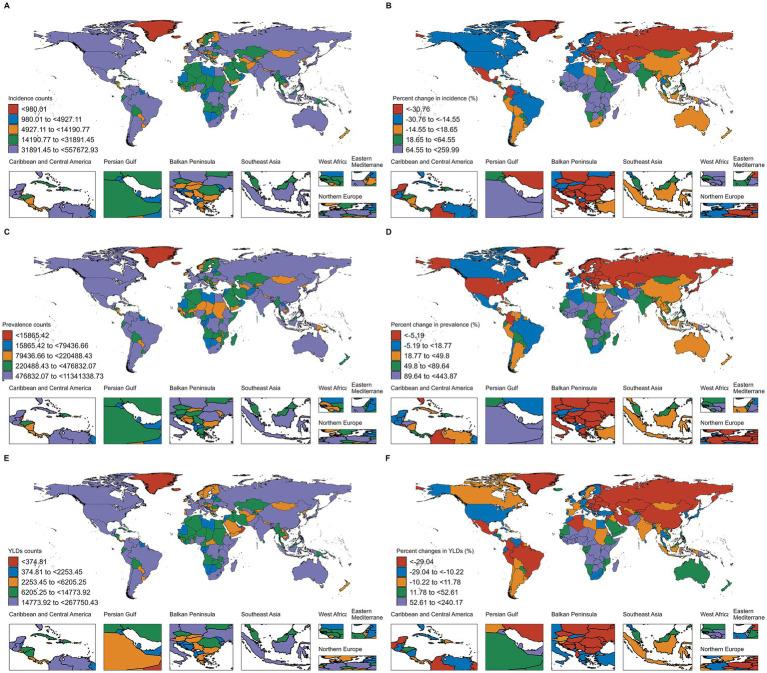
In 2021, the global numbers of thermal burn incident cases and YLDs were approximately 6.19 million and 2.67 million, respectively, representing decreases of 9.44 and 11.86% from 1990. The prevalent cases were around 104.76 million, an increase of 11.38% from 1990. The age-standardized rates of incidence, prevalence, and YLDs all showed declines. Decomposition analysis indicated that population growth is the primary factor hindering the reduction of the thermal burn burden. Frontier analysis suggested that countries at various development levels have the potential to improve the thermal burn burden. By 2040, the number of thermal burn incident cases is predicted to decline, while the numbers of prevalent cases and YLDs will increase.
CONCLUSION
The global burden of thermal burns has been partially alleviated, but it will continue to persist. For low socio-demographic index countries, it is necessary to adopt targeted healthcare measures tailored to their specific circumstances alongside social development to achieve optimal management of thermal burns.
背景
本研究旨在探讨1990年至2021年全球热烧伤负担,并预测到2040年热烧伤负担的趋势。
方法
我们利用2021年全球疾病负担研究的数据,在全球、区域和国家层面评估热烧伤的发病率、患病率和伤残调整生命年(YLDs)。进行分解分析以量化流行病学变化、年龄结构转变和人口增长对热烧伤负担的相对贡献。采用前沿分析来评估给定国家发展状况下热烧伤负担可能实现的潜在改善。使用贝叶斯年龄-时期-队列模型预测到2040年的负担趋势。
结果
2021年,全球热烧伤 incident 病例数和YLDs分别约为619万和267万,较1990年分别下降了9.44%和11.86%。患病病例约为1.0476亿,较1990年增加了11.38%。年龄标准化发病率、患病率和YLDs均呈下降趋势。分解分析表明,人口增长是阻碍热烧伤负担减轻的主要因素。前沿分析表明,不同发展水平的国家都有改善热烧伤负担的潜力。预计到2040年,热烧伤 incident病例数将下降,而患病病例数和YLDs将增加。
结论
全球热烧伤负担已得到部分缓解,但仍将持续存在。对于社会人口统计学指数较低的国家,有必要在社会发展的同时采取适合其具体情况的针对性医疗措施,以实现热烧伤的最佳管理。




 Zotero 插件