Steiger Christoph, Abramson Alex, Nadeau Phillip, Chandrakasan Anantha P, Langer Robert, Traverso Giovanni
Koch Institute for Integrative Cancer Research, Massachusetts Institute of Technology, Cambridge MA, USA.
Division of Gastroenterology, Brigham and Women's Hospital, Harvard Medical School, Boston MA, USA.
Nat Rev Mater. 2019 Feb;4(2):83-98. doi: 10.1038/s41578-018-0070-3. Epub 2018 Dec 17.
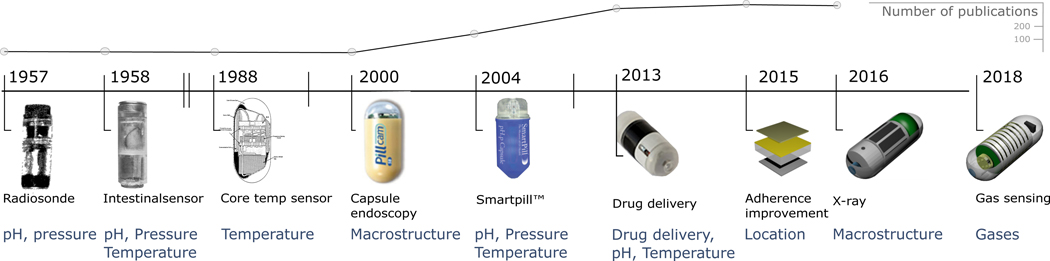
The gastrointestinal (GI) tract offers the opportunity to detect physiological and pathophysiological signals from the human body. Ingestible electronics can gain close proximity to major organs through the GI tract and therefore, can serve as clinical tools for diagnostics and therapy. In this Review, we summarize physiologic and anatomic characteristics of the GI tract, which present both challenges and opportunities for the development of ingestible devices. We describe recent breakthroughs in material science, electrical engineering, and data science that have permitted exploration of technologies for both sensing and therapy via the GI tract. Novel sensing opportunities include electrochemical, electromagnetic, optical, and acoustic protocols, with capacity to sense luminal or extra-luminal analytes in the GI tract. We review novel therapeutic interventions such as anatomic targeting of drug delivery, enhanced drug delivery including the delivery of macromolecules and potentially the delivery of electrical signals as the therapy. Finally, we investigate major challenges associated with ingestible electronics, including safety, communication, powering, steering and tissue interactions. Ingestible electronics are an exciting arena of scientific innovation and they may pave the way for a novel area in medicine, enabling patients to receive remote, electronically-assisted health care.
胃肠道为检测来自人体的生理和病理生理信号提供了机会。可摄入电子器件能够通过胃肠道与主要器官近距离接触,因此可作为诊断和治疗的临床工具。在本综述中,我们总结了胃肠道的生理和解剖特征,这些特征为可摄入设备的开发既带来了挑战,也提供了机遇。我们描述了材料科学、电气工程和数据科学领域的最新突破,这些突破使得通过胃肠道进行传感和治疗技术的探索成为可能。新型传感机会包括电化学、电磁、光学和声学方案,能够检测胃肠道内的腔内或腔外分析物。我们综述了新型治疗干预措施,如药物递送的解剖靶向、包括大分子递送以及可能作为治疗手段的电信号递送在内的增强药物递送。最后,我们研究了与可摄入电子器件相关的主要挑战,包括安全性、通信、供电、操控和组织相互作用。可摄入电子器件是一个令人兴奋的科学创新领域,它们可能为医学的一个新领域铺平道路,使患者能够接受远程电子辅助医疗保健。