Younis Mohamed Ibrahim, Sallam Yahia Ibrahim, Mahmoud Khaled Fahmy, Ruan Zheng, Tlay Rawaa H, Abedelmaksoud Tarek Gamal
Food Science Department Faculty of Agriculture, Cairo University Giza Egypt.
Food Technology Department National Research Center Giza Egypt.
Food Sci Nutr. 2025 Sep 2;13(9):e70880. doi: 10.1002/fsn3.70880. eCollection 2025 Sep.
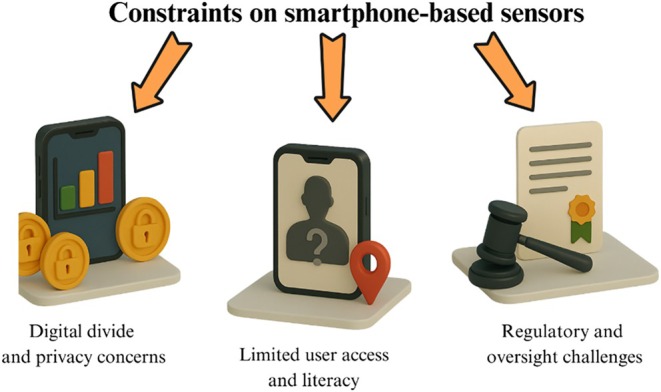
Naturally occurring bioactive compounds such as polyphenols, flavonoids, and vitamins play critical roles in human health and sustainable food systems. Yet their widespread utilization is constrained by complex detection methods and limited accessibility. This review explores how smartphones are emerging as transformative platforms for real-time analysis, enhanced synergy discovery, and personalized nutrition. By integrating spectroscopy, imaging, electrochemical sensing, microfluidics, and AI, smartphones now enable field-grade assays that rival laboratory precision at a fraction of the cost. Their deployment across agriculture, food processing, and consumer health is examined, with a focus on how smartphone-based tools can be used to quantify synergistic interactions between bioactives, optimize nutrient retention, and deliver data-driven dietary guidance. Coupled with machine learning, these devices can identify optimal compound pairings and adapt recommendations to individual physiology and environmental conditions. Limitations related to sensor calibration, data standards, and regulatory readiness are also highlighted. Finally, a roadmap for advancing smartphone-enabled nutrition science through standardization, accessibility, and responsible innovation is presented. As smartphones evolve from passive sensors into intelligent, connected analyzers, they hold unprecedented potential to reshape food quality monitoring, democratize nutrition, and accelerate the global transition toward more resilient and health-focused food systems.
天然存在的生物活性化合物,如多酚、黄酮类化合物和维生素,在人类健康和可持续食品系统中发挥着关键作用。然而,它们的广泛应用受到复杂检测方法和有限可及性的限制。本综述探讨了智能手机如何成为实时分析、增强协同作用发现和个性化营养的变革性平台。通过整合光谱学、成像、电化学传感、微流控技术和人工智能,智能手机现在能够进行现场级别的检测,其精度可与实验室相媲美,而成本却只是实验室的一小部分。本文研究了智能手机在农业、食品加工和消费者健康领域的应用,重点关注基于智能手机的工具如何用于量化生物活性物质之间的协同相互作用、优化营养保留,并提供数据驱动的饮食指导。与机器学习相结合,这些设备可以识别最佳的化合物组合,并根据个体生理状况和环境条件调整建议。还强调了与传感器校准、数据标准和监管准备相关的局限性。最后,提出了一条通过标准化、可及性和负责任的创新来推进智能手机支持的营养科学发展的路线图。随着智能手机从被动传感器演变为智能、联网的分析仪,它们具有重塑食品质量监测、使营养民主化以及加速全球向更具韧性和以健康为重点的食品系统转型的前所未有的潜力。