Sebo Paul, Delaunay Bruno, Tudrej Benoit, Moussa Mohamed Amir, Maisonneuve Hubert
University Institute for Primary Care, University of Geneva, Geneva, CHE.
University College of General Medicine, University Claude Bernard Lyon 1, Lyon, FRA.
Cureus. 2025 Aug 6;17(8):e89457. doi: 10.7759/cureus.89457. eCollection 2025 Aug.
Meat consumption is deeply embedded in many cultures but poses significant health and environmental challenges. This study investigates the association between attachment to meat, as measured by the validated French Meat Attachment Questionnaire (MAQ), and actual meat consumption among primary care patients.
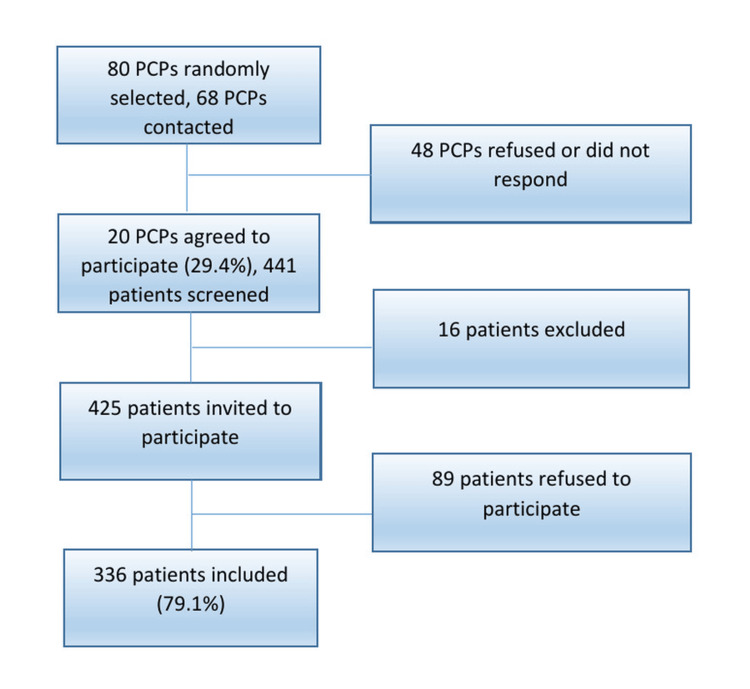
This cross-sectional study was conducted in primary care practices in Geneva, Switzerland, from January to May 2024. A total of 425 patients were invited to participate. Participants were non-urgent, French-speaking, consecutive adult patients who were able to understand the study and provide written informed consent, and data were collected using self-administered questionnaires during routine consultations. The French version of the 16-item MAQ (MAQ-16) was used to assess attachment to meat, and meat consumption patterns for poultry, beef, veal, and pork were measured. ANOVA and multivariable linear regressions were conducted to examine associations between meat attachment and consumption.
Of the 425 invited patients, 336 accepted the invitation, resulting in a participation rate of 79%. The sample comprised 61% women, with a median age of 53 years. Participants had a mean MAQ score of 3.3 (SD: 0.7), with male individuals reporting significantly higher scores than female individuals (3.5 vs. 3.2, adjusted difference: 0.4 (95% CI: 0.2-0.6), adjusted p-value<0.001). Poultry was the most frequently consumed meat, with 39% of participants consuming it more than once a week. Men reported higher meat consumption across all types examined. Higher MAQ scores were significantly associated with greater meat consumption; for example, those consuming poultry more than once per week had a mean score of 3.5 compared to 2.7 for non-consumers (adjusted difference: 0.8 (95% CI: 0.6-0.9), adjusted p-value<0.001).
This study demonstrates that a strong emotional attachment to meat is significantly associated with higher levels of meat consumption. Understanding these psychological factors can inform public health strategies aimed at promoting dietary changes, addressing both health outcomes and environmental sustainability.
肉类消费在许多文化中根深蒂固,但对健康和环境构成重大挑战。本研究调查了通过经过验证的法国肉类依恋问卷(MAQ)衡量的对肉类的依恋与初级保健患者实际肉类消费之间的关联。
这项横断面研究于2024年1月至5月在瑞士日内瓦的初级保健机构中进行。共邀请了425名患者参与。参与者为非急诊、讲法语的连续成年患者,他们能够理解研究内容并提供书面知情同意书,在常规会诊期间使用自填式问卷收集数据。使用16项MAQ的法语版本(MAQ - 16)来评估对肉类的依恋,并测量家禽、牛肉、小牛肉和猪肉的消费模式。进行方差分析和多变量线性回归以检查肉类依恋与消费之间的关联。
在425名受邀患者中,336人接受了邀请,参与率为79%。样本中女性占61%,中位年龄为53岁。参与者的MAQ平均得分为3.3(标准差:0.7),男性的得分显著高于女性(3.5对3.2,调整后差异:0.4(95%置信区间:0.2 - 0.6),调整后p值<0.001)。家禽是最常食用的肉类,39%的参与者每周食用超过一次。在所有检查的肉类类型中,男性的肉类消费量更高。MAQ得分越高与肉类消费量越大显著相关;例如,每周食用家禽超过一次的人平均得分为3.5,而非消费者为2.7(调整后差异:0.8(95%置信区间:0.6 - 0.9),调整后p值<0.001)。
本研究表明,对肉类的强烈情感依恋与更高水平的肉类消费显著相关。了解这些心理因素可为旨在促进饮食变化、解决健康结果和环境可持续性问题的公共卫生策略提供信息。