Zhang Manzhan, Wan Yuxin, Wang Jing, Li Shiliang, Li Honglin
Shanghai Key Laboratory of New Drug Design, State Key Laboratory of Bioreactor Engineering, School of Pharmacy, East China University of Science & Technology, Shanghai, 200237, China.
Innovation Center for AI and Drug Discovery, School of Pharmacy, East China Normal University, Shanghai, 200062, China.
J Pharm Anal. 2025 Aug;15(8):101437. doi: 10.1016/j.jpha.2025.101437. Epub 2025 Aug 18.
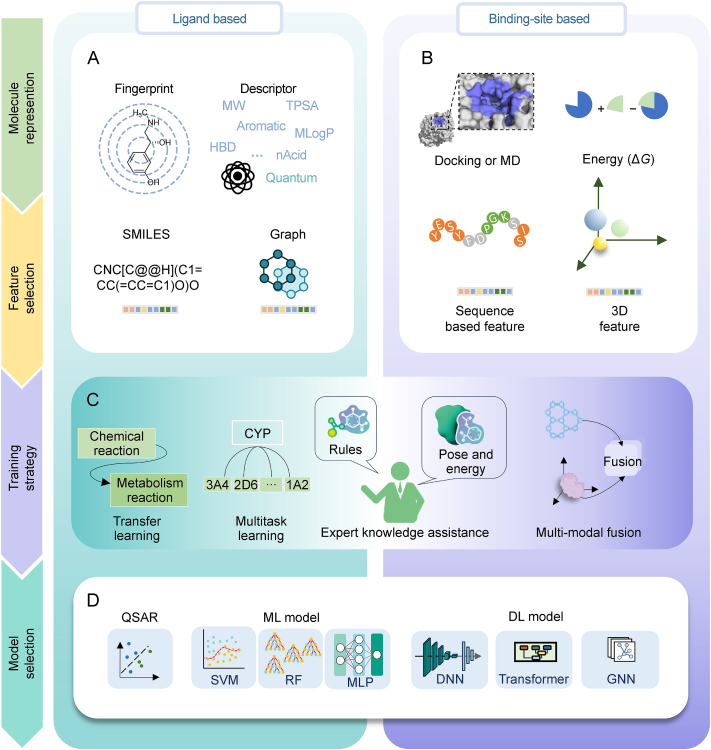
Understanding the metabolism of endogenous and exogenous substances in the human body is essential for elucidating disease mechanisms and evaluating the safety and efficacy of drug candidates during the drug development process. Recent advancements in artificial intelligence (AI), particularly in machine learning (ML) and deep learning (DL) techniques, have introduced innovative approaches to metabolism research, enabling more accurate predictions and insights. This paper emphasizes computational and AI-driven methodologies, highlighting how ML enhances predictive modeling for human metabolism at the molecular level and facilitates integration into genome-scale metabolic models (GEMs) at the omics level. Challenges still remain, including data heterogeneity and model interpretability. This work aims to provide valuable insights and references for researchers in drug discovery and development, ultimately contributing to the advancement of precision medicine.
了解人体内内源性和外源性物质的代谢对于阐明疾病机制以及在药物开发过程中评估候选药物的安全性和有效性至关重要。人工智能(AI)的最新进展,特别是机器学习(ML)和深度学习(DL)技术,为代谢研究引入了创新方法,能够实现更准确的预测和深入理解。本文重点介绍计算和人工智能驱动的方法,强调机器学习如何在分子水平上增强对人类代谢的预测建模,并在组学水平上促进其整合到基因组规模代谢模型(GEMs)中。挑战依然存在,包括数据异质性和模型可解释性。这项工作旨在为药物发现和开发领域的研究人员提供有价值的见解和参考,最终推动精准医学的发展。