Velo Marilia Mattar de Amoêdo Campos, Forcin Letícia Vendrametto, Marun Beatriz Medola, Nascimento Tatiana Rita De Lima, Rodrigues Mariana Souza, Alhotan Abdulaziz, Alhijji Saleh, Brondino Nair Cristina, Bombonatti Juliana Fraga Soares
Department of Restorative Dentistry, Araraquara School of Dentistry, Sao Paulo State University (FOAr-UNESP), Humaitá, 1680, Araraquara 14801-903, SP, Brazil.
Department of Restorative Dentistry, Bauru School of Dentistry, University of São Paulo (FOB/USP), Alameda Dr. Octávio Pinheiro Brisolla, 9-75, Bauru 17012-901, SP, Brazil.
Polymers (Basel). 2025 Sep 3;17(17):2400. doi: 10.3390/polym17172400.
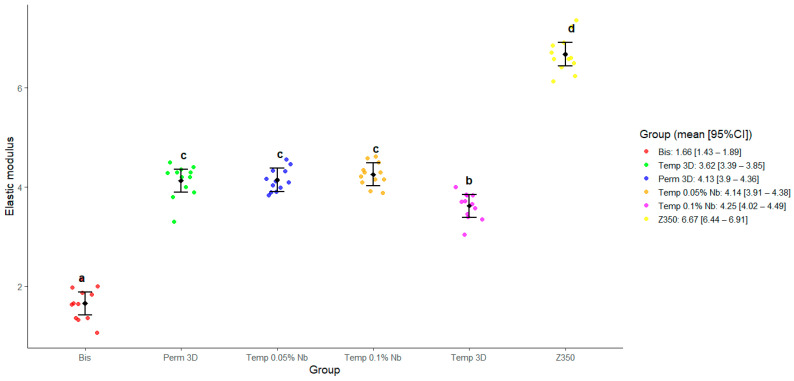
: Three-dimensional (3D) printing has emerged as a valuable tool in dentistry for producing provisional restorations with high precision and reduced costs. However, the limited mechanical strength of temporary 3D-printed resins remains a clinical concern. This in vitro study aimed to enhance the mechanical properties of a 3D-printed temporary resin by incorporating functionalized niobium (Nb) nanoparticles and to compare its performance with a conventional resin composite and a permanent 3D-printed resin. : Six groups were evaluated: bisacrylic resin (Protemp), resin composite (Z350), temporary 3D resin (Temp 3D), permanent 3D resin (Perm 3D), Temp 3D + 0.05% Nb, and Temp 3D + 0.1% Nb. Niobium oxyhydroxide nanoparticles were synthesized using a hydrothermal method, silanized, and incorporated into the Temp 3D at 0.05% and 0.1% by weight. The tested variables included flexural strength (FS), elastic modulus (EM), surface hardness (SH), and color stability (ΔE). : The Z350 resin showed the best mechanical results. The addition of 0.1% Nb nanoparticles significantly improved the FS, EM, and SH of the Temp 3D, reaching values comparable to the Perm 3D ( > 0.05). Color stability remained unaffected across all groups. : These findings suggest that Nb reinforcement at a low concentration is a promising strategy for improving the performance of 3D-printed temporary restorations.
三维(3D)打印已成为牙科领域一种有价值的工具,可用于生产高精度且成本降低的临时修复体。然而,临时3D打印树脂有限的机械强度仍是一个临床关注点。本体外研究旨在通过加入功能化铌(Nb)纳米颗粒来提高3D打印临时树脂的机械性能,并将其性能与传统树脂复合材料和永久性3D打印树脂进行比较。
双丙烯酸树脂(Protemp)、树脂复合材料(Z350)、临时3D树脂(Temp 3D)、永久性3D树脂(Perm 3D)、Temp 3D + 0.05% Nb和Temp 3D + 0.1% Nb。采用水热法合成氢氧化铌纳米颗粒,进行硅烷化处理,并按重量的0.05%和0.1%加入到Temp 3D中。测试变量包括弯曲强度(FS)、弹性模量(EM)、表面硬度(SH)和颜色稳定性(ΔE)。
Z350树脂显示出最佳的机械性能结果。加入0.1% Nb纳米颗粒显著提高了Temp 3D的FS、EM和SH,达到了与Perm 3D相当的值(> 0.05)。所有组的颜色稳定性均未受影响。
这些发现表明,低浓度的Nb增强是改善3D打印临时修复体性能的一种有前景的策略。