
人工智能辅助纵向分析揭示了全牙列下颌骨中一种新型罕见的晕厥智齿现象。
Artificial Intelligence-Assisted Longitudinal Analysis Reveals a Novel Rare Fainting Wisdom Tooth Phenomenon in Fully Dentate Mandibles.
作者信息
Gracea Rellyca Sola, Chopra Shivi, Östgren Peter, Benchimol Daniel, Jacobs Reinhilde
机构信息
OMFS-IMPATH Research Group, Department of Imaging and Pathology, Faculty of Medicine, KU Leuven, Leuven, Belgium.
Department of Oral and Maxillofacial Surgery, University Hospitals Leuven, Leuven, Belgium.
出版信息
Int J Dent. 2025 Oct 12;2025:1932229. doi: 10.1155/ijod/1932229. eCollection 2025.
OBJECTIVES
This study aims to characterise the rare 'fainting wisdom tooth' phenomenon, defined as the angular transition of a mandibular wisdom tooth from an initially upright position to mesial or horizontal inclination during adolescence in fully dentate mandibles.
MATERIALS AND METHODS
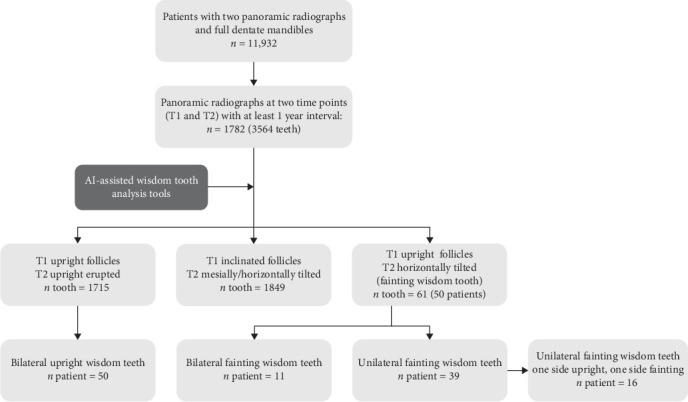
A retrospective longitudinal analysis was conducted using panoramic radiographs from a pooled database of 11,932 patients. Fifty cases of fainting wisdom teeth (0.4% prevalence) were identified using a validated deep learning (DL) convolutional neural network (CNN)-based artificial intelligence (AI) tool and compared to 50 matched controls with vertically erupted wisdom teeth. Radiographic variables were measured at two time points: T1 (ages 8-15) and T2 (ages 16-23). Angular changes and anatomical features, including space/crown width ratio, tooth depth, proximity to the second molar and mandibular canal, cemento-enamel junction (CEJ)/apical width ratio and gonial angle, were assessed. Logistic regression was used to determine predictive factors associated with the fainting phenomenon, with results reported as odds ratios (ORs).
RESULTS
Fainting wisdom teeth showed a significant angular shift from a median of 29° at T1 to 83° at T2, while controls showed minimal change. Logistic regression identified tooth depth as the strongest predictor (OR = 0.1, < 0.001), with additional risk factors including reduced space/crown width ratio, increased proximity to the second molar, higher CEJ/apical width ratio and increasing gonial angle.
CONCLUSION
This is the first study to describe and analyse the rare fainting wisdom tooth phenomenon using AI-assisted longitudinal analysis of panoramic radiographs. The findings suggest that early tooth positioning and surrounding anatomical constraints may interfere with vertical eruption and increase the risk of fainting.
目的
本研究旨在描述罕见的“晕厥智齿”现象,该现象定义为在青春期全牙列下颌骨中,下颌智齿从最初的直立位置向近中或水平倾斜的角度转变。
材料与方法
使用来自11932例患者汇总数据库的全景X线片进行回顾性纵向分析。使用经过验证的基于深度学习(DL)卷积神经网络(CNN)的人工智能(AI)工具识别出50例晕厥智齿病例(患病率为0.4%),并与50例匹配的垂直萌出智齿的对照进行比较。在两个时间点测量影像学变量:T1(8 - 15岁)和T2(16 - 23岁)。评估角度变化和解剖特征,包括间隙/牙冠宽度比、牙深度、与第二磨牙和下颌管的接近程度、牙骨质 - 釉质界(CEJ)/根尖宽度比和下颌角。采用逻辑回归确定与晕厥现象相关的预测因素,结果以比值比(OR)表示。
结果
晕厥智齿显示出显著的角度变化,从中位值T1时的29°转变为T2时的83°,而对照组变化极小。逻辑回归确定牙深度是最强的预测因素(OR = 0.1,< 0.001),其他危险因素包括间隙/牙冠宽度比减小、与第二磨牙的接近程度增加、CEJ/根尖宽度比升高以及下颌角增大。
结论
这是第一项使用AI辅助的全景X线片纵向分析来描述和分析罕见的晕厥智齿现象的研究。研究结果表明,早期牙齿定位和周围解剖结构限制可能会干扰垂直萌出并增加晕厥风险。



 Zotero 插件