Marcus P I, Carver D H
J Virol. 1967 Apr;1(2):334-43. doi: 10.1128/JVI.1.2.334-343.1967.
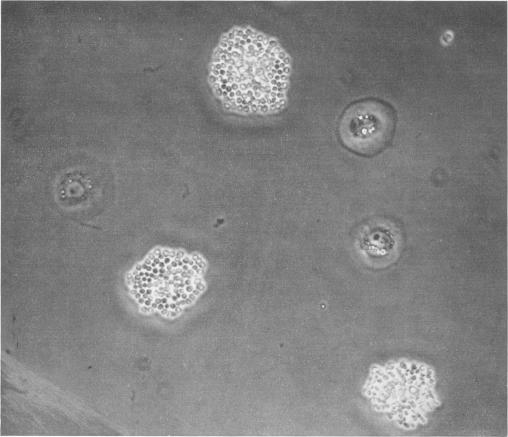
The hemadsorption-negative plaque test has revealed a new type of viral interference, termed intrinsic interference. Several unrelated types of noncytopathic viruses were shown to induce in infected host cells a state of interference unique in being directed solely against superinfection by Newcastle disease virus (NDV). The NDV-refractory state arises only in those individual cells of a population actually infected by the inducing virus, and presumably results from the action of a protein(s) coded for by the viral genome. Thus, intrinsic interference differs fundamentally from that mediated by an extrinsic protein detectable under conditions favoring resistance to a broad spectrum of viruses and characteristic of interference induced by interferon, the latter being coded for by the cell genome. Intrinsic interference is defined as a viral genome-induced cellular state of resistance to challenge by high multiplicities of NDV, coexistent with a state of susceptibility to a broad spectrum of other viruses, similarly tested at high multiplicities. The capacity to induce intrinsic interference was demonstrated with rubella virus, Sindbis virus (arbovirus, group A), West Nile virus (arbovirus, group B), poliovirus (MEF, type 2), the lactic dehydrogenase virus (Riley's agent), and an unidentified nonhemadsorbing, noncytopathic adventitious virus. A state of intrinsic interference was also observed in the V5 line of mouse cells carrying a murine leukemia virus, probably resulting from some heretofore unsuspected contaminating virus. The molecular basis for intrinsic interference is not known, but it appears to involve a step in the NDV growth cycle beyond that of viral attachment, entry, and eclipse.
血细胞吸附阴性蚀斑试验揭示了一种新型的病毒干扰,称为内在干扰。几种不相关类型的非细胞病变病毒被证明能在受感染的宿主细胞中诱导出一种独特的干扰状态,这种状态仅针对新城疫病毒(NDV)的超感染。NDV难治状态仅在实际被诱导病毒感染的群体中的那些单个细胞中出现,推测是由病毒基因组编码的一种蛋白质的作用所致。因此,内在干扰与在有利于抵抗广谱病毒的条件下可检测到的由外在蛋白质介导的干扰以及干扰素诱导的干扰(后者由细胞基因组编码)有根本区别。内在干扰被定义为一种由病毒基因组诱导的细胞状态,对高感染复数的NDV具有抗性,同时对同样以高感染复数测试的广谱其他病毒仍保持敏感状态。风疹病毒、辛德毕斯病毒(A组虫媒病毒)、西尼罗河病毒(B组虫媒病毒)、脊髓灰质炎病毒(MEF,2型)、乳酸脱氢酶病毒(莱利氏因子)以及一种未鉴定的非血细胞吸附、非细胞病变的偶然病毒都证明了诱导内在干扰的能力。在携带鼠白血病病毒的小鼠细胞V5系中也观察到了内在干扰状态,这可能是由某种迄今未被怀疑的污染病毒引起的。内在干扰的分子基础尚不清楚,但它似乎涉及NDV生长周期中病毒附着、进入和隐蔽期之后的一个步骤。