Honess R W, Roizman B
J Virol. 1973 Dec;12(6):1347-65. doi: 10.1128/JVI.12.6.1347-1365.1973.
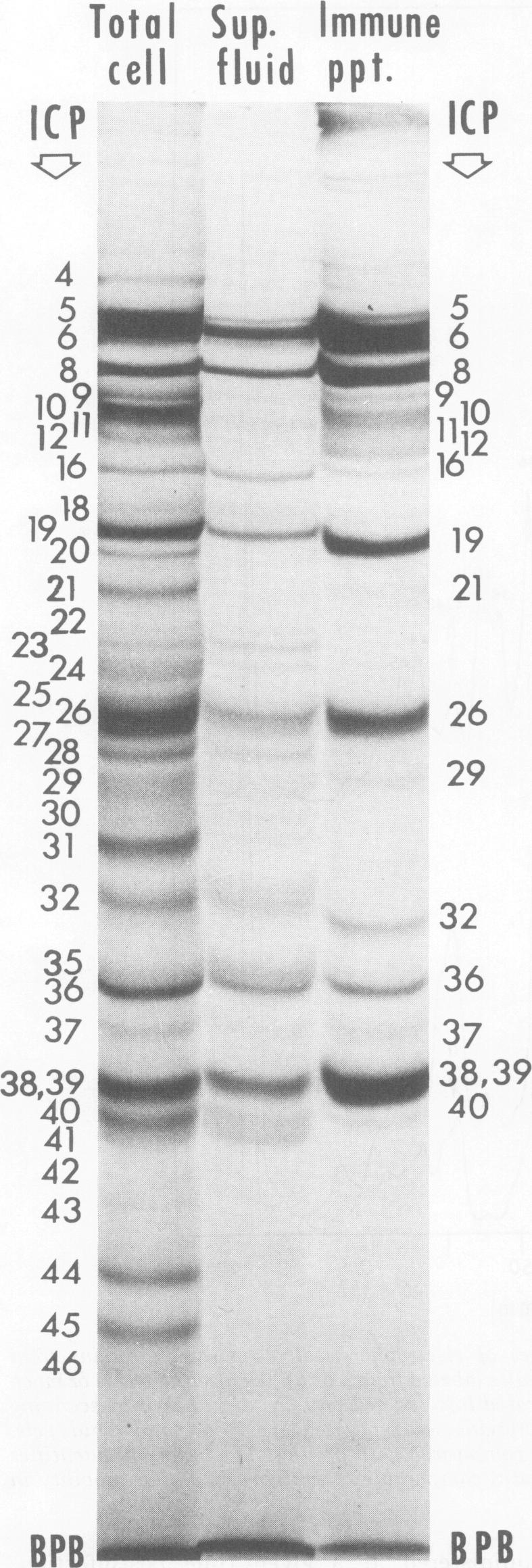
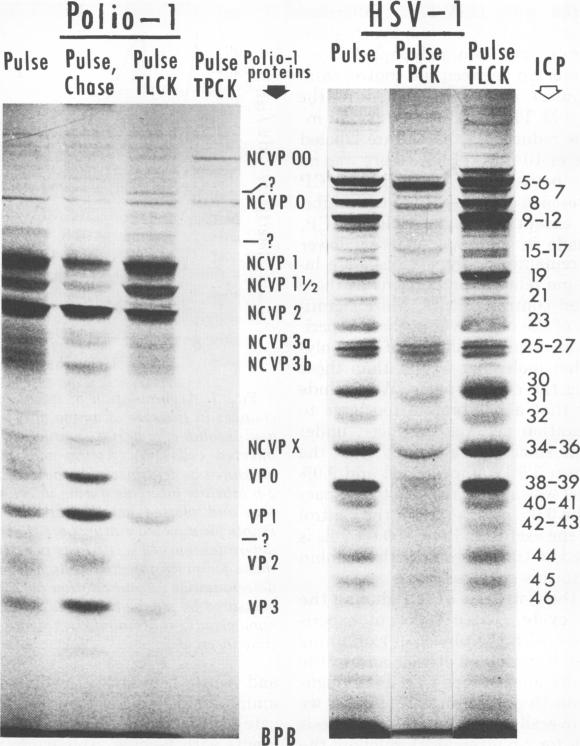
Analyses of polypeptides made in HEp-2 cells infected with herpes simplex virus type 1 by high-resolution polyacrylamide gel electrophoresis revealed the synthesis of at least 49 infected cell polypeptides (ICP) ranging in molecular weight from 15,000 to 280,000. Evidence for virus specificity based on increased rates of synthesis postinfection, immunological specificity, and viral control of mobility and rate of synthesis was available for 47 of the ICP. These 47 polypeptides can account for 75% of the virus genetic information assuming a DNA molecular weight of 10(8) and asymmetric transcription. On the basis of their mobility relative to virion proteins, the ICP were classified as structural (S, 23 polypeptides), nonstructural (NS, 16 polypeptides), and unassigned (U, 10 polypeptides). Analysis of the synthesis of the ICP revealed the following. (i) Rapid posttranslational cleavages of HSV proteins were not detected; in parallel experiments rapid posttranslational cleavages were readily demonstrated in poliovirus-infected cells and these were blocked by protease inhibitors. (ii) Slow posttranslational changes in the mobility of at least two polypeptides were observed. (iii) Analysis of the rates of synthesis of ICP examined at four intervals postinfection revealed regulation of the pattern and amount of ICP synthesized. ICP formed six classes (A to F) differing in their kinetics of synthesis. S and NS ICP were distributed nonrandomly among these classes. Thus, of the sum of S protein amino acid sequences apportioned among these kinetic classes, 47%, constituting class A and comprising "late" structural proteins, were characterized by progressively increasing rates of synthesis until at least 12 h postinfection; whereas "early" structural proteins constituting class C, amounting to 31% of the total amino acid sequences, were synthesized with initially increasing rates until 4 h postinfection and with declining rates thereafter. NS polypeptides and remaining S polypeptides were distributed among the other kinetic classes-B, D, E, and F. Control of protein abundance was evident in that the polypeptides were not made in equimolar amounts. However, S and NS polypeptides could not be differentiated on the basis of their molar rates of synthesis. The bulk of the detected polypeptides did not differ by more than eightfold in their molar rates of synthesis.
通过高分辨率聚丙烯酰胺凝胶电泳对感染1型单纯疱疹病毒的HEp - 2细胞中产生的多肽进行分析,结果显示至少合成了49种受感染细胞多肽(ICP),其分子量范围为15,000至280,000。基于感染后合成速率增加、免疫特异性以及病毒对迁移率和合成速率的控制等证据,47种ICP具有病毒特异性。假设DNA分子量为10⁸且转录不对称,这47种多肽可占病毒遗传信息的75%。根据它们相对于病毒体蛋白的迁移率,ICP被分类为结构蛋白(S,23种多肽)、非结构蛋白(NS,16种多肽)和未分类蛋白(U,10种多肽)。对ICP合成的分析揭示了以下几点。(i)未检测到单纯疱疹病毒蛋白的快速翻译后切割;在平行实验中,脊髓灰质炎病毒感染的细胞中很容易观察到快速翻译后切割,并且这些切割被蛋白酶抑制剂阻断。(ii)观察到至少两种多肽的迁移率存在缓慢的翻译后变化。(iii)对感染后四个时间间隔检测的ICP合成速率进行分析,结果显示ICP合成的模式和数量受到调控。ICP形成了六类(A至F),它们的合成动力学不同。S和NS ICP在这些类别中的分布是非随机的。因此,在分配到这些动力学类别的S蛋白氨基酸序列总和中,47%构成A类,包含“晚期”结构蛋白,其特征是合成速率逐渐增加,直至感染后至少12小时;而构成C类的“早期”结构蛋白,占总氨基酸序列的31%,在感染后4小时内合成速率最初增加,此后逐渐下降。NS多肽和其余的S多肽分布在其他动力学类别——B、D、E和F中。蛋白质丰度的控制很明显,因为多肽并非以等摩尔量合成。然而,S和NS多肽不能根据它们的摩尔合成速率来区分。检测到的大多数多肽的摩尔合成速率差异不超过八倍。