van Ginkel C J, Thörig L, Thompson J, Oh J I, van Aken W G
Infect Immun. 1979 Jul;25(1):388-95. doi: 10.1128/iai.25.1.388-395.1979.
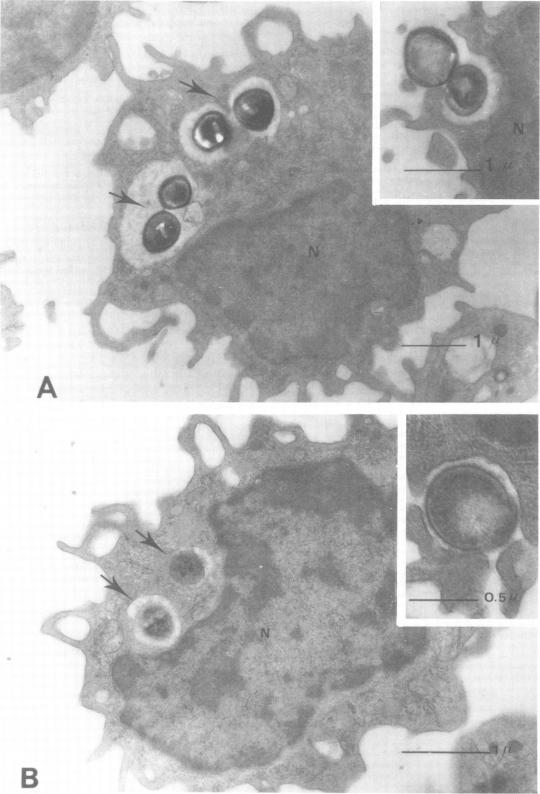
The deposition of fibrin on infected vegetations and the presence of mononuclear phagocytes that have phagocytized bacteria are remarkabe features in experimental bacterial endocarditis. In a study in vitro, we show that phagocytosis of bacteria by human monocytes enhances thromboplastin generation by these cells. Maximal enhancement of the generation of thromboplastin by monocytes was about six times compared with that in the control experiment without bacteria, and it was obtained by preincubation of the monocytes with 5 to 10 bacteria per monocyte. No quantitative difference was observed between Staphylococcus epidermidis and Streptococcus sanguis as to the enhancement of the monocyte thromboplastin generation. An enhancement of the procoagulant activity generation was also observed after addition of bacteria to human or rabbit whole blood. Probably, this generation was also due to synthesis of thromboplastin by monocytes. It is conceivable that fibrin deposition on infected vegetations during bacterial endocarditis is mediated by thromboplastin synthesis by monocytes.
纤维蛋白在感染性赘生物上的沉积以及已吞噬细菌的单核吞噬细胞的存在是实验性细菌性心内膜炎的显著特征。在一项体外研究中,我们发现人单核细胞对细菌的吞噬作用增强了这些细胞的凝血活酶生成。与无细菌的对照实验相比,单核细胞凝血活酶生成的最大增强约为6倍,这是通过单核细胞与每单核细胞5至10个细菌预孵育获得的。就单核细胞凝血活酶生成的增强而言,表皮葡萄球菌和血链球菌之间未观察到定量差异。向人或兔全血中添加细菌后也观察到促凝活性生成增强。可能,这种生成也是由于单核细胞合成凝血活酶所致。可以想象,细菌性心内膜炎期间感染性赘生物上的纤维蛋白沉积是由单核细胞合成凝血活酶介导的。