Norlander L, Davies J K, Hagblom P, Normark S
J Bacteriol. 1981 Feb;145(2):788-95. doi: 10.1128/jb.145.2.788-795.1981.
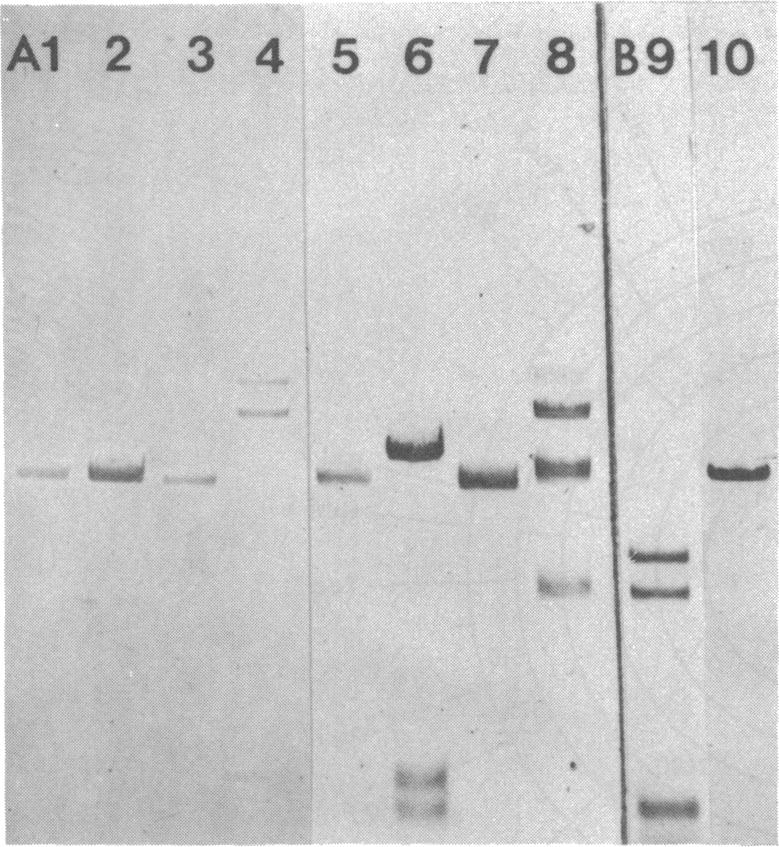
Modification of gonococcal deoxyribonucleic acid (DNA) was investigated, and the relationship with endonuclease production was explored. Both chromosomal and plasmid DNA from different gonococcal strains, irrespective of their plasmid content, was poorly cleaved by the restriction endonucleases HaeII, HaeIII, SacII, and BamHI. The fragment pattern of the Tn3 segment present on the 7.2-kilobase gonococcal resistance plasmid, when compared to its known DNA sequence, allowed us to conclude that the HaeIII and BamHI resistance was due to modification of these sites. A comparison of the fragment pattern of the resistance plasmid, when isolated from Escherichia coli or Neisseria gonorrhoeae, revealed that the resistance of HaeII must also be due to modification of its recognition sequence. Isoschizomers of HaeII and HaeIII can be found in isolates of N. gonorrhoeae (NgoI and NgoII, respectively). A new restriction endonuclease in gonococci, NgoIII, with a specificity similar to SacII, is reported here. High-pressure liquid chromatography of gonococcal DNA showed the presence of 5-methylcytosine. It is suggested that the methylation of cytosine residues in the HaeII (NgoI), HaeIII (NgoII), and SacII (NgoIII) recognition sites is the basis for the resistance of gonococcal DNA to cleavage by these enzymes. This methylation may be part of a host restriction modification system. In two out of five gonococcal strains the sequence -GATC- was modified. One strain unable to modify this sequence was a spontaneous mutant of a strain carrying such a modifying function.
研究了淋球菌脱氧核糖核酸(DNA)的修饰情况,并探讨了其与内切酶产生的关系。来自不同淋球菌菌株的染色体DNA和质粒DNA,无论其质粒含量如何,均难以被限制性内切酶HaeII、HaeIII、SacII和BamHI切割。将存在于7.2千碱基淋球菌耐药质粒上的Tn3片段的片段模式与其已知DNA序列进行比较后,我们得出结论,HaeIII和BamHI耐药性是由于这些位点的修饰。从大肠杆菌或淋病奈瑟菌中分离出的耐药质粒的片段模式比较显示,HaeII的耐药性也必定是由于其识别序列的修饰。在淋病奈瑟菌分离株中可发现HaeII和HaeIII的同裂酶(分别为NgoI和NgoII)。本文报道了淋球菌中一种新的限制性内切酶NgoIII,其特异性与SacII相似。淋球菌DNA的高压液相色谱显示存在5-甲基胞嘧啶。有人提出,HaeII(NgoI)、HaeIII(NgoII)和SacII(NgoIII)识别位点中的胞嘧啶残基甲基化是淋球菌DNA对这些酶切割产生抗性的基础。这种甲基化可能是宿主限制修饰系统的一部分。在五株淋球菌菌株中有两株的序列-GATC-被修饰。一株无法修饰该序列的菌株是携带这种修饰功能的菌株的自发突变体。