Giri C P, Hodgson C P, Elder P K, Courtney M G, Getz M J
Nucleic Acids Res. 1983 Jan 25;11(2):305-19. doi: 10.1093/nar/11.2.305.
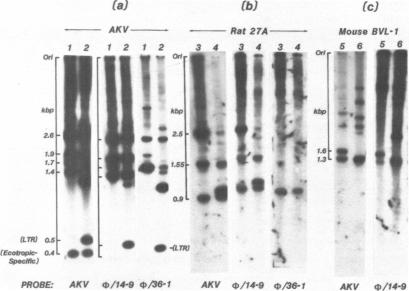
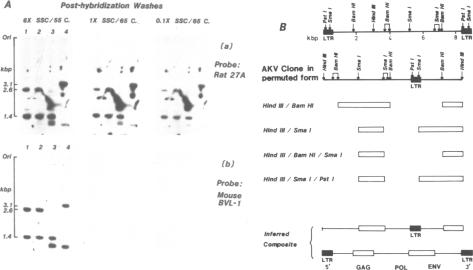
Southern blot analyses using reduced stringency hybridization conditions have been employed to search for sequence homologies between rodent VL30 genes and murine leukemia virus (MuLV) proviruses. These constitute two classes of transposon-like elements previously believed to be genetically unrelated. Our results demonstrate that cloned representatives of both ecotropic and xenotropic-like proviruses share discrete regions of sequence homology with VL30 genes of both rat and mouse origin. These regions of homology exist in both 3' and 5' halves of the MuLV genome but do not include extensive portions of the long terminal repeat (LTR) or a 0.4 Kbp segment of the env gene specific for recently acquired ecotropic-type MuLV proviruses. DNA sequencing, however, revealed that the short inverted terminal repeat sequence of MuLV proviral LTRs is almost perfectly conserved at the terminus of an integrated mouse VL30 gene. These results suggest that recombination events with rodent VL30-type sequences occurred during early MuLV evolution. The strong conservation of the inverted terminal repeat sequence may reflect a common integration mechanism for VL30 elements and MuLV proviruses.
利用降低严谨性的杂交条件进行Southern印迹分析,以寻找啮齿动物VL30基因与鼠白血病病毒(MuLV)前病毒之间的序列同源性。这两类转座子样元件以前被认为在遗传上没有关系。我们的结果表明,亲嗜性和异嗜性样前病毒的克隆代表与大鼠和小鼠来源的VL30基因都有离散的序列同源区域。这些同源区域存在于MuLV基因组的3'和5'两半,但不包括长末端重复序列(LTR)的广泛部分或最近获得的亲嗜性MuLV前病毒特有的env基因的0.4 Kbp片段。然而,DNA测序显示,MuLV前病毒LTRs的短反向末端重复序列在整合的小鼠VL30基因末端几乎完全保守。这些结果表明,在MuLV早期进化过程中发生了与啮齿动物VL30型序列的重组事件。反向末端重复序列的高度保守可能反映了VL30元件和MuLV前病毒的共同整合机制。