Lueders K K, Kuff E L
Nucleic Acids Res. 1983 Jul 11;11(13):4391-408. doi: 10.1093/nar/11.13.4391.
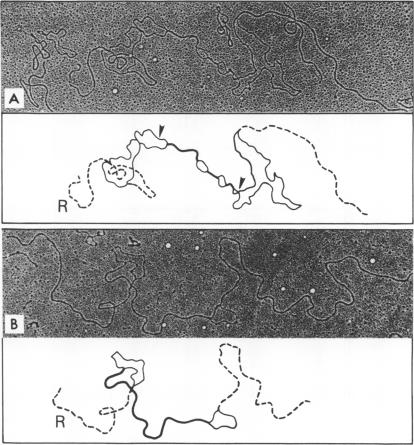
Sequences related to mouse intracisternal A-particle (IAP) genes have been isolated from rat and Syrian hamster gene libraries as recombinants in lambda phage. The sequences are moderately reiterated in both these genomes but their sequence organization in the hamster genome is different from that in the rat genome. Restriction analysis and electron microscopy indicate that the Syrian hamster IAP sequences represent a family of relatively homogeneous well-conserved units; in this, they resemble the mouse IAP genes. The rat sequences, in contrast, are heterogeneous. Both the hamster and rat IAP sequences contain regions homologous to mouse IAP genes interspersed with regions of apparent non-homology. The interspersed regions range in size from 0.5-1.0 kilobases (Kb). The regions of homology among the mouse, rat and Syrian hamster IAP sequences have been mapped to a 5-6 Kb internal region on the mouse IAP genes. Mouse IAP long terminal repeat (LTR) sequences were not detected in the rat and Syrian hamster genomes. We used the thermal stability of hybrids between cloned and genomic IAP sequences to measure family homogeneity. Mouse and Syrian hamster IAP sequences are homogeneous by this criterion, but the rat IAP sequences are heterogeneous with a Tm 6 degrees C below the self-hybrid. The contrasting organization of IAP-related elements in the genomes of these rodents indicates that amplification or homogenization of this sequence family has occurred independently and at different periods of time during their evolution.
与小鼠脑内A颗粒(IAP)基因相关的序列已从大鼠和叙利亚仓鼠基因文库中分离出来,作为λ噬菌体中的重组体。这些序列在这两个基因组中都有中度重复,但它们在仓鼠基因组中的序列组织与大鼠基因组不同。限制性分析和电子显微镜表明,叙利亚仓鼠IAP序列代表了一个相对同源且保守性良好的单元家族;在这方面,它们类似于小鼠IAP基因。相比之下,大鼠序列是异质的。仓鼠和大鼠的IAP序列都包含与小鼠IAP基因同源的区域,其间穿插着明显非同源的区域。穿插区域的大小在0.5 - 1.0千碱基(Kb)之间。小鼠、大鼠和叙利亚仓鼠IAP序列之间的同源区域已定位到小鼠IAP基因上一个5 - 6 Kb的内部区域。在大鼠和叙利亚仓鼠基因组中未检测到小鼠IAP长末端重复(LTR)序列。我们利用克隆的IAP序列与基因组IAP序列之间杂交体的热稳定性来测量家族同源性。根据这一标准,小鼠和叙利亚仓鼠IAP序列是同源的,但大鼠IAP序列是异质的,其熔解温度(Tm)比自身杂交低6摄氏度。这些啮齿动物基因组中IAP相关元件的不同组织形式表明,这个序列家族的扩增或均一化在它们进化过程中的不同时期独立发生。