Fujiwara T, Hunter S W, Cho S N, Aspinall G O, Brennan P J
Infect Immun. 1984 Jan;43(1):245-52. doi: 10.1128/iai.43.1.245-252.1984.
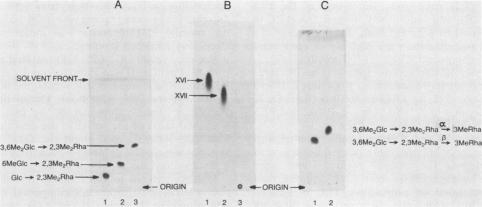
We examined the structural requirements within the species-specific 3,6-di-O-methyl-beta-D-glucopyranosyl-(1 leads to 4)-2,3-di-O-methyl- alpha-L-rhamnopyranosyl-(1 leads to 2)-3-O-methyl-alpha-L-rhamnopyranose unit of the phenolic glycolipid I antigen of Mycobacterium leprae for binding to anti-glycolipid immunoglobulin M from human leprosy sera. We used chemically defined, partially deglycosylated fragments of phenolic glycolipid I, two other minor M. leprae-specific phenolic glycolipids (those containing 6-O-methyl-beta-D-glucopyranosyl-(1 leads to 4)-2,3-di-O-methyl-alpha- L-rhamnopyranosyl-(1 leads to 2)-3-O-methyl-alpha-L-rhamnopyranose and 3,6-di-O-methyl-beta-D-glucopyranosyl-(1 leads to 4)-3-O-methyl-alpha- L-rhamnopyranosyl-(1 leads to 2)-3-O-methyl-alpha-rhamnopyranose units), and phenolic glycolipids from other mycobacteria. Additionally, the trisaccharide of phenolic glycolipid I, the 3,6-di-O-methyl-beta-D-glucopyranosyl-(1 leads to 4)-2, 3-di-O-methyl-alpha-L-rhamnopyranose, the 6-O-methyl-beta-D-glucopyranosyl-(1 leads to 4)-2,3-di-O-methyl-alpha- L-rhamnopyranose, and the beta-D-glucopyranosyl-(1 leads to 4)-2,3-di-O-methyl-alpha- L-rhamnopyranose disaccharides were synthesized and characterized, and their activities were examined. Only the phenolic glycolipids containing 3,6-di-O-methyl-beta-D-glucopyranosyl at the nonreducing terminus were efficient in binding the anti-glycolipid immunoglobulin M, and the 3,6-di-O-methyl-beta-D-glucopyranosyl-containing di- and trisaccharides were the most effective in inhibiting this binding. Thus, the 3,6-di-O-methyl-beta-D-glucopyranosyl substituent was recognized as the primary antigen determinant in phenolic glycolipid I. With this information, bovine serum albumin containing reductively aminated 3,6-di-O-methyl-beta-D-glucopyranosyl-(1 leads to 4)-2,3-di-O-methyl- L-rhamnose was prepared and shown to be highly active in the serodiagnosis of leprosy.
我们研究了麻风分枝杆菌酚糖脂I抗原的种特异性3,6 - 二 - O - 甲基 - β - D - 吡喃葡萄糖基 -(1→4)- 2,3 - 二 - O - 甲基 - α - L - 鼠李吡喃糖基 -(1→2)- 3 - O - 甲基 - α - L - 鼠李吡喃糖单元内与来自麻风病人血清的抗糖脂免疫球蛋白M结合的结构要求。我们使用了化学定义的、部分去糖基化的酚糖脂I片段、另外两种麻风分枝杆菌特异性次要酚糖脂(那些含有6 - O - 甲基 - β - D - 吡喃葡萄糖基 -(1→4)- 2,3 - 二 - O - 甲基 - α - L - 鼠李吡喃糖基 -(1→2)- 3 - O - 甲基 - α - L - 鼠李吡喃糖和3,6 - 二 - O - 甲基 - β - D - 吡喃葡萄糖基 -(1→4)- 3 - O - 甲基 - α - L - 鼠李吡喃糖基 -(1→2)- 3 - O - 甲基 - α - 鼠李吡喃糖单元)以及来自其他分枝杆菌的酚糖脂。此外,还合成并表征了酚糖脂I的三糖、3,6 - 二 - O - 甲基 - β - D - 吡喃葡萄糖基 -(1→4)- 2,3 - 二 - O - 甲基 - α - L - 鼠李吡喃糖、6 - O - 甲基 - β - D - 吡喃葡萄糖基 -(1→4)- 2,3 - 二 - O - 甲基 - α - L - 鼠李吡喃糖以及β - D - 吡喃葡萄糖基 -(1→4)- 2,3 - 二 - O - 甲基 - α - L - 鼠李吡喃糖二糖,并检测了它们的活性。只有在非还原末端含有3,6 - 二 - O - 甲基 - β - D - 吡喃葡萄糖基的酚糖脂能有效地结合抗糖脂免疫球蛋白M,且含有3,6 - 二 - O - 甲基 - β - D - 吡喃葡萄糖基的二糖和三糖在抑制这种结合方面最有效。因此,3,6 - 二 - O - 甲基 - β - D - 吡喃葡萄糖基取代基被认为是酚糖脂I中的主要抗原决定簇。基于此信息,制备了含有还原性胺化的3,6 - 二 - O - 甲基 - β - D - 吡喃葡萄糖基 -(1→4)- 2,3 - 二 - O - 甲基 - L - 鼠李糖的牛血清白蛋白,并证明其在麻风病血清诊断中具有高活性。