Sanui H, Yoshida S, Himeno K, Nomoto K
Immunology. 1983 May;49(1):45-51.
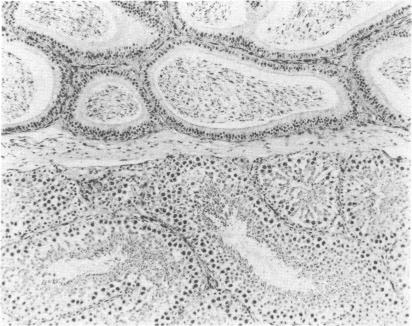
Inoculation of 1 X 10(3) viable Listeria monocytogenes into unilateral testis induced pathological changes in the contralateral testis and epididymis in guinea-pigs. Because L. Monocytogenes was not detected in the contralateral testis, liver or spleen during the period of the experiment, that is, bacterial growth was limited to the inoculated site, the pathological changes in the contralateral testis may be due to autoimmune mechanisms, but not due to bacterial inflammation. The pathological changes in our system were similar to those observed after the injection of testicular antigen in Freund's complete adjuvant. Delayed-in-onset erythematous skin reaction against testicular antigen and antisperm antibody in sera were detected in the guinea-pigs. The animal model in our system is a new one in which experimental autoimmune orchitis is induced by bacterial infection.
将1×10³个活的单核细胞增生李斯特菌接种到豚鼠的单侧睾丸中,可导致对侧睾丸和附睾出现病理变化。由于在实验期间,对侧睾丸、肝脏或脾脏中未检测到单核细胞增生李斯特菌,即细菌生长仅限于接种部位,因此对侧睾丸的病理变化可能是由于自身免疫机制,而非细菌感染引起的炎症。我们系统中的病理变化与在弗氏完全佐剂中注射睾丸抗原后观察到的变化相似。在豚鼠中检测到对睾丸抗原的迟发性红斑皮肤反应以及血清中的抗精子抗体。我们系统中的动物模型是一种新的模型,其中实验性自身免疫性睾丸炎是由细菌感染诱发的。