Saad M J, Folli F, Kahn J A, Kahn C R
Joslin Diabetes Center, Department of Medicine, Boston, Massachusetts 02215.
J Clin Invest. 1993 Oct;92(4):2065-72. doi: 10.1172/JCI116803.
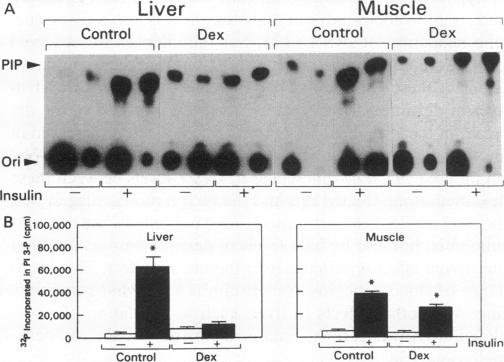
Insulin rapidly stimulates tyrosine kinase activity of its receptor resulting in phosphorylation of its cytosolic substrate, insulin receptor substrate-1 (IRS-1), which in turn associates with phosphatidylinositol 3-kinase (PI 3-kinase), thus activating the enzyme. Glucocorticoid treatment is known to produce insulin resistance, but the exact molecular mechanism is unknown. In the present study we have examined the levels and phosphorylation state of the insulin receptor and IRS-1, as well as the association/activation between IRS-1 and PI 3-kinase in the liver and muscle of rats treated with dexamethasone. After dexamethasone treatment (1 mg/kg per d for 5 d), there was no change in insulin receptor concentration in liver of rats as determined by immunoblotting with antibody to the COOH-terminus of the receptor. However, insulin stimulation of receptor autophosphorylation determined by immunoblotting with antiphosphotyrosine antibody was reduced by 46.7 +/- 9.1%. IRS-1 and PI 3-kinase protein levels increased in liver of dexamethasone-treated animals by 73 and 25%, respectively (P < 0.05). By contrast, IRS-1 phosphorylation was decreased by 31.3 +/- 10.9% (P < 0.05), and insulin stimulated PI 3-kinase activity in anti-IRS-1 immunoprecipitates was decreased by 79.5 +/- 11.2% (P < 0.02). In muscle, the changes were less dramatic, and often in opposite direction of those observed in liver. Thus, there was no significant change in insulin receptor level or phosphorylation after dexamethasone treatment. IRS-1 and PI 3-kinase levels were decreased to 38.6 and 65.6%, respectively (P < 0.01 and P < 0.05). IRS-1 phosphorylation showed no significant change in muscle, but insulin-stimulated IRS-1 associated PI 3-kinase was decreased by 41%. Thus, dexamethasone has differential effects on the proteins involved in the early steps in insulin action in liver and muscle. In both tissues, dexamethasone treatment results in a reduction in insulin-stimulated IRS-1-associated P I3-kinase, which may play a role in the pathogenesis of insulin resistance at the cellular level in these animals.
胰岛素可迅速刺激其受体的酪氨酸激酶活性,导致其胞质底物胰岛素受体底物-1(IRS-1)发生磷酸化,而IRS-1继而与磷脂酰肌醇3-激酶(PI 3-激酶)结合,从而激活该酶。已知糖皮质激素治疗会产生胰岛素抵抗,但其确切的分子机制尚不清楚。在本研究中,我们检测了地塞米松处理的大鼠肝脏和肌肉中胰岛素受体及IRS-1的水平和磷酸化状态,以及IRS-1与PI 3-激酶之间的结合/激活情况。用地塞米松处理(每日1 mg/kg,共5天)后,用针对受体COOH末端的抗体进行免疫印迹分析,结果显示大鼠肝脏中的胰岛素受体浓度没有变化。然而,用抗磷酸酪氨酸抗体进行免疫印迹分析测定,胰岛素刺激的受体自身磷酸化降低了46.7±9.1%。地塞米松处理的动物肝脏中IRS-1和PI 3-激酶蛋白水平分别升高了73%和25%(P<0.05)。相比之下,IRS-1磷酸化降低了31.3±10.9%(P<0.05),抗IRS-1免疫沉淀物中胰岛素刺激的PI 3-激酶活性降低了79.5±11.2%(P<0.02)。在肌肉中,变化没有那么显著,且往往与在肝脏中观察到的变化方向相反。因此,地塞米松处理后胰岛素受体水平或磷酸化没有显著变化。IRS-1和PI 3-激酶水平分别降至38.6%和65.6%(P<0.01和P<0.05)。肌肉中IRS-1磷酸化没有显著变化,但胰岛素刺激的与IRS-1相关的PI 3-激酶降低了41%。因此,地塞米松对肝脏和肌肉中胰岛素作用早期步骤所涉及的蛋白质有不同的影响。在这两种组织中,地塞米松处理均导致胰岛素刺激的与IRS-1相关的PI 3-激酶减少,这可能在这些动物细胞水平胰岛素抵抗的发病机制中起作用。