Augustyns K, Godard G, Hendrix C, Van Aerschot A, Rozenski J, Saison-Behmoaras T, Herdewijn P
Rega Institute for Medical Research, Laboratory of Medicinal Chemistry, Katholieke Universiteit Leuven, Belgium.
Nucleic Acids Res. 1993 Oct 11;21(20):4670-6. doi: 10.1093/nar/21.20.4670.
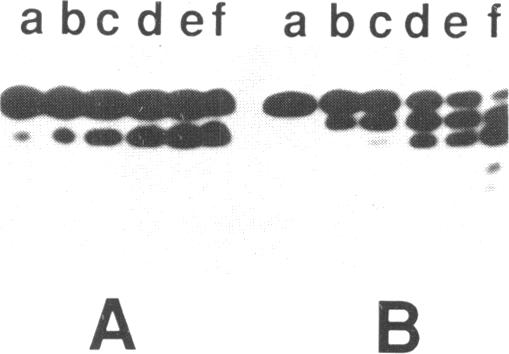
Antisense oligonucleotides with a 2,4-dideoxyhexopyranosyl nucleoside incorporated at the 3'-end and at a mutation site of the Ha-ras oncogene mRNA were synthesized. Melting temperature studies revealed that an A*-G mismatch is more stable than an A*-T mismatch with these hexopyranosyl nucleosides incorporated at the mutation site. The oligonucleotides are stable against enzymatic degradation. RNase H mediated cleavage studies revealed selective cleavage of mutated Ha-ras mRNA. The oligonucleotide containing two pyranose nucleosides at the penultimate position activates RNase H more strongly than natural oligonucleotides. No correlation, however, was found between DNA - DNA or RNA - DNA melting temperatures and RNase H mediated cleavage capacity. Although the A*-G mismatch gives more stable hybridization than the A*-T base pairing, only the oligonucleotides containing an A*-T base pair are recognized by RNase H. This modification is situated 3 base pairs upstream to the cleavage site. Finally, the double pyranose modified oligonucleotide was able to reduce the growth of T24 cells (bladder carcinoma) while the unmodified antisense oligonucleotide was not.
合成了在3'-末端以及Ha-ras癌基因mRNA的突变位点掺入了2,4-二脱氧己吡喃糖基核苷的反义寡核苷酸。熔解温度研究表明,在突变位点掺入这些己吡喃糖基核苷时,A* - G错配比A* - T错配更稳定。这些寡核苷酸对酶促降解具有稳定性。RNase H介导的切割研究表明突变的Ha-ras mRNA有选择性切割。在倒数第二个位置含有两个吡喃糖核苷的寡核苷酸比天然寡核苷酸更强烈地激活RNase H。然而,在DNA - DNA或RNA - DNA熔解温度与RNase H介导的切割能力之间未发现相关性。尽管A* - G错配比A* - T碱基配对产生更稳定的杂交,但只有含有A* - T碱基对的寡核苷酸能被RNase H识别。这种修饰位于切割位点上游3个碱基对处。最后,双吡喃糖修饰的寡核苷酸能够降低T24细胞(膀胱癌细胞)的生长,而未修饰的反义寡核苷酸则不能。