Vink C, Lutzke R A, Plasterk R H
Division of Molecular Biology, Netherlands Cancer Institute, Amsterdam.
Nucleic Acids Res. 1994 Oct 11;22(20):4103-10. doi: 10.1093/nar/22.20.4103.
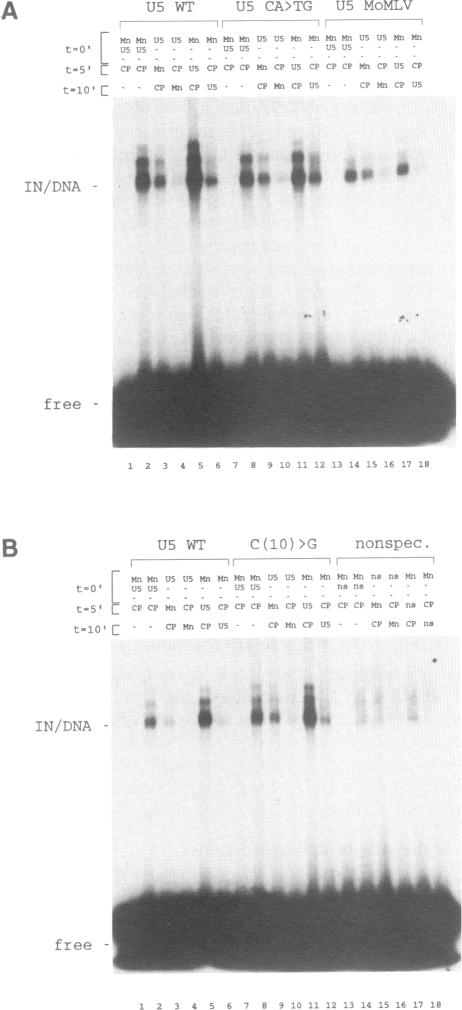
The integrase (IN) protein of the human immunodeficiency virus (HIV) mediates two distinct reactions: (i) specific removal of two nucleotides from the 3' ends of the viral DNA and (ii) integration of the viral DNA into target DNA. Although IN discriminates between specific (viral) DNA and nonspecific DNA in physical in vitro assays, a sequence-specific DNA-binding domain could not be identified in the protein. A nonspecific DNA-binding domain, however, was found at the C terminus of the protein. We examined the DNA-binding characteristics of HIV-1 IN, and found that a stable complex of IN and viral DNA is formed in the presence of Mn2+. The IN-viral DNA complex is resistant to challenge by an excess of competitor DNA. Stable binding of IN to the viral DNA requires that the protein contains an intact N-terminal domain and active site (in the central region of the protein), in addition to the C-terminal DNA-binding domain.
人类免疫缺陷病毒(HIV)的整合酶(IN)蛋白介导两种不同反应:(i)从病毒DNA的3'末端特异性去除两个核苷酸;(ii)将病毒DNA整合到靶DNA中。尽管在体外物理测定中IN能区分特异性(病毒)DNA和非特异性DNA,但在该蛋白中未鉴定出序列特异性DNA结合结构域。然而,在该蛋白的C末端发现了一个非特异性DNA结合结构域。我们研究了HIV-1 IN的DNA结合特性,发现Mn2+存在时会形成IN与病毒DNA的稳定复合物。IN-病毒DNA复合物能抵抗过量竞争DNA的挑战。IN与病毒DNA的稳定结合要求该蛋白除了C末端DNA结合结构域外,还包含完整的N末端结构域和活性位点(在蛋白的中央区域)。