Azure M T, Archer R D, Sastry K S, Rao D V, Howell R W
Department of Radiology, University of Medicine & Dentistry of New Jersey, New Jersey Medical School, Newark 07103.
Radiat Res. 1994 Nov;140(2):276-83.
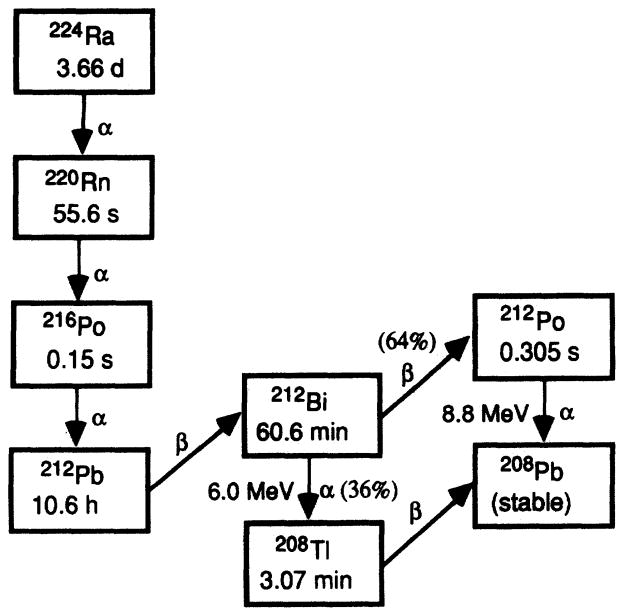
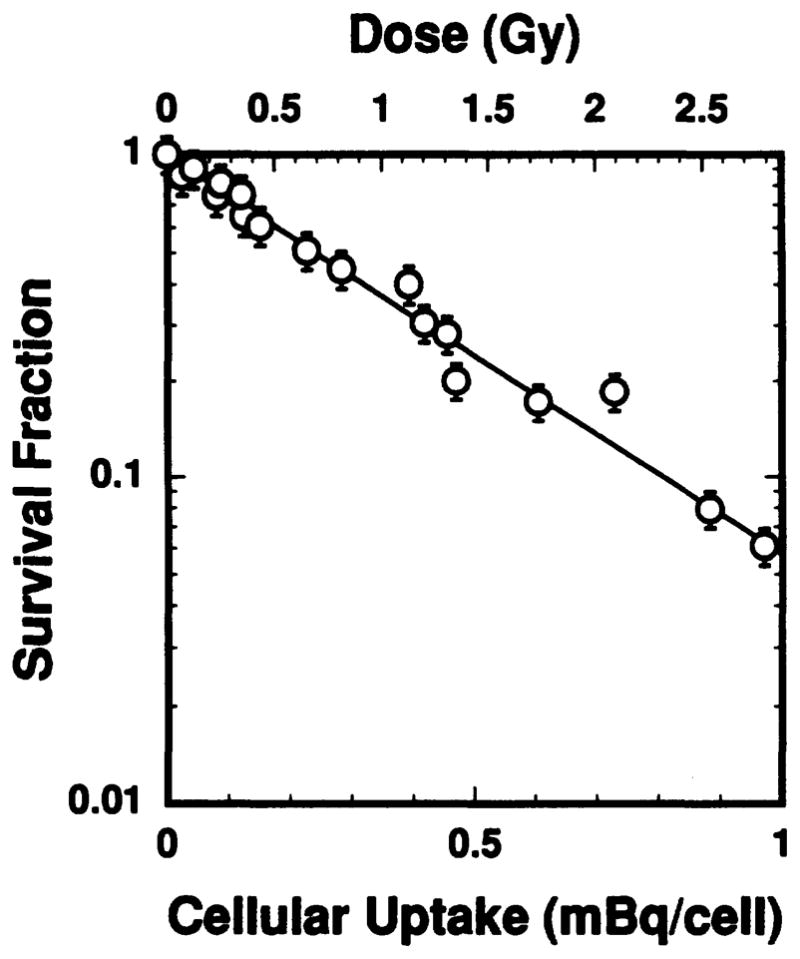
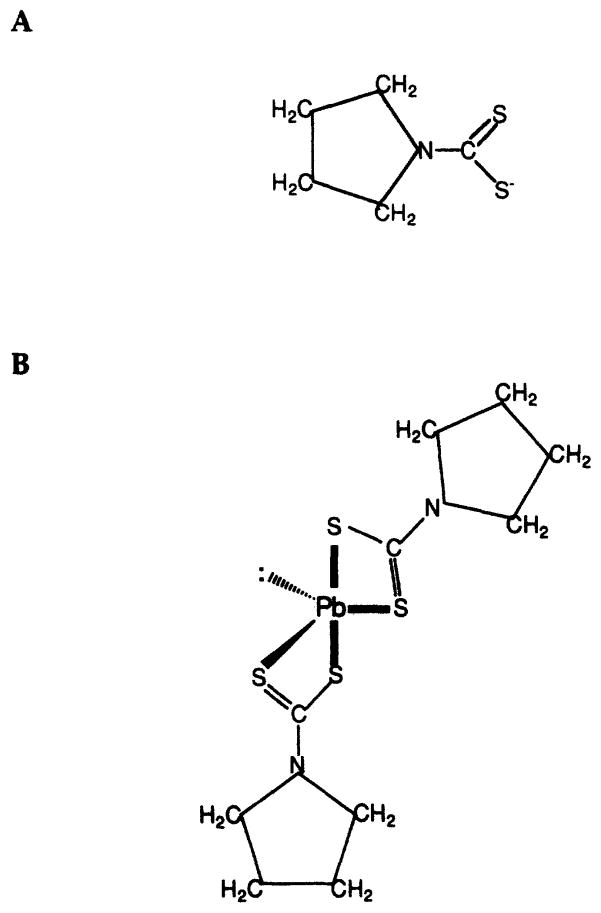
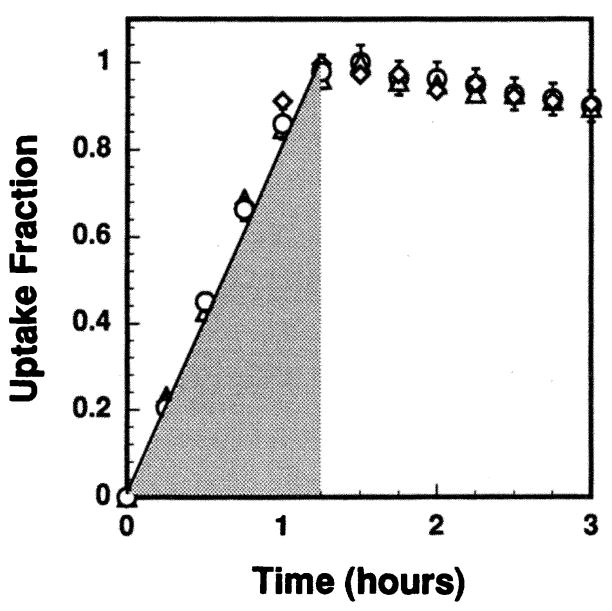
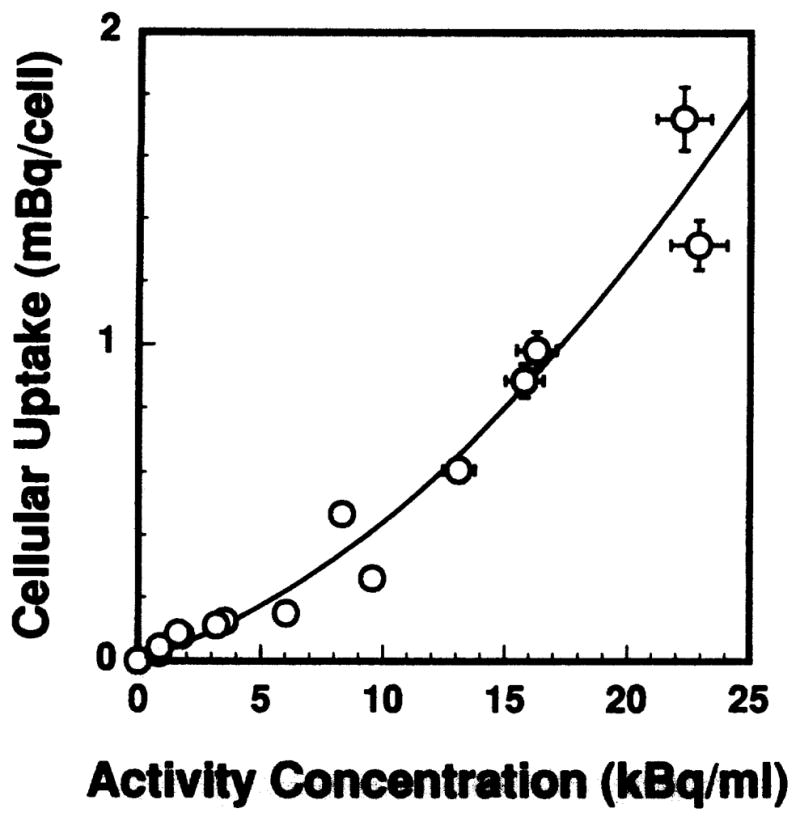
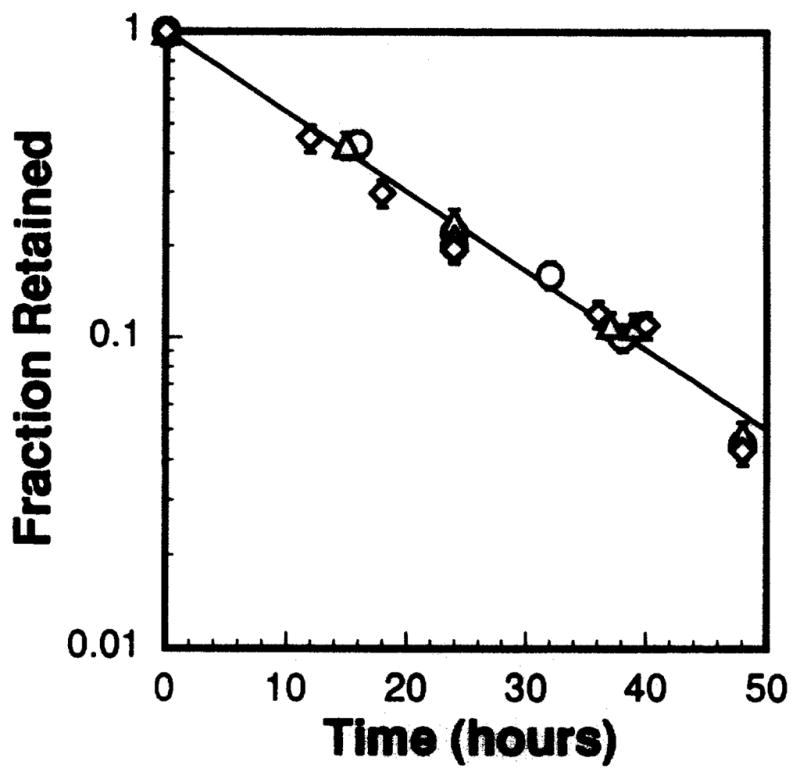
The radiochemical dipyrrolidinedithiocarbamato-212Pb(II) [212Pb(PDC)2] is synthesized and its effects on colony formation in cultured Chinese hamster V79 cells are investigated. The cellular uptake, biological retention, subcellular distribution and cytotoxicity of the radiocompound are determined. The 212Pb is taken up quickly by the cells, reaching saturation levels in 1.25 h. When the cells are washed, the intracellular activity is retained with a biological half-life of 11.6 h. Gamma-ray spectroscopy indicates that the 212Pb daughters (212Bi, 212Po and 208Tl) are in secular equilibrium within the cell. About 72% of the cellular activity localizes in the cell nucleus, of which 35% is bound specifically to nuclear DNA. The mean cellular uptake required to achieve 37% survival is 0.35 mBq of 212Pb per cell, which delivers a dose of 1.0 Gy to the cell nucleus when the recoil energy of 212Bi and 212Po decays is ignored and 1.7 Gy when recoil is included. The corresponding RBE values compared to acute external 137Cs gamma rays at 37% survival are 4.0 and 2.3, respectively. The chemical Pb(PDC)2 is not chemotoxic at the concentrations used in this study. Because the beta-particle emitter 212Pb decays to the alpha-particle-emitting daughters 212Bi and 212Po, these studies provide information on the biological effects of alpha-particle decays that occur in the cell nucleus. Our earlier studies with cells of the same cell line using 210Po (emits 5.3 MeV alpha particle) localized predominantly in the cytoplasm resulted in an RBE of 6. These earlier results for 210Po, along with the present results for 212Pb, suggest that the recoil energy associated with the 212Bi and 212Po daughter nuclei plays little or no role in imparting biological damage to critical targets in the cell nucleus.
合成了放射化学物质二吡咯烷基二硫代氨基甲酸 - 212Pb(II) [212Pb(PDC)2],并研究了其对培养的中国仓鼠V79细胞集落形成的影响。测定了该放射性化合物的细胞摄取、生物滞留、亚细胞分布和细胞毒性。212Pb被细胞快速摄取,在1.25小时内达到饱和水平。当细胞被洗涤时,细胞内活性以11.6小时的生物半衰期保留。γ射线光谱表明212Pb的子体(212Bi、212Po和208Tl)在细胞内处于长期平衡。约72%的细胞活性定位于细胞核,其中35%特异性结合于核DNA。实现37%存活率所需的平均细胞摄取量为每细胞0.35 mBq的212Pb,当忽略212Bi和212Po衰变的反冲能量时,这会给细胞核带来1.0 Gy的剂量,当考虑反冲时为1.7 Gy。与急性外部137Cs γ射线在37%存活率时相比,相应的RBE值分别为4.0和2.3。化学物质Pb(PDC)2在本研究使用的浓度下没有化学毒性。由于β粒子发射体212Pb衰变为发射α粒子的子体212Bi和212Po,这些研究提供了关于细胞核中发生的α粒子衰变生物效应的信息。我们早期使用主要定位于细胞质的210Po(发射5.3 MeV α粒子)对同一细胞系细胞进行的研究得出的RBE为6。210Po的这些早期结果以及212Pb的当前结果表明,与212Bi和212Po子核相关的反冲能量在对细胞核中的关键靶点造成生物损伤方面作用很小或没有作用。