Puig M, Jofre J, Lucena F, Allard A, Wadell G, Girones R
Department of Microbiology, University of Barcelona, Spain.
Appl Environ Microbiol. 1994 Aug;60(8):2963-70. doi: 10.1128/aem.60.8.2963-2970.1994.
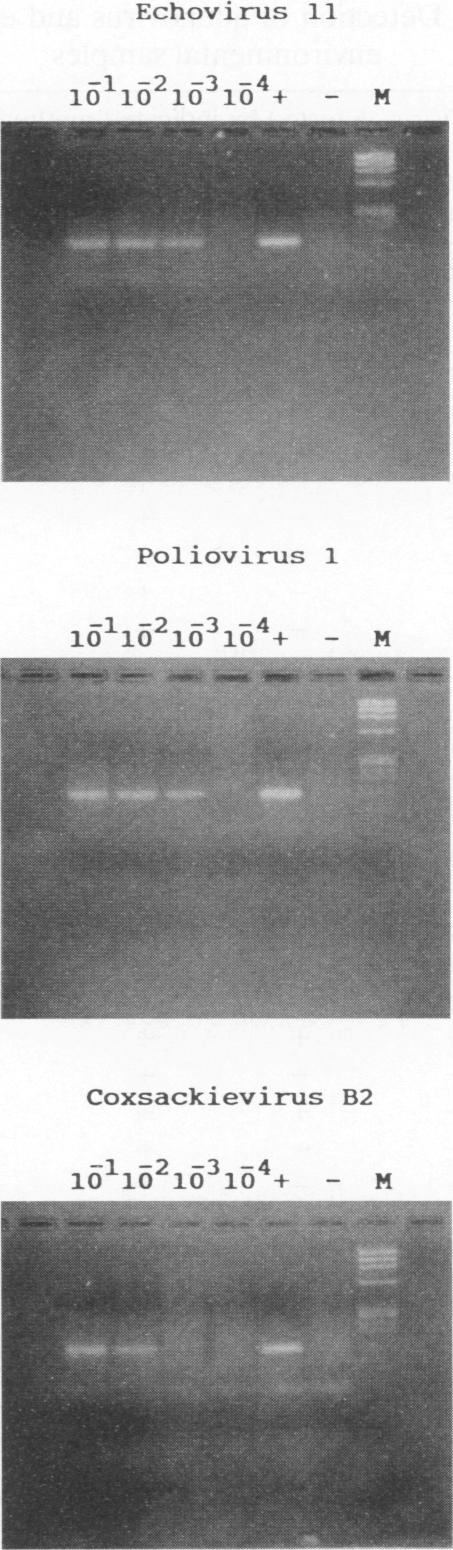
A procedure has been developed for the rapid detection of enteroviruses and adenoviruses in environmental samples. Several systems for virus concentration and extraction of nucleic acid were tested by adding adenovirus type 2 and poliovirus type 1 to different sewage samples. The most promising method for virus recovery involved the concentration of viruses by centrifugation and elution of the virus pellets by treatment with 0.25 N glycine buffer, pH 9.5. Nucleic acid extraction by adsorption of RNA and DNA to silica particles was the most efficient. One aliquot of the extracted nucleic acids was used for a nested two-step PCR, with specific primers for all adenoviruses; and another aliquot was used to synthesize cDNA for a nested two-step PCR with specific primers for further detection of seeded polioviruses or all enteroviruses in the river water and sewage samples. The specificity and sensitivity were evaluated, and 24 different enterovirus strains and the 47 human adenovirus serotypes were recognized by the primers used. The sensitivity was estimated to be between 1 and 10 virus particles for each of the species tested. Twenty-five samples of sewage and polluted river water were analyzed and showed a much higher number of positive isolates by nested PCR than by tissue culture analysis. The PCR-based detection of enteroviruses and adenoviruses shows good results as an indicator of possible viral contamination in environmental wastewater.
已开发出一种用于快速检测环境样本中肠道病毒和腺病毒的方法。通过向不同污水样本中添加2型腺病毒和1型脊髓灰质炎病毒,对几种病毒浓缩和核酸提取系统进行了测试。最有前景的病毒回收方法包括通过离心浓缩病毒,并用0.25N甘氨酸缓冲液(pH 9.5)处理病毒沉淀以洗脱病毒。通过将RNA和DNA吸附到硅胶颗粒上来提取核酸是最有效的方法。提取的核酸的一份用于巢式两步PCR,使用针对所有腺病毒的特异性引物;另一份用于合成cDNA,用于巢式两步PCR,使用特异性引物以进一步检测河流水和污水样本中接种的脊髓灰质炎病毒或所有肠道病毒。评估了特异性和敏感性,所用引物识别出24种不同的肠道病毒株和47种人腺病毒血清型。对于所测试的每种病毒,估计敏感性在1至10个病毒颗粒之间。对25份污水和污染河水样本进行了分析,结果显示,与组织培养分析相比,巢式PCR检测出的阳性分离株数量要多得多。基于PCR的肠道病毒和腺病毒检测作为环境废水中可能存在病毒污染的指标显示出良好的结果。