Swaminathan N, George D, McMaster K, Szablewski J, Van Etten J L, Mead D A
CHIMERx, Madison, WI 53704.
Nucleic Acids Res. 1994 Apr 25;22(8):1470-5. doi: 10.1093/nar/22.8.1470.
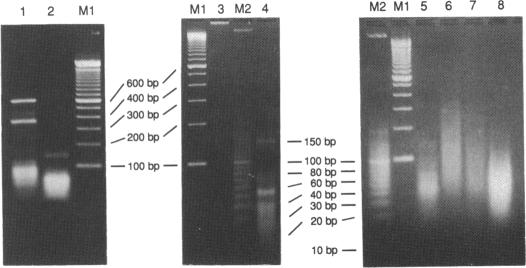
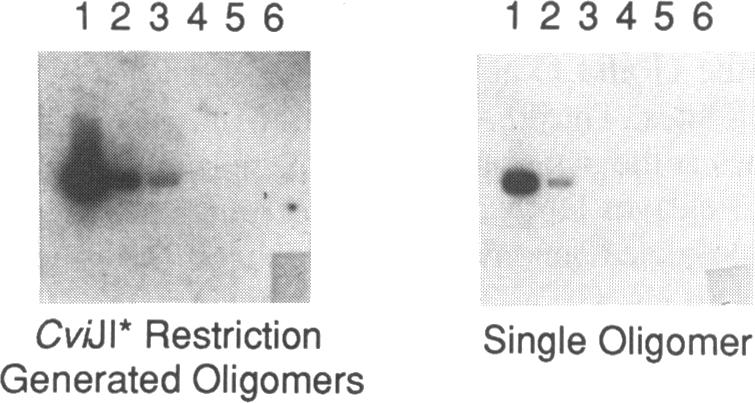
The conversion of an anonymous DNA sample into numerous oligonucleotides is enzymatically feasible using an unusual restriction endonuclease, CviJI. Depending on reaction conditions, CviJI is capable of digesting DNA at a two or three base recognition sequence. CviJI normally cleaves RGCY sites between the G and C to leave blunt ends. Under 'relaxed' conditions CviJI* cleaves RGCY, and RGCR/YGCY, but not YGCR sites. In theory, CviJI* restriction of pUC19 (2686 bp) should produce 157 fragments, 75% of which are smaller than 20 bp. Instead, 96% of the CviJI* fragments were 18-56 bp long and none of the fragments were smaller than 18 bp. Thermal denaturation of these fragments generates sequence specific oligonucleotides homologous for the cognate template. The enzymatic conversion of anonymous DNA into sequence specific oligomers has implications for several conventional and novel molecular biology procedures.
使用一种特殊的限制性内切酶CviJI,可通过酶促反应将匿名DNA样本转化为大量寡核苷酸。根据反应条件,CviJI能够在二碱基或三碱基识别序列处切割DNA。CviJI通常在G和C之间切割RGCY位点,产生平端。在“宽松”条件下,CviJI可切割RGCY以及RGCR/YGCY,但不能切割YGCR位点。理论上,用CviJI限制pUC19(2686 bp)应产生157个片段,其中75%小于20 bp。然而,实际上96%的CviJI*片段长度为18 - 56 bp,且没有片段小于18 bp。这些片段的热变性产生了与同源模板同源的序列特异性寡核苷酸。将匿名DNA酶促转化为序列特异性寡聚物对几种传统和新型分子生物学程序具有重要意义。