Brandimarti R, Huang T, Roizman B, Campadelli-Fiume G
Department of Experimental Pathology, University of Bologna, Italy.
Proc Natl Acad Sci U S A. 1994 Jun 7;91(12):5406-10. doi: 10.1073/pnas.91.12.5406.
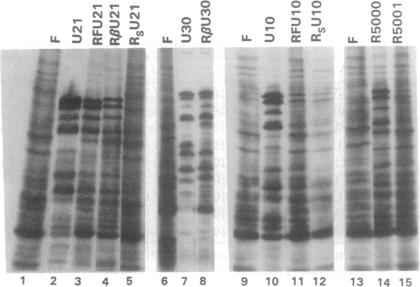
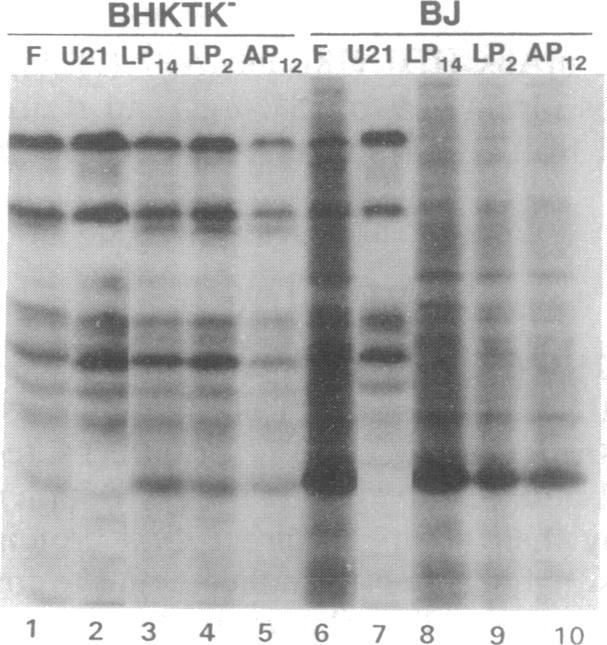
Earlier studies have shown that the thymidine kinase-negative baby hamster kidney (BHKTK-) cell lines expressing constitutively the herpes simplex virus 1 (HSV-1) glycoprotein D (gD), designated BJ, restrict infection by HSV-1 at the level of virus entry. U10, a HSV-1 mutant not restricted by the BJ cells, carried the substitution of proline for Leu25 in the gD gene, suggesting that gD encodes a specialized domain which precludes virus entry into cells expressing gD. Analyses of a new series of 36 unrestricted viral mutants showed the following. (i) Only two mutants contained mutations at a site which did not overlap with the previously reported mutation. A representative of a previously mapped mutant and one of the two new mutants were examined in detail. Thus, in the gD of mutant U30 Ala185 was replaced by threonine, whereas in gD of U21, Ala185 and Leu25 were replaced with threonine and proline, respectively. U30 and U21 multiplied better than the wild-type parent virus in the parental BHKTK- cells. (ii) Transfer of the gD gene from U21 or U30 to wild-type parent virus or to the gD- virus FgD beta yielded recombinants which, while capable of infecting BJ cells, were considerably less efficient than the parent unrestricted mutants, suggesting that the latter contained additional mutations which were responsible in part for the unrestricted phenotype. Conversely, marker rescue of mutant viruses with wild-type gD reduced but did not abrogate entirely the unrestricted phenotype. (iii) Mutations in gD which conferred the unrestricted phenotype were not random. (iv) gD plays a role in the restriction, inasmuch as preincubation of cells expressing gD with antibodies to gD abolished restriction. (v) In mutant R5000, the gD substitution Ser140 to Asn was capable of overcoming a restriction of a BHKTK- clonal line which does not express gD but conferred very low ability to replicate on BJ cells. We conclude that (a) uncloned stocks of BHKTK- cells exhibit a low level restriction to infection with wild-type virus, (b) clonal lines of BHKTK- cells which vary with respect to the stringency of restriction express either allelic genes differing in the properties of their products or products of different genes, and (c) both the restricted and unrestricted phenotypes reflect the interactions of gD with these cellular products. The implications of these conclusions with respect to the restriction imposed on BHK cells by the expression of gD are discussed.
早期研究表明,组成型表达单纯疱疹病毒1型(HSV-1)糖蛋白D(gD)的胸苷激酶阴性幼仓鼠肾(BHKTK-)细胞系(命名为BJ)在病毒进入水平限制HSV-1感染。U10是一种不受BJ细胞限制的HSV-1突变体,其gD基因中的亮氨酸25被脯氨酸取代,这表明gD编码一个特殊结构域,可阻止病毒进入表达gD的细胞。对新的一系列36个不受限制的病毒突变体进行分析,结果如下。(i)只有两个突变体在一个与先前报道的突变不重叠的位点发生突变。对一个先前定位的突变体代表和两个新突变体之一进行了详细研究。因此,在突变体U30的gD中,丙氨酸185被苏氨酸取代,而在U21的gD中,丙氨酸185和亮氨酸25分别被苏氨酸和脯氨酸取代。U30和U21在亲本BHKTK-细胞中的增殖能力优于野生型亲本病毒。(ii)将U21或U30的gD基因转移到野生型亲本病毒或gD-病毒FgDβ中,产生的重组体虽然能够感染BJ细胞,但其效率远低于亲本不受限制的突变体,这表明后者含有其他突变,这些突变部分导致了不受限制的表型。相反,用野生型gD对突变病毒进行标志拯救,可降低但不能完全消除不受限制的表型。(iii)赋予不受限制表型的gD突变并非随机发生。(iv)gD在限制过程中发挥作用,因为用抗gD抗体对表达gD的细胞进行预孵育可消除限制作用。(v)在突变体R5000中,gD中丝氨酸140被天冬酰胺取代能够克服对不表达gD的BHKTK-克隆系的限制,但在BJ细胞上的复制能力很低。我们得出以下结论:(a)未克隆的BHKTK-细胞株对野生型病毒感染表现出低水平的限制;(b)在限制严格程度上存在差异的BHKTK-细胞克隆系表达的要么是其产物特性不同的等位基因,要么是不同基因的产物;(c)受限和不受限表型均反映了gD与这些细胞产物的相互作用。讨论了这些结论对gD表达对BHK细胞施加限制的意义。