Tillmann M, Wessner R, Wigdahl B
Department of Microbiology and Immunology, College of Medicine, Pennsylvania State University, Hershey 17033.
J Virol. 1994 Jul;68(7):4597-608. doi: 10.1128/JVI.68.7.4597-4608.1994.
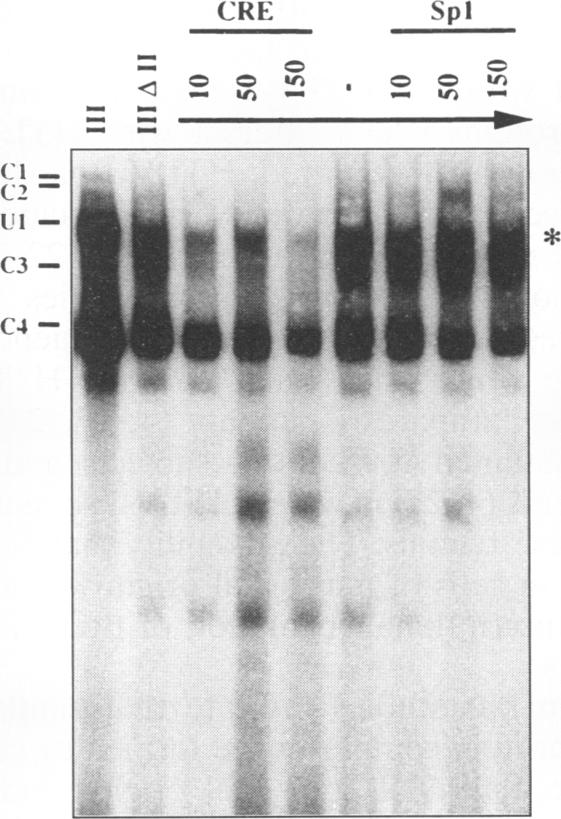
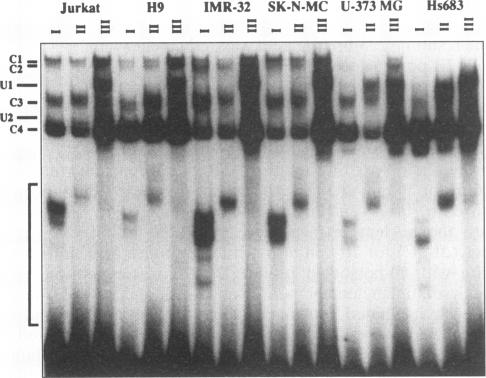
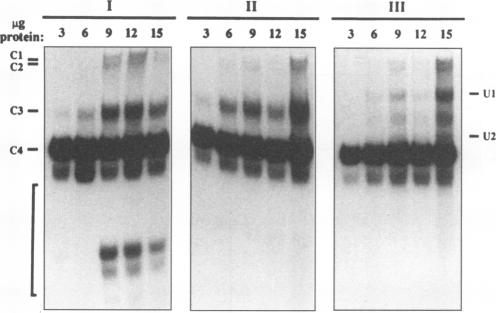
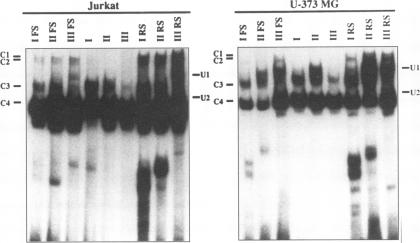
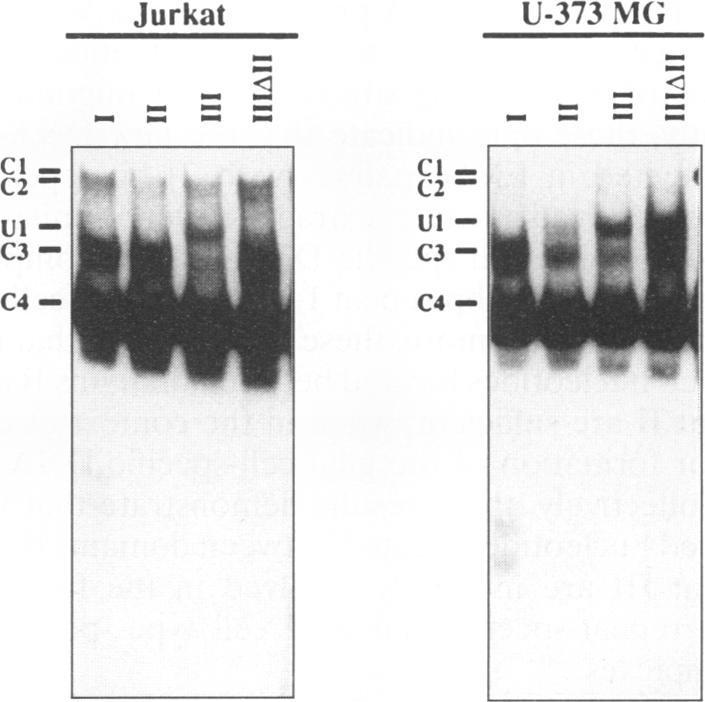
The human T-cell lymphotropic virus type I (HTLV-I)-encoded protein, Tax, is capable of trans-activating HTLV-I transcription by interacting with specific sequences in the HTLV-I long terminal repeat (LTR) which comprise an inducible enhancer containing three imperfect tandem repeats of a 21-bp sequence. There is no evidence that purified Tax can bind to DNA in the absence of cellular factors, suggesting that Tax most likely regulates transcription via interaction with cellular factors. Since HTLV-I is a documented agent of adult T-cell leukemia and tropical spastic paraparesis, disorders of the immune and nervous systems, respectively, characterization of cellular factors of lymphoid and neuroglial origin which interact with the 21-bp repeat elements is essential to understanding of the mechanisms involved in basal and Tax-mediated transcription in cells of immune and nervous system origin. Utilizing electrophoretic mobility shift (EMS) analyses, we have detected both 21-bp repeat-specific and glial cell-specific DNA-protein complexes. Several 21-bp repeat-specific DNA-protein complexes were detected when nuclear extracts derived from cells of lymphoid (Jurkat, SupT1, and H9), neuronal (IMR-32 and SK-N-MC), and glial (U-373 MG, Hs683, and U-118) origin were used in reactions with each of the three 21-bp repeat elements. In addition, a glial cell-specific DNA-protein complex was detected when nuclear extracts derived from U-373 MG, Hs683, and U-118 glial cell lines reacted with the promoter-distal and central 21-bp repeat elements. Furthermore, EMS analyses performed with nuclear extracts derived from lymphocytic and glial cell origin and a 223-bp fragment of the HTLV-I long terminal repeat encompassing the three 21-bp repeat elements (designated Tax-responsive elements 1 and 2, TRE-1/-2) have also resulted in the detection of glial cell type-specific DNA-protein complexes. Competition EMS analyses with oligonucleotides containing transcription factor binding site sequences indicate the involvement of a cyclic AMP response element binding protein in the formation of DNA-protein complexes which form with all three 21-bp repeat elements and the glial cell-specific DNA-protein complex as well as the involvement of Sp1 or an Sp1-related factor in the formation of the 21-bp repeat III-specific DNA-protein complexes.
人类嗜T细胞病毒I型(HTLV-I)编码的蛋白Tax能够通过与HTLV-I长末端重复序列(LTR)中的特定序列相互作用来反式激活HTLV-I转录,该LTR包含一个诱导型增强子,其含有一个21bp序列的三个不完全串联重复。没有证据表明纯化的Tax在没有细胞因子的情况下能与DNA结合,这表明Tax很可能通过与细胞因子相互作用来调节转录。由于HTLV-I分别是成人T细胞白血病和热带痉挛性截瘫(分别为免疫和神经系统疾病)的已记录病原体,因此鉴定与21bp重复元件相互作用的淋巴样和神经胶质来源的细胞因子对于理解免疫和神经系统来源细胞中基础转录和Tax介导的转录所涉及的机制至关重要。利用电泳迁移率变动(EMS)分析,我们检测到了21bp重复序列特异性和神经胶质细胞特异性的DNA-蛋白质复合物。当用来自淋巴样(Jurkat、SupT1和H9)、神经元(IMR-32和SK-N-MC)和神经胶质(U-373 MG、Hs683和U-118)来源的细胞的核提取物与三个21bp重复元件中的每一个进行反应时,检测到了几种21bp重复序列特异性的DNA-蛋白质复合物。此外,当用来自U-373 MG、Hs683和U-118神经胶质细胞系的核提取物与启动子远端和中央21bp重复元件反应时,检测到了一种神经胶质细胞特异性的DNA-蛋白质复合物。此外,用来自淋巴细胞和神经胶质细胞来源的核提取物以及包含三个21bp重复元件(称为Tax反应元件1和2,TRE-1/-2)的HTLV-I长末端重复序列的223bp片段进行的EMS分析也检测到了神经胶质细胞类型特异性的DNA-蛋白质复合物。用含有转录因子结合位点序列的寡核苷酸进行的竞争EMS分析表明,环磷酸腺苷反应元件结合蛋白参与了与所有三个21bp重复元件形成的DNA-蛋白质复合物以及神经胶质细胞特异性DNA-蛋白质复合物的形成,并且Sp1或与Sp1相关的因子参与了21bp重复序列III特异性DNA-蛋白质复合物的形成。