Suzuki Y, Sanekata T, Sato M, Tajima K, Matsuda Y, Nakagomi O
Department of Microbiology, Akita University School of Medicine, Japan.
J Clin Microbiol. 1993 Nov;31(11):3046-9. doi: 10.1128/jcm.31.11.3046-3049.1993.
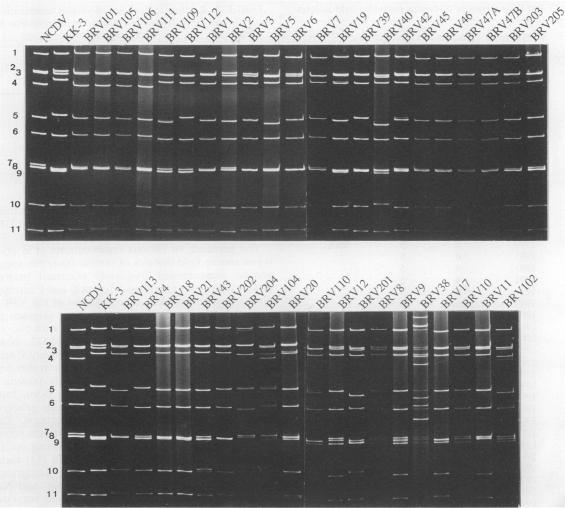
The relative frequencies of both the G (VP7) and P (VP4) serotypes of 40 bovine rotaviruses isolated in cell culture from diarrheic calves in Japan between January 1983 and February 1991 were determined by recently developed polymerase chain reaction assays. Isolates with G serotype 6 and P serotype 5 (UK-like strains) were most frequently found (42.5%) followed by isolates with G6P11 (17.5%), G6P1 (10%), or G10P5 (10%). Isolates with G10P11 (B223-like strains) were least frequently found (7.5%). The presence of various combinations of G and P serotypes suggests frequent reassortment in nature among bovine rotaviruses.
采用最近开发的聚合酶链反应分析法,测定了1983年1月至1991年2月间从日本腹泻犊牛细胞培养物中分离出的40株牛轮状病毒的G(VP7)和P(VP4)血清型的相对频率。最常发现的是G血清型6和P血清型5的分离株(类英国毒株)(42.5%),其次是G6P11(17.5%)、G6P1(10%)或G10P5(10%)的分离株。G10P11(B223类毒株)的分离株最少见(7.5%)。G和P血清型的各种组合的存在表明牛轮状病毒在自然界中频繁发生重配。