Bauminger E R, Harrison P M, Hechel D, Hodson N W, Nowik I, Treffry A, Yewdall S J
Racah Institute of Physics, Hebrew University of Jerusalem, Israel.
Biochem J. 1993 Dec 15;296 ( Pt 3)(Pt 3):709-19. doi: 10.1042/bj2960709.
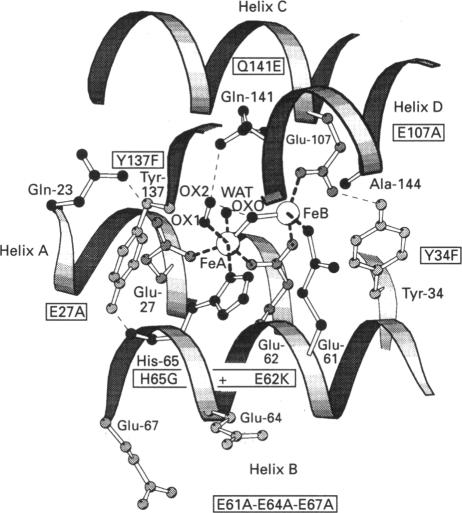
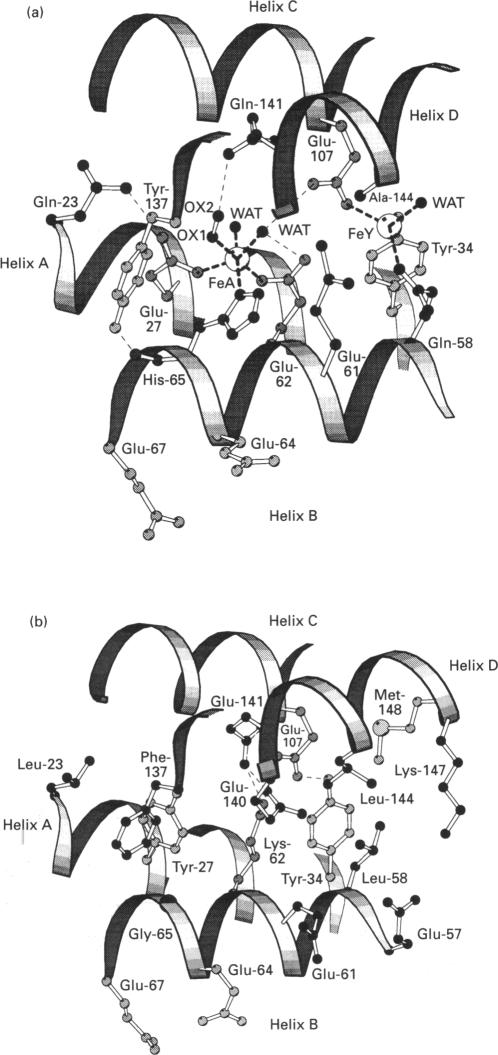
The paper describes a study of Fe(II) oxidation and the formation of Fe(III)-apoferritin complexes in recombinant human H-chain ferritin and its variants. The effects of site-directed changes in the conserved residues associated with a proposed ferroxidase centre have been investigated. A change in any of these residues is shown to reduce the rate of Fe(II) oxidation, confirming the importance of the ferroxidase centre in the catalysis of Fe(II) oxidation. Mössbauer and u.v.-difference spectroscopy show that in the wild-type protein Fe(II) oxidation gives rise to Fe(III) monomers, dimers and larger clusters. The formation of Fe(III) mu-oxo-bridged dimers occurs at the ferroxidase centre and is associated with fast oxidation: in three variants in which Fe(II) oxidation is especially slow, no Fe(III) dimers are seen. Within the time scale 0.5-20 min in wild-type human H-chain ferritin, dimer formation precedes that of the monomer and the progression dimer-->monomer-->cluster is observed, although not to completion. In a preliminary investigation of oxidation intermediates using a stopped-flow instrument, an Fe(III)-tyrosine complex reported by Waldo et al. (1993), is attributed to Tyr-34, a residue at the ferroxidase centre. The Fe(III)-Tyr-34 complex, forms in 0.5 s and then decays, as dimer absorbance increases. The relationship between Fe(III)-tyrosinate and the formation of Fe(III) dimers is uncertain.
本文描述了对重组人H链铁蛋白及其变体中Fe(II)氧化以及Fe(III)-脱铁铁蛋白复合物形成的研究。已研究了与拟议的铁氧化酶中心相关的保守残基的定点变化的影响。这些残基中任何一个的变化均显示会降低Fe(II)氧化速率,证实了铁氧化酶中心在催化Fe(II)氧化中的重要性。穆斯堡尔谱和紫外差光谱表明,在野生型蛋白中,Fe(II)氧化会产生Fe(III)单体、二聚体和更大的簇。Fe(III) μ-氧桥联二聚体在铁氧化酶中心形成,并与快速氧化相关:在Fe(II)氧化特别缓慢的三个变体中,未观察到Fe(III)二聚体。在野生型人H链铁蛋白0.5 - 20分钟的时间范围内,二聚体形成先于单体,并且观察到二聚体→单体→簇的进程,尽管未完成。在使用停流仪器对氧化中间体进行的初步研究中,Waldo等人(1993年)报道的一种Fe(III)-酪氨酸复合物归因于铁氧化酶中心的残基Tyr-34。Fe(III)-Tyr-34复合物在0.5秒内形成,然后随着二聚体吸光度增加而衰减。Fe(III)-酪氨酸盐与Fe(III)二聚体形成之间的关系尚不确定。