De Bernardis F, Adriani D, Lorenzini R, Pontieri E, Carruba G, Cassone A
Laboratoires of Bacteriology and Medical Mycology, University of L'Aquila, Italy.
Infect Immun. 1993 Apr;61(4):1500-8. doi: 10.1128/iai.61.4.1500-1508.1993.
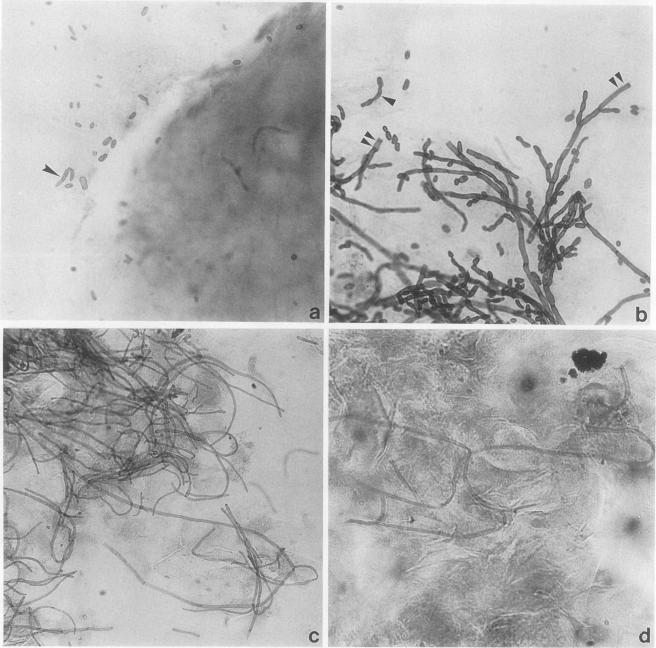
The vaginopathic potential and the intravaginal morphology of a nongerminative variant of Candida albicans, strain CA-2, were studied in a rat vaginitis model. Although it expressed low virulence in systemic infections, strain CA-2 was capable of causing a vaginal infection of the same duration and extent as that obtained in rats challenged with the germ-tube-forming strain C. albicans 3153 from the stock collection or with a fresh clinical isolate of C. albicans from a case of human vaginitis. During the experimental infection, the CA-2 cells did not maintain their yeast morphology but gave rise to single enlarged-elongated elements (1 to 2 days) which grew predominantly as coarse, short, pseudomycelium-like filaments (2 to 3 days) and then as long threads (7 days). These latter filaments were ultimately indistinguishable from the hyphal filaments formed by the germ-tube-forming strains, which, however, initially developed in the vagina by typical germ tube formation. This peculiar morphological development of strain CA-2 was not observed in organs of systemically infected mice, where, in contrast to strain 3153 which formed typical hyphae, strain CA-2 maintained a typical pattern of yeast growth. Vaginal isolates of strain CA-2 taken at different days of infection were found to be identical to the challenging CA-2 cells, in terms of biochemical characteristics, inability to form germ tubes in any medium at 37 degrees C in vitro, echinocandin resistance, DNA biotype, and low virulence in systemic infections in mice. Thus, experimental vaginitis by strain CA-2 is associated with a peculiar filamentous growth in the vagina, through an apparently novel morphological development bypassing classical germ tube formation but ultimately leading to ordinary hyphae. The elevated vaginopathic potential of strain CA-2, in contrast to its low virulence in systemic infection, also suggests that different Candida virulence factors (and host responses) come into play in local and disseminated candidal infections.
在大鼠阴道炎模型中,研究了白色念珠菌非发芽变种CA - 2菌株的致阴道病潜力和阴道内形态。尽管CA - 2菌株在全身感染中表现出低毒力,但它能够引起与用保藏的形成芽管的白色念珠菌3153菌株或来自人类阴道炎病例的白色念珠菌新鲜临床分离株攻击的大鼠相同持续时间和程度的阴道感染。在实验性感染期间,CA - 2细胞没有保持其酵母形态,而是产生单个增大拉长的细胞(1至2天),这些细胞主要生长为粗大、短小、假菌丝样细丝(2至3天),然后生长为长线状(7天)。这些后期的细丝最终与由形成芽管的菌株形成的菌丝细丝无法区分,然而,形成芽管的菌株最初是通过典型的芽管形成在阴道中发育的。在全身感染小鼠的器官中未观察到CA - 2菌株这种特殊的形态发育,与形成典型菌丝的3153菌株相比,CA - 2菌株在那里保持典型的酵母生长模式。发现在感染不同天数采集的CA - 2菌株的阴道分离株在生化特征、在37℃体外任何培养基中不能形成芽管、对棘白菌素耐药、DNA生物型以及在小鼠全身感染中的低毒力方面与攻击的CA - 2细胞相同。因此,CA - 2菌株引起的实验性阴道炎与阴道中特殊的丝状生长有关,通过一种明显新颖的形态发育绕过经典的芽管形成,但最终导致普通菌丝。与它在全身感染中的低毒力相比,CA - 2菌株升高的致阴道病潜力也表明不同的念珠菌毒力因子(和宿主反应)在局部和播散性念珠菌感染中发挥作用。