Wilson J B, Bell J L, Levine A J
Robertson Building of Biotechnology, Division of Molecular Genetics, Institute of Biomedical and Life Sciences, Glasgow University, UK.
EMBO J. 1996 Jun 17;15(12):3117-26.
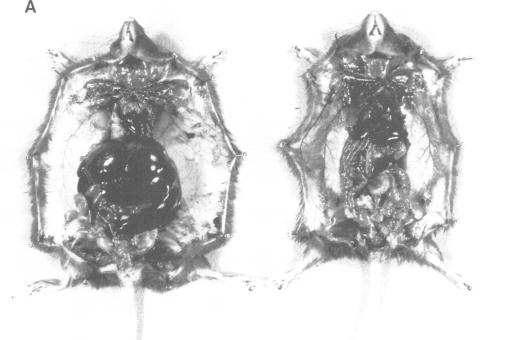
The Epstein-Barr virus (EBV) nuclear antigen-1 (EBNA-1) is a pleiotropic protein which has been characterized extensively both biochemically and functionally. It is the only one of the identified latent protein-encoding genes to be consistently expressed in viral-associated endemic Burkitt's lymphoma cells. As such, it is the only candidate viral protein to possibly perform a maintenance function in the tumour pathology. Despite this, no oncogenic activity has been attributed to the protein in tissue culture assays. The experiments described here were initiated to explore the activity of the protein in B cells in vivo. EBNA-1 transgenic mice were generated with transgene expression directed to the B cell compartment using the mouse Ig heavy chain intron enhancer. Transgene expression was demonstrated in the lymphoid tissues of mice of two independent lines. Transgenic positive mice of both lines succumb to B cell lymphoma. The B cell tumours are monoclonal, frequently of follicular centre cell origin and remarkably similar to those induced by transgenic c-myc expression. These results demonstrate that EBNA-1 is oncogenic in vivo and suggest that the gene product may play a direct role in the pathogenesis of Burkitt's lymphoma and possibly other EBV-associated malignancies.
爱泼斯坦-巴尔病毒(EBV)核抗原1(EBNA-1)是一种多效性蛋白,已在生物化学和功能方面得到广泛表征。它是已鉴定的潜伏性蛋白编码基因中唯一一个在病毒相关的地方性伯基特淋巴瘤细胞中持续表达的基因。因此,它是唯一可能在肿瘤病理学中发挥维持功能的病毒蛋白候选物。尽管如此,在组织培养试验中尚未发现该蛋白具有致癌活性。此处描述的实验旨在探索该蛋白在体内B细胞中的活性。利用小鼠Ig重链内含子增强子,构建了转基因表达定向于B细胞区室的EBNA-1转基因小鼠。在两个独立品系小鼠的淋巴组织中均证实了转基因表达。两个品系的转基因阳性小鼠均死于B细胞淋巴瘤。B细胞肿瘤是单克隆性的,通常起源于滤泡中心细胞,与转基因c-myc表达诱导的肿瘤非常相似。这些结果表明EBNA-1在体内具有致癌性,并提示该基因产物可能在伯基特淋巴瘤以及可能的其他EBV相关恶性肿瘤的发病机制中起直接作用。