Ziman M, Chuang J S, Schekman R W
Department of Molecular and Cell Biology, Howard Hughes Medical Institute, University of California, Berkeley, USA.
Mol Biol Cell. 1996 Dec;7(12):1909-19. doi: 10.1091/mbc.7.12.1909.
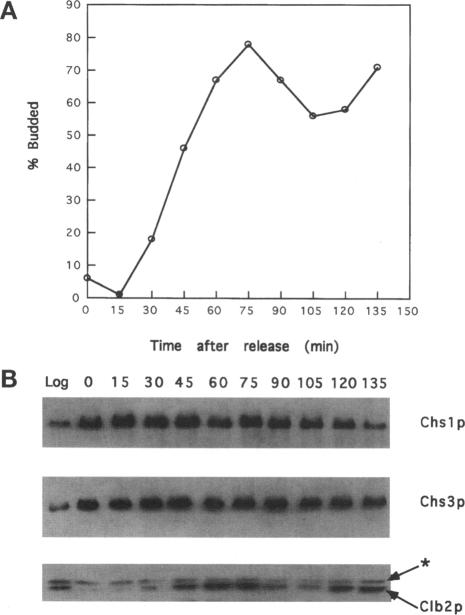
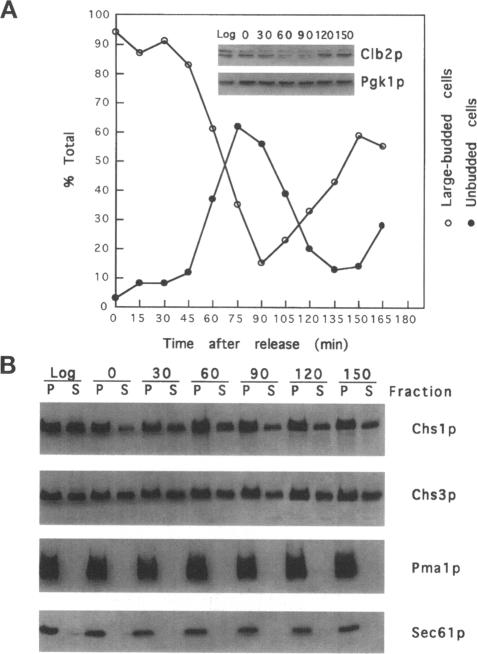
In Saccharomyces cerevisiae, the synthesis of chitin, a cell-wall polysaccharide, is temporally and spatially regulated with respect to the cell cycle and morphogenesis. Using immunological reagents, we found that steady-state levels of Chs1p and Chs3p, two chitin synthase enzymes, did not fluctuate during the cell cycle, indicating that they are not simply regulated by synthesis and degradation. Previous cell fractionation studies demonstrated that chitin synthase I activity (CSI) exists in a plasma membrane form and in intracellular membrane-bound particles called chitosomes. Chitosomes were proposed to act as a reservoir for regulated transport of chitin synthase enzymes to the division septum. We found that Chs1p and Chs3p resided partly in chitosomes and that this distribution was not cell cycle regulated. Pulse-chase cell fractionation experiments showed that chitosome production was blocked in an endocytosis mutant (end4-1), indicating that endocytosis is required for the formation or maintenance of chitosomes. Additionally, Ste2p, internalized by ligand-induced endocytosis, cofractionated with chitosomes, suggesting that these membrane proteins populate the same endosomal compartment. However, in contrast to Ste2p, Chs1p and Chs3p were not rapidly degraded, thus raising the possibility that the temporal and spatial regulation of chitin synthesis is mediated by the mobilization of an endosomal pool of chitin synthase enzymes.
在酿酒酵母中,细胞壁多糖几丁质的合成在时间和空间上与细胞周期及形态发生相关。使用免疫试剂,我们发现两种几丁质合酶Chs1p和Chs3p的稳态水平在细胞周期中并不波动,这表明它们并非简单地受合成和降解调控。先前的细胞分级分离研究表明,几丁质合酶I活性(CSI)以质膜形式存在于称为几丁质体的细胞内膜结合颗粒中。有人提出几丁质体作为几丁质合酶向分裂隔膜进行调控运输的储存库。我们发现Chs1p和Chs3p部分存在于几丁质体中,且这种分布不受细胞周期调控。脉冲追踪细胞分级分离实验表明,在一个内吞作用突变体(end4 - 1)中几丁质体的产生受阻,这表明内吞作用是几丁质体形成或维持所必需的。此外,通过配体诱导的内吞作用内化的Ste2p与几丁质体共分级分离,这表明这些膜蛋白存在于同一内体区室中。然而,与Ste2p不同,Chs1p和Chs3p不会迅速降解,因此增加了几丁质合成的时空调控是由几丁质合酶内体池的动员介导的可能性。