Moudgil K D, Chang T T, Eradat H, Chen A M, Gupta R S, Brahn E, Sercarz E E
Department of Microbiology and Molecular Genetics, University of California, Los Angeles 90095, USA.
J Exp Med. 1997 Apr 7;185(7):1307-16. doi: 10.1084/jem.185.7.1307.
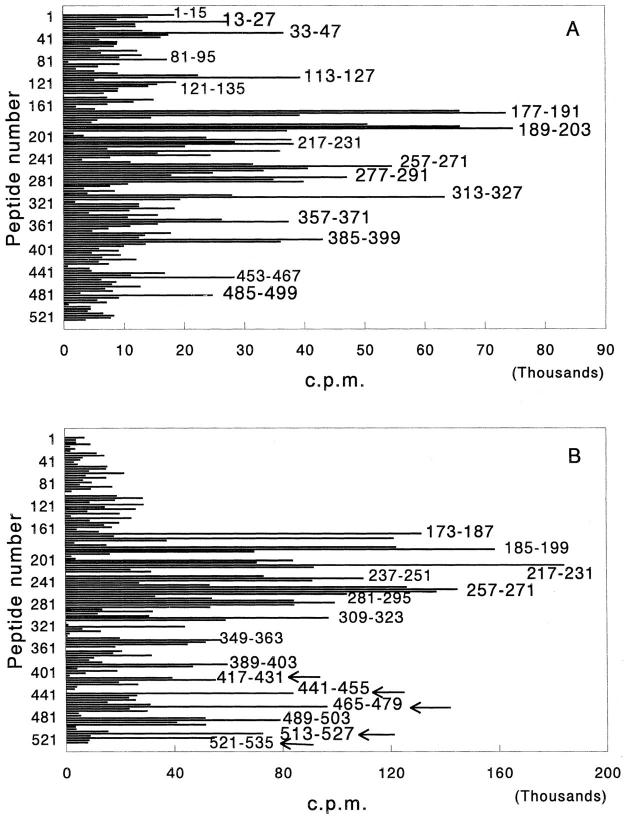
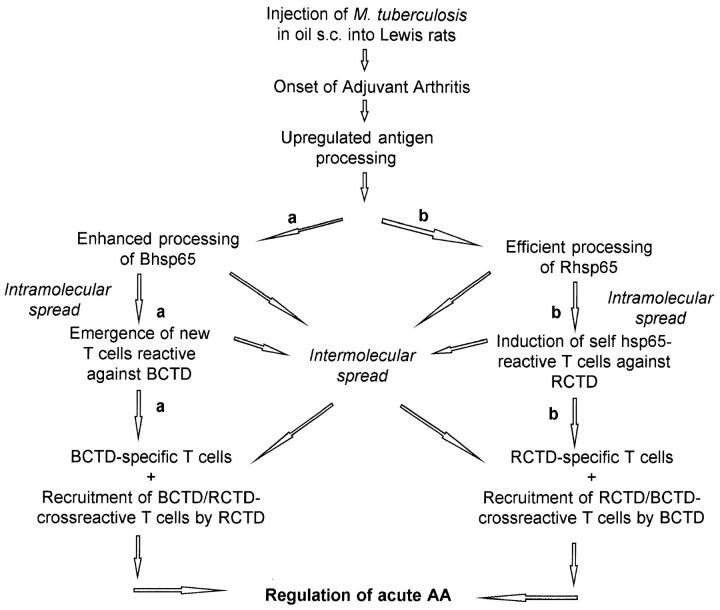
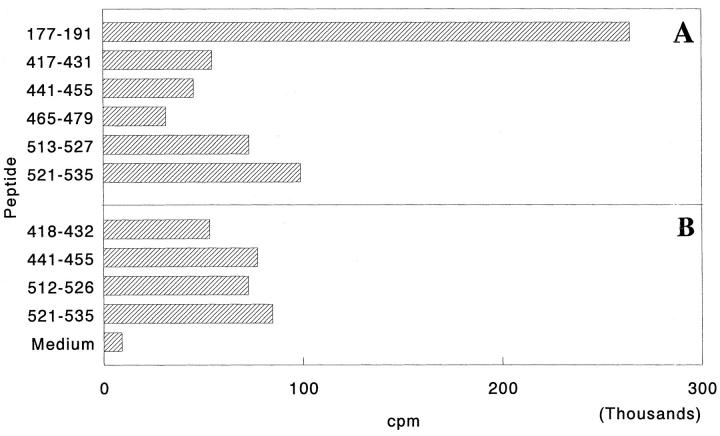
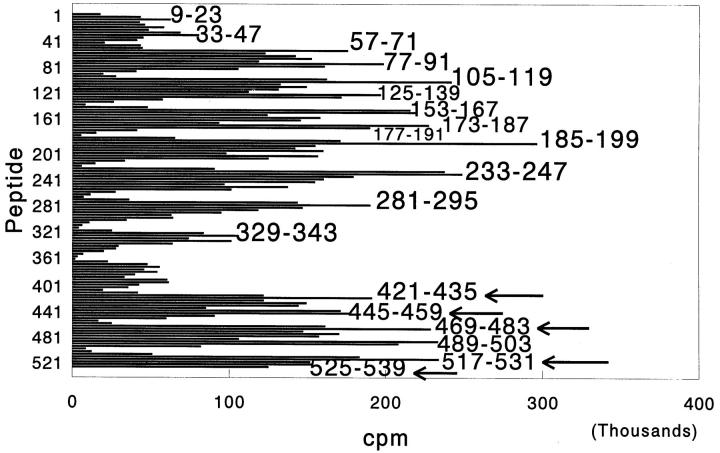
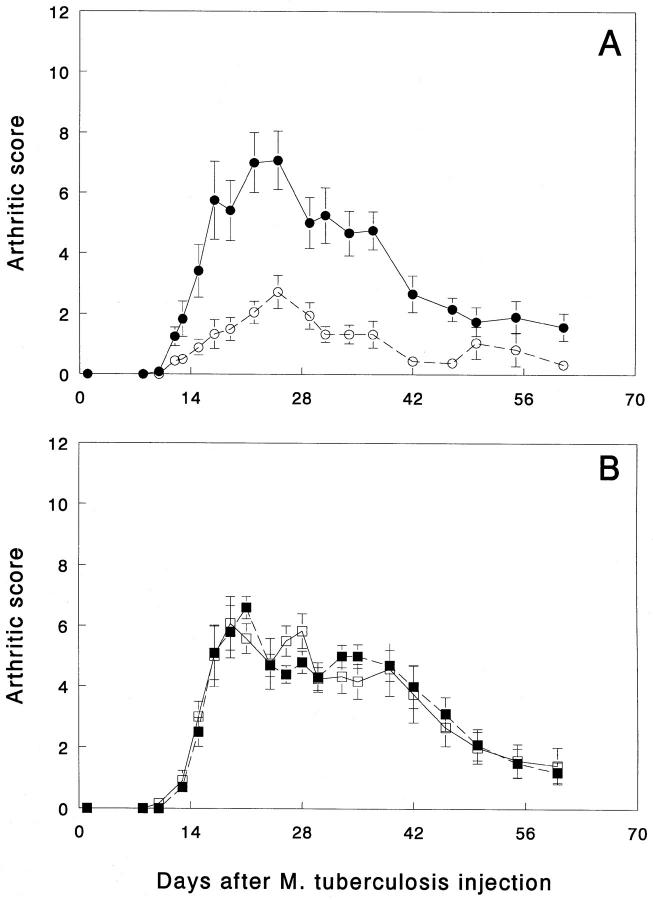
The T cell response to the 65-kD mycobacterial heat-shock protein (Bhsp65) has been implicated in the pathogenesis of autoimmune arthritis. Adjuvant arthritis (AA) induced in the Lewis rat (RT-1(l)) by injection of Mycobacterium tuberculosis serves as an experimental model for human rheumatoid arthritis (RA). However, the immunological basis of regulation of acute AA, or of susceptibility/resistance to AA is not known. We have defined the specificity of the proliferative T cell responses to Bhsp65 during the course of AA in the Lewis rat. During the early phase of the disease (6-9 d after onset of AA), Lewis rats raised T cell responses to many determinants within Bhsp65, spread throughout the molecule. Importantly, in the late phase of the disease (8-10 wk after onset of AA), there was evidence for diversification of the T cell responses toward Bhsp65 carboxy-terminal determinants (BCTD) (namely, 417-431, 441-455, 465-479, 513-527, and 521-535). Moreover, arthritic rats in the late phase of AA also raised vigorous T cell responses to those carboxy-terminal determinants within self(rat) hsp65 (Rhsp65) that correspond in position to the above BCTD. These results suggest that the observed diversification is possibly triggered in vivo by induction of self(Rhsp65)-reactive T cells. Interestingly, another strain of rat, the Wistar Kyoto (WKY/NHsd) rat (RT-1(l)), with the same major histocompatibility complex class II molecules as the Lewis rat, was found to be resistant to AA. In WKY rats, vigorous responses to the BCTD, to which the Lewis rat responded only in the late phase of AA, were observed very early, 10 d after injection of M. tuberculosis, Strikingly, pretreatment with the peptides comprising the set of BCTD, but not its amino-terminal determinants, provided significant protection to naive Lewis rats from subsequent induction of AA. Thus, T cell responses to the BCTD are involved in regulating inflammatory arthritis in the Lewis rat and in conferring resistance to AA in the WKY rat. These results have important implications in understanding the pathogenesis of RA and in devising new immunotherapeutic strategies for this disease.
T细胞对65-kD分枝杆菌热休克蛋白(Bhsp65)的反应与自身免疫性关节炎的发病机制有关。通过注射结核分枝杆菌在Lewis大鼠(RT-1(l))中诱导的佐剂性关节炎(AA)可作为人类类风湿性关节炎(RA)的实验模型。然而,急性AA调节的免疫基础,或对AA的易感性/抗性的免疫基础尚不清楚。我们已经确定了Lewis大鼠AA病程中对Bhsp65增殖性T细胞反应的特异性。在疾病的早期阶段(AA发病后6 - 9天),Lewis大鼠对Bhsp65内的许多决定簇产生T细胞反应,这些决定簇遍布整个分子。重要的是,在疾病的晚期阶段(AA发病后8 - 10周),有证据表明T细胞反应朝着Bhsp65羧基末端决定簇(BCTD)(即417 - 431、441 - 455、465 - 479、513 - 527和521 - 535)多样化。此外,AA晚期的关节炎大鼠对自身(大鼠)hsp65(Rhsp65)中与上述BCTD位置相对应的那些羧基末端决定簇也产生强烈的T细胞反应。这些结果表明,观察到的多样化可能是由自身(Rhsp65)反应性T细胞的诱导在体内触发的。有趣的是,发现另一品系的大鼠,即Wistar Kyoto(WKY/NHsd)大鼠(RT-1(l)),与Lewis大鼠具有相同的主要组织相容性复合体II类分子,但对AA具有抗性。在WKY大鼠中,在注射结核分枝杆菌后10天很早就观察到对Lewis大鼠仅在AA晚期才产生反应的BCTD的强烈反应。引人注目的是,用包含BCTD组的肽而不是其氨基末端决定簇进行预处理,能为未感染的Lewis大鼠提供显著保护,使其免受随后诱导的AA。因此,对BCTD的T细胞反应参与调节Lewis大鼠的炎性关节炎,并赋予WKY大鼠对AA的抗性。这些结果对理解RA的发病机制以及为该疾病设计新的免疫治疗策略具有重要意义。