
大鼠新皮层锥体神经元动作电位的起始与传播
Action potential initiation and propagation in rat neocortical pyramidal neurons.
作者信息
Stuart G, Schiller J, Sakmann B
机构信息
Abteilung Zellphysiologie, Max-Planck-Institut für medizinische Forschung, Heidelberg, Germany.
出版信息
J Physiol. 1997 Dec 15;505 ( Pt 3)(Pt 3):617-32. doi: 10.1111/j.1469-7793.1997.617ba.x.
Abstract
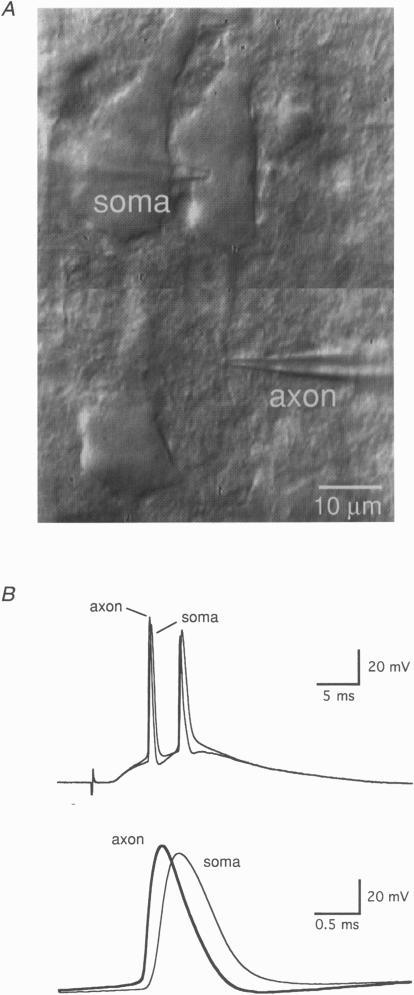
- Initiation and propagation of action potentials evoked by extracellular synaptic stimulation was studied using simultaneous dual and triple patch pipette recordings from different locations on neocortical layer 5 pyramidal neurons in brain slices from 4-week-old rats (P26-30) at physiological temperatures. 2. Simultaneous cell-attached and whole-cell voltage recordings from the apical trunk (up to 700 microns distal to the soma) and the soma indicated that proximal synaptic stimulation (layer 4) initiated action potentials first at the soma, whereas distal stimulation (upper layer 2/3) could initiate dendritic regenerative potentials prior to somatic action potentials following stimulation at higher intensity. 3. Somatic action potentials, once initiated, propagated back into the apical dendrites in a decremented manner which was frequency dependent. The half-width of back propagating action potentials increased and their maximum rate of rise decreased with distance from the soma, with the peak of these action potentials propagating with a conduction velocity of approximately 0.5 m s-1. 4. Back-propagation of action potentials into the dendritic tree was associated with dendritic calcium electrogenesis, which was particularly prominent during bursts of somatic action potentials. 5. When dendritic regenerative potentials were evoked prior to somatic action potentials, the more distal the dendritic recording was made from the soma the longer the time between the onset of the dendritic regenerative potential relative to somatic action potential. This suggested that dendritic regenerative potentials were initiated in the distal apical dendrites, possibly in the apical tuft. 6. At any one stimulus intensity, the initiation of dendritic regenerative potentials prior to somatic action potentials could fluctuate, and was modulated by depolarizing somatic or hyperpolarizing dendritic current injection. 7. Dendritic regenerative potentials could be initiated prior to somatic action potentials by dendritic current injections used to simulate the membrane voltage change that occurs during an EPSP. Initiation of these dendritic potentials was not affected by cadmium (200 microM), but was blocked by TTX (1 microM). 8. Dendritic regenerative potentials in some experiments were initiated in isolated from somatic action potentials. The voltage change at the soma in response to these dendritic regenerative events was small and subthreshold, showing that dendritic regenerative events are strongly attenuated as they spread to the soma. 9. Simultaneous whole-cell recordings from the axon initial segment and the soma indicated that synaptic stimulation always initiated action potentials first in the axon. The further the axonal recording was made from the soma the greater the time delay between axonal and somatic action potentials, indicating a site of action potential initiation in the axon at least 30 microns distal to the soma. 10. Simultaneous whole-cell recordings from the apical dendrite, soma and axon initial segment showed that action potentials were always initiated in the axon prior to the soma, and with the same latency difference, independent of whether dendritic regenerative potentials were initiated or not. 11. It is concluded that both the apical dendrites and the axon of neocortical layer 5 pyramidal neurons in P26-30 animals are capable of initiating regenerative potentials. Regenerative potentials initiated in dendrites, however, are significantly attenuated as they spread to the soma and axon. As a consequence, action potentials are always initiated in the axon before the soma, even when synaptic activation is intense enough to initiate dendritic regenerative potentials. Once initiated, the axonal action potentials are conducted orthogradely into the axonal arbor and retrogradely into the dendritic tree.
摘要
- 使用同时双电极和三电极膜片钳记录技术,在生理温度下,对4周龄大鼠(P26 - 30)脑片新皮层第5层锥体神经元不同位置进行细胞外突触刺激,研究动作电位的起始和传播。2. 从顶树突主干(距胞体最远达700微米)和胞体同时进行细胞贴附式和全细胞电压记录,结果表明近端突触刺激(第4层)首先在胞体引发动作电位,而远端刺激(上层2/3)在更高强度刺激后,可在胞体动作电位之前引发树突再生电位。3. 一旦引发,胞体动作电位以频率依赖的方式递减传播回顶树突。动作电位向树突传播时,其半高宽增加,最大上升速率随距胞体距离增加而降低,动作电位峰值的传导速度约为0.5米/秒。4. 动作电位向树突树的反向传播与树突钙电流生成相关,在胞体动作电位爆发期间尤为显著。5. 当在胞体动作电位之前引发树突再生电位时,树突记录位置距胞体越远,树突再生电位起始相对于胞体动作电位的时间间隔越长。这表明树突再生电位在顶树突远端起始,可能在顶树突簇。6. 在任何一个刺激强度下,胞体动作电位之前树突再生电位的起始可能会波动,并受去极化胞体电流或超极化树突电流注入的调节。7. 通过用于模拟兴奋性突触后电位(EPSP)期间发生的膜电压变化的树突电流注入,可在胞体动作电位之前引发树突再生电位。这些树突电位的起始不受镉(200微摩尔)影响,但被河豚毒素(1微摩尔)阻断。8. 在一些实验中,树突再生电位独立于胞体动作电位起始。这些树突再生事件引起的胞体电压变化很小且低于阈值,表明树突再生事件向胞体传播时强烈衰减。9. 从轴突起始段和胞体同时进行全细胞记录表明,突触刺激总是首先在轴突引发动作电位。轴突记录位置距胞体越远,轴突动作电位与胞体动作电位之间的时间延迟越大,表明动作电位起始位点在距胞体至少30微米远的轴突处。10. 从顶树突、胞体和轴突起始段同时进行全细胞记录表明,动作电位总是在轴突中先于胞体起始,且具有相同的潜伏期差异,与是否引发树突再生电位无关。11. 得出结论,P26 - 30动物新皮层第5层锥体神经元的顶树突和轴突都能够引发再生电位。然而,在树突中起始的再生电位向胞体和轴突传播时会显著衰减。因此,即使突触激活强度足以引发树突再生电位,动作电位也总是先在轴突中起始,然后才在胞体中起始。一旦起始,轴突动作电位沿轴突正向传导进入轴突分支,并沿树突逆向传导。
 Zotero 插件