Huber-Spitzy V, Böhler-Sommeregger K, Arocker-Mettinger E, Grabner G
2nd Department of Ophthalmology, University of Vienna, Austria.
Br J Ophthalmol. 1992 May;76(5):272-4. doi: 10.1136/bjo.76.5.272.
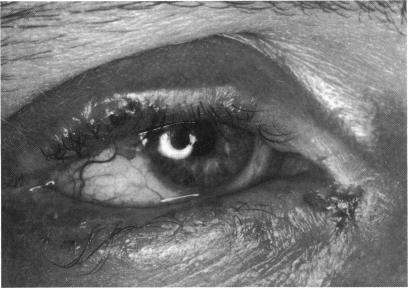
A total of 50 patients suffering both from atopic skin disease and different clinical forms of blepharitis have been included in this study. Microbiological investigations (for bacteria and fungi) of the lid margins were performed in all cases. In 21 (42%) of the patients an ulcerative blepharitis which heavily involved the follicles of the lashes was diagnosed. The remaining 29 cases presented with blepharitis of the squamous type. The cultures revealed that 19 of the 21 patients with ulcerative blepharitis were found to grow Candida species, whereas fungi could not be detected in any of the other cases of blepharitis. The frequencies of concomitant bacterial organisms found in the cultures were similar in both groups. As atopic patients are known to exhibit a defect in their cell-mediated immunity and possibly also a defective IgA antibody response it is a widely accepted assumption that these immunological changes are contributing factors to the development of a localised inflammation of the lids which is initiated by a variety of micro-organisms. We postulate that when Candida species happen to coincide with severe inflammation in atopic patients a blepharitis of the ulcerative type will develop or deteriorate thereby implying that these microorganisms may play an important role in the development or deterioration of this severe chronic inflammation. It is therefore advisable to perform repeated scrapings and cultures in every case of recalcitrant blepharitis.
本研究共纳入50例患有特应性皮肤病且伴有不同临床类型睑缘炎的患者。所有患者均进行了睑缘微生物学检查(包括细菌和真菌)。21例(42%)患者被诊断为溃疡性睑缘炎,严重累及睫毛毛囊。其余29例表现为鳞状睑缘炎。培养结果显示,21例溃疡性睑缘炎患者中有19例培养出念珠菌属,而在其他睑缘炎病例中均未检测到真菌。两组培养中发现的伴随细菌种类频率相似。由于已知特应性患者存在细胞介导免疫缺陷,可能还存在IgA抗体反应缺陷,因此人们普遍认为这些免疫变化是由多种微生物引发的眼睑局部炎症发展的促成因素。我们推测,当念珠菌属与特应性患者的严重炎症同时出现时,溃疡性睑缘炎将会发生或恶化,这意味着这些微生物可能在这种严重慢性炎症的发生或恶化中起重要作用。因此,对于每例顽固性睑缘炎患者,建议反复进行刮片和培养。