Perkins Gavin D, McAuley Danny F, Davies Sarah, Gao Fang
Anaesthesia and Intensive Care Medicine, Intensive Care Unit, Birmingham Heartlands and Solihull NHS Trust (Teaching), Birmingham Heartlands Hospital, Birmingham, UK.
Crit Care. 2003 Dec;7(6):R129-32. doi: 10.1186/cc2359. Epub 2003 Sep 5.
The autopsy has long been regarded as an important tool for confirming the clinical cause of death, education and quality assurance. Concerns surrounding informed consent and the retention of organs have heightened clinicians' anxieties in requesting permission to perform an autopsy. The present study was conducted to determine whether the autopsy still has a role to play in extending knowledge about the cause of death in a group of patients who died while receiving intensive care.
We retrospectively investigated trends in postmortem examination rates and discrepancies between premortem clinical and postmortem diagnoses in a population of critically ill patients admitted to a 13 bed, general medical/surgical intensive care unit between January 1998 and June 2001. Agreement between diagnoses before death and postmortem findings were compared using the Goldman system.
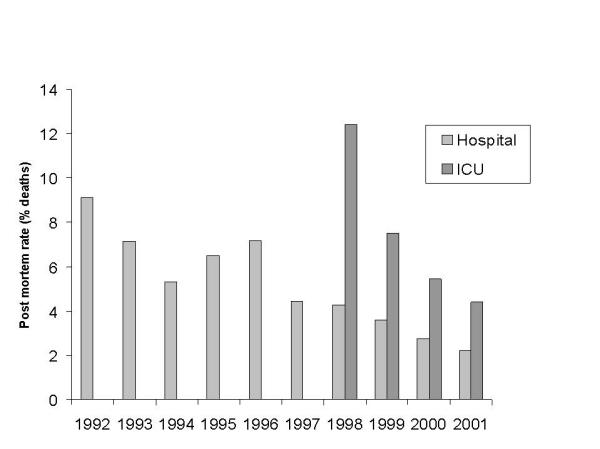
Out of total 636 deaths, 49 (7.7%) underwent postmortem examinations. Of these, 38 (78%) cases were available for review. We found that postmortem findings were in complete agreement with predeath diagnoses in fewer than half of the cases (n = 17, 45%). Major missed diagnoses were present in 15 cases (39%). Myocardial infarction, carcinoma and pulmonary embolism represented the most frequently missed diagnoses.
Postmortem examinations remain a useful tool in confirming diagnostic accuracy and should be considered in all patients who die in the intensive care unit. Recognition of the diagnoses missed before death may improve outcome or avoid unnecessary prolongation of life where terminal disease is present.
长期以来,尸检一直被视为确认临床死因、开展教学及保证医疗质量的重要手段。围绕知情同意和器官留存的担忧加剧了临床医生在请求进行尸检许可时的焦虑。本研究旨在确定尸检在扩展对一组重症监护期间死亡患者死因的认识方面是否仍发挥作用。
我们回顾性调查了1998年1月至2001年6月期间入住一家拥有13张床位的普通内科/外科重症监护病房的危重症患者群体的尸检率趋势以及生前临床诊断与死后诊断之间的差异。使用戈德曼系统比较死亡前诊断与尸检结果之间的一致性。
在总共636例死亡病例中,49例(7.7%)接受了尸检。其中,38例(78%)可供审查。我们发现,不到一半的病例(n = 17,45%)尸检结果与死前诊断完全一致。15例(39%)存在重大漏诊。心肌梗死、癌症和肺栓塞是最常见的漏诊疾病。
尸检仍然是确认诊断准确性的有用工具,所有在重症监护病房死亡的患者都应考虑进行尸检。认识到死前漏诊的诊断可能会改善预后,或在存在终末期疾病时避免不必要的生命延长。