Sulaiman Irshad M, Fayer Ronald, Bern Caryn, Gilman Robert H, Trout James M, Schantz Peter M, Das Pradeep, Lal Altaf A, Xiao Lihua
Centers for Disease Control and Prevention, Atlanta, Georgia 30341-3717, USA.
Emerg Infect Dis. 2003 Nov;9(11):1444-52. doi: 10.3201/eid0911.030084.
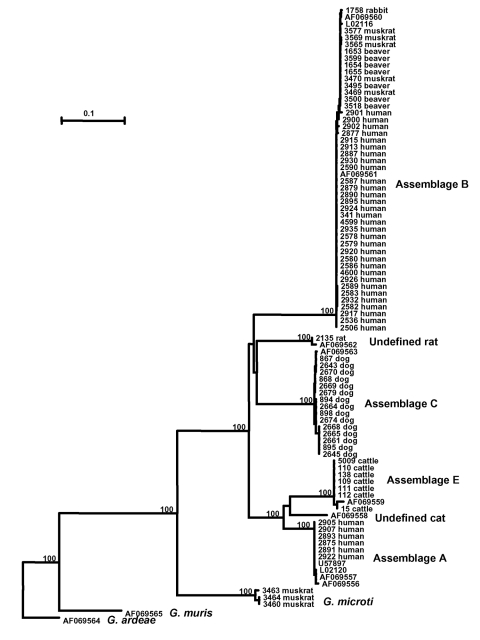
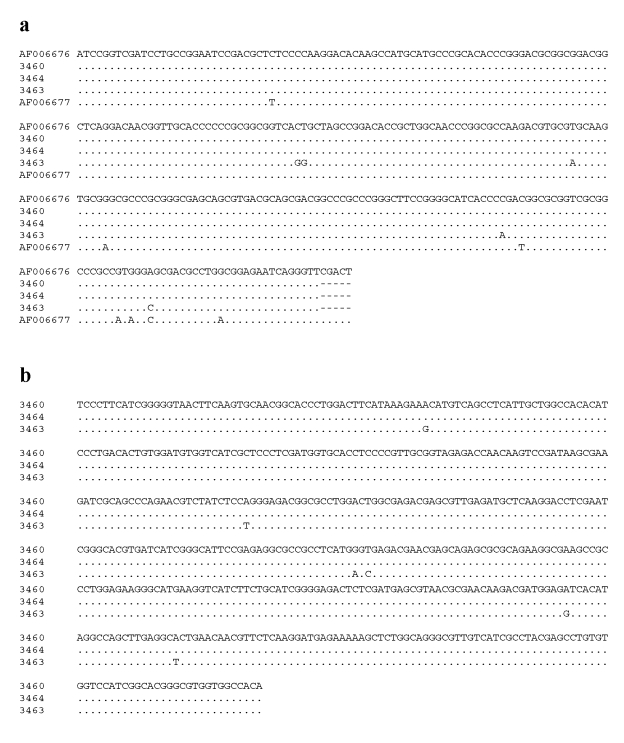
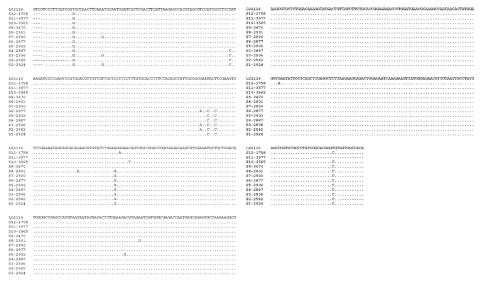
To address the source of infection in humans and public health importance of Giardia duodenalis parasites from animals, nucleotide sequences of the triosephosphate isomerase (TPI) gene were generated for 37 human isolates, 15 dog isolates, 8 muskrat isolates, 7 isolates each from cattle and beavers, and 1 isolate each from a rat and a rabbit. Distinct genotypes were found in humans, cattle, beavers, dogs, muskrats, and rats. TPI and small subunit ribosomal RNA (SSU rRNA) gene sequences of G. microti from muskrats were also generated and analyzed. Phylogenetic analysis on the TPI sequences confirmed the formation of distinct groups. Nevertheless, a major group (assemblage B) contained most of the human and muskrat isolates, all beaver isolates, and the rabbit isolate. These data confirm that G. duodenalis from certain animals can potentially infect humans and should be useful in the detection, differentiation, and taxonomy of Giardia spp.
为了探究人体感染源以及动物源十二指肠贾第虫寄生虫对公共卫生的重要性,我们测定了37株人体分离株、15株犬分离株、8株麝鼠分离株、7株牛分离株、7株海狸分离株、1株大鼠分离株和1株家兔分离株的磷酸丙糖异构酶(TPI)基因的核苷酸序列。在人体、牛、海狸、犬、麝鼠和大鼠中发现了不同的基因型。我们还测定并分析了来自麝鼠的微小贾第虫的TPI和小亚基核糖体RNA(SSU rRNA)基因序列。对TPI序列的系统发育分析证实了不同类群的形成。然而,一个主要类群(组合B)包含了大多数人体和麝鼠分离株、所有海狸分离株以及家兔分离株。这些数据证实,某些动物源的十二指肠贾第虫可能会感染人类,并且这些数据在贾第虫属的检测、鉴别和分类方面应该会很有用。