Vinette Kathleen M B, Gibney Kathleen M, Proujansky Roy, Fawcett Paul T
Immunology Laboratory, Department of Research, Alfred I, duPont Hospital for Children, Wilmington, Delaware,
BMC Microbiol. 2004 Jan 27;4:5. doi: 10.1186/1471-2180-4-5.
Histology and/or culture are generally considered the gold standard for the detection of H. pylori infection. Especially in children, these tests may result in a false negative outcome because of patchy distribution of the organism in the stomach mucosa. We have developed a PCR assay utilizing nested primer pairs directed against a subunit of the H. pylori urease gene (ureA). As part of a prospective evaluation of diagnostic tests to aid in detecting H. pylori infection in children, the aim of this study was to compare our PCR and Western blot assays with results obtained from histologic examination of biopsy specimens, rapid urease tests, and an FDA approved serologic assay and published PCR results to determine if we could validate the assays for diagnostic use on our patient population.
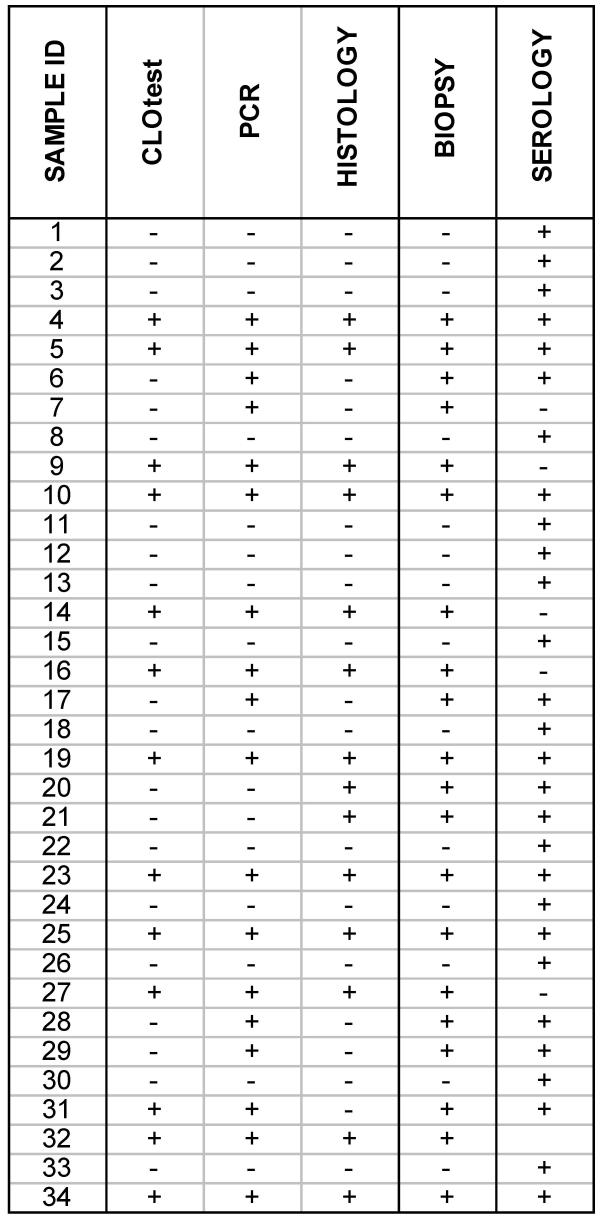
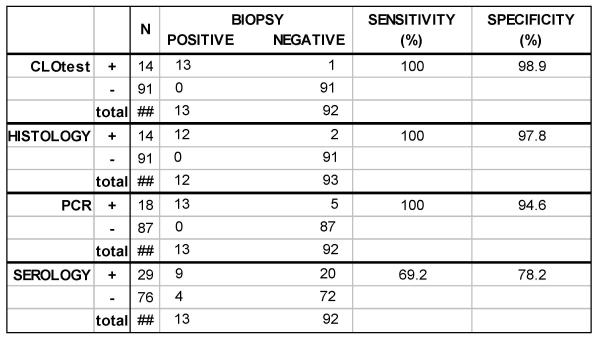
Gastric biopsy specimens obtained from 101 pediatric patients were evaluated for the presence of H. pylori using histologic techniques, rapid urease (CLOtest) test and the PCR assay. Serum samples from each patient were assayed using both ELISA and Western Blot for antibodies to H. pylori. A total of 32 patients tested were positive by at least one of the methods evaluated. Thirteen patients had positive histology, 13 had a positive CLOtest, and 17 patients had positive H. pylori PCR. Out of the 13 CLO positive patients, 12 were positive by histologic analysis and all 13 were positive by PCR. Results of serologic tests on the same population did not correlate well with other assays. Twenty-eight patients showed serologic evidence of H. pylori infection, of which 9 were both CLO and histology positive and 12 were positive by PCR. Of the seropositive patients, 26 were ELISA positive, 13 were positive by Western blot, and 11 by both serologic methods.
The results obtained suggest that our nested PCR assay has the specificity and sensitivity necessary for clinical application when compared to standard histologic examination and rapid urease test. In addition, we found the current commercially available approved ELISA method appears unable to accurately detect H. pylori in this population. The Western blot assay yielded better concordance with CLOtest and histology, but not as good as the nested PCR assay.
组织学检查和/或培养通常被认为是检测幽门螺杆菌感染的金标准。尤其是在儿童中,由于该菌在胃黏膜中呈斑片状分布,这些检测可能会出现假阴性结果。我们开发了一种聚合酶链反应(PCR)检测方法,该方法使用针对幽门螺杆菌脲酶基因(ureA)一个亚基的巢式引物对。作为一项旨在辅助检测儿童幽门螺杆菌感染的诊断试验前瞻性评估的一部分,本研究的目的是将我们的PCR和蛋白质印迹分析结果与活检标本的组织学检查、快速尿素酶试验、美国食品药品监督管理局(FDA)批准的血清学检测结果以及已发表的PCR结果进行比较,以确定我们是否能够验证这些检测方法在我们患者群体中的诊断用途。
使用组织学技术、快速尿素酶(CLOtest)试验和PCR检测方法对从101名儿科患者获取的胃活检标本进行幽门螺杆菌检测。使用酶联免疫吸附测定(ELISA)和蛋白质印迹法检测每位患者血清样本中的幽门螺杆菌抗体。在接受检测的32名患者中,至少有一种评估方法检测为阳性。13名患者组织学检查呈阳性,13名患者CLOtest试验呈阳性,17名患者幽门螺杆菌PCR检测呈阳性。在13名CLO阳性患者中,12名经组织学分析呈阳性,所有13名患者PCR检测均呈阳性。对同一群体进行的血清学检测结果与其他检测方法的相关性不佳。28名患者有幽门螺杆菌感染的血清学证据,其中9名患者CLOtest试验和组织学检查均呈阳性,12名患者PCR检测呈阳性。在血清学阳性患者中,26名ELISA检测呈阳性,13名蛋白质印迹法检测呈阳性,11名两种血清学方法检测均呈阳性。
所得结果表明,与标准组织学检查和快速尿素酶试验相比,我们的巢式PCR检测方法具有临床应用所需的特异性和敏感性。此外,我们发现目前市售的经批准的ELISA方法似乎无法准确检测该群体中的幽门螺杆菌。蛋白质印迹分析结果与CLOtest试验和组织学检查的一致性更好,但不如巢式PCR检测方法。